Do you find yourself saying “I know” repeatedly during conversations? Although this common expression is useful, relying on it too often can make your communication sound repetitive or less expressive. For you are chatting with friends, participating in a meeting, responding to a teacher, or improving your everyday English, knowing different ways to express agreement, understanding, or familiarity can help you communicate more naturally. Small changes in your word choice can make your conversations more engaging and help you respond appropriately to different situations. The key is to choose an expression that reflects what you actually mean rather than simply replacing one phrase with another.
In this guide, you will discover 30 other ways to say “I know,” complete with practical examples and explanations of when to use each expression. From casual responses like “I get it” and “I hear you” to more professional alternatives such as “I’m aware of that” and “I understand,” these phrases will help you expand your vocabulary. You will also learn how tone and context affect meaning, making it easier to communicate clearly and confidently in everyday conversations and professional settings.
Quick Categories
Formal alternatives to “I know”
- I am aware of that. Best for acknowledging information.
- I understand. Best for confirming comprehension.
- I am familiar with this. Best for discussing a known subject.
- I acknowledge that. Best for formally recognizing a point.
Pro Tip: In formal writing, choose an expression that explains what you mean. “I understand” confirms comprehension, while “I acknowledge that” recognizes a statement or issue.
Casual alternatives
- I see. A natural response when learning something.
- Got it. A quick way to confirm understanding.
- That makes sense. Shows that an explanation is logical.
- I get what you mean. Shows that you understand someone’s point.
Pro Tip: Use casual phrases with friends and colleagues you know well. “Got it” is especially useful for short, everyday exchanges.
Professional alternatives
- I’m aware of the situation. Confirms awareness of a matter.
- I understand your point. Acknowledges someone’s argument.
- I’m familiar with the process. Communicates relevant knowledge.
- I’ve taken that into account. Shows that you have considered information.
Pro Tip: In professional communication, be specific when possible. “I’ve taken that into account” shows consideration, whereas “I know” may not explain what you understood or did with the information.
Informal expressions
- I know what you mean. Shows shared understanding.
- Absolutely. Expresses strong agreement.
- Right, I follow you. Confirms that you understand the explanation.
- Yeah, I know. A familiar, relaxed response that can sound impatient depending on tone.
Pro Tip: Informal expressions work best when the relationship and situation support a relaxed tone. Pay attention to how your response might sound to the other person.
“Fluent English is not about using more words. It is about choosing the right words for the moment.”
Common Mistakes When Using “I Know”
Here are five errors to avoid when choosing alternatives to “I know.”
1. Using “I know” when you mean “I understand.” Knowing a fact and understanding an explanation are not always the same.
- Example: “I understand how the process works.”
2. Sounding dismissive. Saying “I know!” while someone is explaining something may sound impatient.
- Example: “I know what you mean. Please finish your explanation.”
3. Using overly formal language in casual conversations. “I acknowledge your statement” may sound unnatural with friends.
- Example: “Got it. Thanks for explaining.”
4. Claiming expertise when you only recognize a topic. “I’m familiar with the subject” does not mean you know every detail.
- Example: “I’m familiar with the basics, but I need to learn more.”
5. Using “I agree” when you only understand. Understanding someone’s opinion does not necessarily mean you share it.
- Example: “I understand your argument, although I have a different view.”
What Does “I Know” Mean?
“I know” is a common English expression used to communicate that you possess information, recognize a fact, understand something, or are already aware of what another person has said.
Grammar explanation: “I” is the subject pronoun, and “know” is the present simple form of the verb know. The phrase can stand alone as a complete statement or appear in a longer sentence.
Example: “I know the answer to that question.”
The exact meaning depends on context. “I know the answer” expresses knowledge, while “I know what you mean” expresses understanding.
When to Use “I Know”
Choose the phrase based on what you want to communicate.
- Everyday conversations: Confirm information or show that you understand.
- Meetings: Acknowledge a point without interrupting the discussion.
- Emails: Confirm that you have received or understood information.
- Learning environments: Show familiarity with a concept or topic.
- Discussions and debates: Distinguish between understanding a viewpoint and agreeing with it.
- Sensitive conversations: Respond empathetically without making the other person feel dismissed.
Spoken vs. written English
- Spoken: “I see,” “Got it,” and “I know what you mean” often sound natural.
- Written: “I understand,” “I’m aware of that,” and “I acknowledge your point” can suit more formal contexts.
Formal vs. informal English
- Formal: I am aware of that. I understand your position.
- Informal: Got it. Yeah, I know.
- Neutral: I see. That makes sense.
“Understanding someone does not always mean agreeing with them. Choose a phrase that communicates the difference.”
Is It Professional or Polite to Say “I Know”?
Politeness: Yes, “I know” can be polite when said with a friendly tone and appropriate context. However, it may sound dismissive if someone is sharing important information or explaining something at length.
Professionalism: Yes, in many cases. The expression is not inherently unprofessional, but more specific alternatives can be better for formal emails, client discussions, and workplace meetings.
Business-style example:
Instead of writing, “I know about the deadline,” you could write:
“I’m aware of the deadline and have included it in the project schedule.”
This version acknowledges the information and explains how you are addressing it.
Pros and Cons of Using “I Know”
Pros
- Simple and natural: Easy to say and understand.
- Friendly tone: Can create a relaxed conversational atmosphere.
- Common usage: Widely understood by English speakers.
- Easy to understand: Communicates knowledge or awareness directly.
Cons
- May sound dismissive: Tone can make it seem as though you do not want to listen.
- Can become repetitive: Frequent use makes conversations less varied.
- Limited emotional range: Does not always communicate agreement, empathy, or understanding precisely.
- May lack detail in formal writing: A more specific phrase can better demonstrate awareness or action.
Other Ways to Say “I Know” With Examples
These 30 alternatives will help you sound more fluent, confident, and natural in different situations.
Use them according to tone, context, and audience to communicate knowledge, understanding, agreement, or awareness accurately.
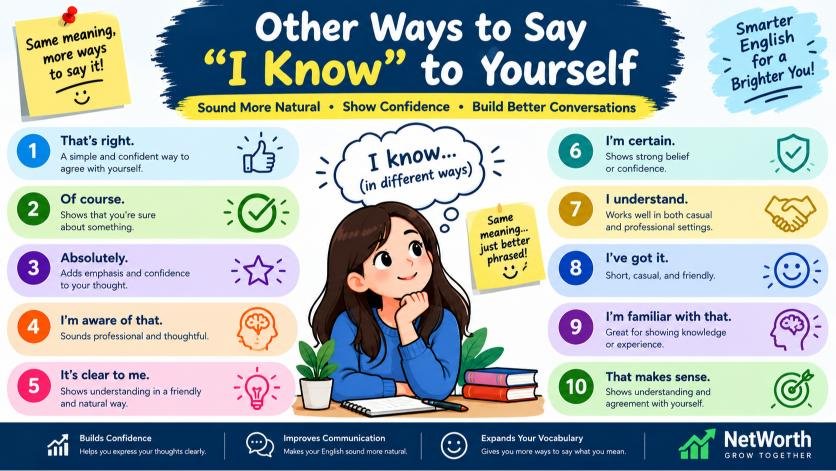
1. Phrase: I Understand
Meaning: You comprehend the information or explanation.
Explanation: This is a polite, neutral way to confirm that you understand.
Example Sentence: “I understand your concerns about the revised schedule.”
Best Use: Work conversations
Worst Use: Proving expertise
Tone: Polite, neutral, considerate
Context Variability:
- Casual: “I understand what you mean.”
- Professional: “I understand the requirements.”
- Spoken: “I understand. Please continue.”
2. Phrase: I’m Aware
Meaning: You already know about something.
Explanation: This phrase emphasizes awareness rather than necessarily showing complete understanding.
Example Sentence: “I’m aware of the upcoming changes.”
Best Use: Formal acknowledgment
Worst Use: Emotional support
Tone: Formal, direct, neutral
Context Variability:
- Casual: “I’m aware of that.”
- Professional: “I’m aware of the issue and its potential impact.”
- Spoken: “Yes, I’m aware.”
3. Phrase: I See
Meaning: You understand or recognize the point being made.
Explanation: It is a natural conversational response that often signals understanding as someone speaks.
Example Sentence: “I see why you chose that approach.”
Best Use: Everyday conversation
Worst Use: Detailed confirmation
Tone: Friendly, neutral, receptive
Context Variability:
- Casual: “Oh, I see!”
- Professional: “I see your point.”
- Spoken: “I see. That explains it.”
4. Phrase: Got It
Meaning: You have received or understood the information.
Explanation: This concise expression is useful for confirming instructions or simple messages.
Example Sentence: “Got it. I’ll send the report this afternoon.”
Best Use: Quick responses
Worst Use: Formal letters
Tone: Casual, direct, efficient
Context Variability:
- Casual: “Got it, thanks!”
- Professional: “Got it. I’ll update the document.”
- Spoken: “Got it. I’ll take care of that.”
5. Phrase: That Makes Sense
Meaning: You find an explanation logical or understandable.
Explanation: This phrase acknowledges someone’s reasoning without necessarily saying you already knew the information.
Example Sentence: “That makes sense given the results we received.”
Best Use: Discussing reasoning
Worst Use: Confirming prior knowledge
Tone: Thoughtful, friendly, affirming
Context Variability:
- Casual: “Oh, that makes sense.”
- Professional: “That makes sense based on the available data.”
- Spoken: “Yes, that makes sense to me.”
6. Phrase: I’m Familiar With That
Meaning: You have some knowledge or experience with a subject.
Explanation: Use this when you recognize a topic but do not necessarily claim complete expertise.
Example Sentence: “I’m familiar with that software platform.”
Best Use: Subject knowledge
Worst Use: Complete certainty
Tone: Professional, measured, confident
Context Variability:
- Casual: “I’m familiar with that app.”
- Professional: “I’m familiar with the platform’s main features.”
- Spoken: “Yes, I’m familiar with it.”
7. Phrase: I Know What You Mean
Meaning: You understand another person’s message or experience.
Explanation: This phrase often expresses empathy or shared understanding.
Example Sentence: “I know what you mean; the instructions can be confusing.”
Best Use: Shared understanding
Worst Use: Unfamiliar topics
Tone: Empathetic, friendly, relatable
Context Variability:
- Casual: “I know what you mean!”
- Professional: “I know what you mean regarding the technical difficulties.”
- Spoken: “Yes, I know what you mean.”
8. Phrase: Absolutely
Meaning: You strongly agree with or affirm a statement.
Explanation: This is useful when “I know” is intended to show agreement rather than prior knowledge.
Example Sentence: “Absolutely, clear communication is essential.”
Best Use: Strong agreement
Worst Use: Neutral acknowledgment
Tone: Positive, confident, emphatic
Context Variability:
- Casual: “Absolutely!”
- Professional: “Absolutely, I agree with that recommendation.”
- Spoken: “Absolutely. That is the right approach.”
9. Phrase: I Follow You
Meaning: You understand the explanation or line of reasoning.
Explanation: It is particularly useful when someone is explaining a process or developing an argument.
Example Sentence: “I follow you. The second phase depends on the first.”
Best Use: Following explanations
Worst Use: Formal reports
Tone: Conversational, attentive, neutral
Context Variability:
- Casual: “I follow you.”
- Professional: “I follow your reasoning.”
- Spoken: “Yes, I’m following you.”
10. Phrase: I Acknowledge That
Meaning: You recognize a fact, statement, or concern.
Explanation: This expression is formal and does not automatically mean you agree with the statement.
Example Sentence: “I acknowledge that the initial timeline was too ambitious.”
Best Use: Formal discussions
Worst Use: Casual chatting
Tone: Formal, measured, respectful
Context Variability:
- Casual: “I get that.”
- Professional: “I acknowledge that concern.”
- Spoken: “I acknowledge that this requires attention.”
“Use ‘I understand’ for comprehension, ‘I’m aware’ for knowledge, and ‘I agree’ for agreement. They are not interchangeable.”
11. Phrase: I Get What You Mean
Meaning: You understand the message someone is communicating.
Explanation: This relaxed expression is common in everyday conversation.
Example Sentence: “I get what you mean about needing more time.”
Best Use: Friendly conversations
Worst Use: Formal correspondence
Tone: Casual, understanding, approachable
Context Variability:
- Casual: “I get what you mean.”
- Professional: “I understand what you mean about the deadline.”
- Spoken: “Yes, I get what you’re saying.”
12. Phrase: I’m Up to Speed
Meaning: You have the information needed to understand the current situation.
Explanation: This phrase is especially useful when discussing updates, projects, or developments.
Example Sentence: “I’m up to speed on the latest project changes.”
Best Use: Project updates
Worst Use: First introductions
Tone: Professional, confident, practical
Context Variability:
- Casual: “I’m up to speed now.”
- Professional: “I’m up to speed on the revised plan.”
- Spoken: “Yes, I’m up to speed with the latest updates.”
13. Phrase: I’ve Got That Covered
Meaning: You have already handled something or know how to manage it.
Explanation: This phrase communicates readiness or responsibility rather than simply confirming knowledge.
Example Sentence: “Thanks for the reminder. I’ve got that covered.”
Best Use: Task confirmation
Worst Use: Unresolved tasks
Tone: Confident, reassuring, informal
Context Variability:
- Casual: “Don’t worry, I’ve got that covered.”
- Professional: “I’ve got that covered and will confirm once it’s complete.”
- Spoken: “Yes, I’ve got that covered.”
14. Phrase: I Take Your Point
Meaning: You understand the argument or concern someone has raised.
Explanation: It acknowledges another person’s reasoning without requiring you to agree with it.
Example Sentence: “I take your point about reducing unnecessary costs.”
Best Use: Professional discussion
Worst Use: Simple instructions
Tone: Thoughtful, formal, diplomatic
Context Variability:
- Casual: “I see your point.”
- Professional: “I take your point regarding the proposed budget.”
- Spoken: “I take your point, although I see one concern.”
15. Phrase: I’m Cognizant of That
Meaning: You are aware of a particular fact or issue.
Explanation: This formal expression is suitable for certain professional contexts, although simpler alternatives often sound more natural.
Example Sentence: “I’m cognizant of the risks associated with this decision.”
Best Use: Formal statements
Worst Use: Casual conversation
Tone: Formal, precise, serious
Context Variability:
- Casual: “I know about that.”
- Professional: “I’m cognizant of the potential risks.”
- Spoken: “I’m cognizant of those concerns.”
16. Phrase: I’m Informed
Meaning: You have received information about a subject.
Explanation: Use this phrase when you want to indicate that you have been briefed or given relevant information.
Example Sentence: “I’m informed about the recent policy changes.”
Best Use: Information updates
Worst Use: Personal empathy
Tone: Formal, factual, neutral
Context Variability:
- Casual: “I’ve heard about it.”
- Professional: “I’m informed about the latest developments.”
- Spoken: “Yes, I’ve been informed.”
17. Phrase: I Can Relate
Meaning: You understand someone’s experience because it is similar to your own.
Explanation: This phrase is more about shared experience and empathy than factual knowledge.
Example Sentence: “I can relate to how challenging that transition feels.”
Best Use: Emotional connection
Worst Use: Technical confirmation
Tone: Empathetic, personal, supportive
Context Variability:
- Casual: “I can totally relate.”
- Professional: “I can relate to the challenges your team is facing.”
- Spoken: “I can relate to that experience.”
18. Phrase: I’m on the Same Page
Meaning: You share an understanding of a situation or plan.
Explanation: This phrase is particularly useful for checking alignment within a team.
Example Sentence: “I’m on the same page regarding our priorities for this quarter.”
Best Use: Team alignment
Worst Use: Independent facts
Tone: Collaborative, professional, reassuring
Context Variability:
- Casual: “We’re on the same page.”
- Professional: “I believe we’re on the same page about the next steps.”
- Spoken: “Yes, we’re on the same page.”
19. Phrase: I’ve Noted That
Meaning: You have registered or recorded information.
Explanation: It works well when confirming a detail, instruction, or request that may need follow-up.
Example Sentence: “I’ve noted your feedback and will review it.”
Best Use: Written follow-up
Worst Use: Emotional reassurance
Tone: Professional, concise, neutral
Context Variability:
- Casual: “I’ve noted that.”
- Professional: “I’ve noted your request for the revised version.”
- Spoken: “I’ve noted that and will follow up.”
20. Phrase: I Recognize That
Meaning: You accept or identify a fact, issue, or concern as relevant.
Explanation: Depending on context, this can show awareness or acknowledgment without necessarily expressing agreement.
Example Sentence: “I recognize that the current process has limitations.”
Best Use: Constructive feedback
Worst Use: Quick replies
Tone: Thoughtful, formal, respectful
Context Variability:
- Casual: “I can see that.”
- Professional: “I recognize the importance of this concern.”
- Spoken: “I recognize that this is a priority.”
21. Phrase: I’m Well Aware
Meaning: You are very aware of something.
Explanation: This phrase emphasizes awareness and can sound firm or defensive if delivered sharply.
Example Sentence: “I’m well aware of the deadline and the work involved.”
Best Use: Emphasizing awareness
Worst Use: Sensitive corrections
Tone: Firm, confident, emphatic
Context Variability:
- Casual: “I’m well aware of that.”
- Professional: “I’m well aware of the operational requirements.”
- Spoken: “Yes, I’m well aware.”
22. Phrase: That’s Clear to Me
Meaning: You understand the information or instructions.
Explanation: It directly confirms comprehension, particularly after an explanation.
Example Sentence: “The revised procedure is clear to me now.”
Best Use: Clarifying instructions
Worst Use: Disputed facts
Tone: Neutral, direct, confident
Context Variability:
- Casual: “That’s clear to me.”
- Professional: “The expectations are clear to me.”
- Spoken: “Yes, that’s clear to me.”
23. Phrase: I See Where You’re Coming From
Meaning: You understand the reasons behind another person’s viewpoint.
Explanation: It communicates perspective-taking, even when you do not share the same opinion.
Example Sentence: “I see where you’re coming from regarding the budget restrictions.”
Best Use: Different viewpoints
Worst Use: Simple facts
Tone: Empathetic, diplomatic, conversational
Context Variability:
- Casual: “I see where you’re coming from.”
- Professional: “I understand the reasoning behind your recommendation.”
- Spoken: “I see where you’re coming from, even though I disagree.”
24. Phrase: I’ve Taken That Into Account
Meaning: You have considered the information when making a decision or plan.
Explanation: This phrase demonstrates consideration rather than merely confirming that you heard something.
Example Sentence: “I’ve taken your feedback into account in the revised proposal.”
Best Use: Decision updates
Worst Use: Casual greetings
Tone: Professional, considered, reassuring
Context Variability:
- Casual: “I’ve thought about that.”
- Professional: “I’ve taken those concerns into account.”
- Spoken: “Yes, I’ve taken that into account.”
25. Phrase: I’m Familiar With the Details
Meaning: You know the specific information about a subject or situation.
Explanation: This phrase is more precise than saying you are familiar with a general topic.
Example Sentence: “I’m familiar with the details of the proposed agreement.”
Best Use: Detailed discussions
Worst Use: Unverified claims
Tone: Professional, informed, precise
Context Variability:
- Casual: “I know the details.”
- Professional: “I’m familiar with the details of the proposal.”
- Spoken: “Yes, I’m familiar with those details.”
26. Phrase: I Hear You
Meaning: You recognize what someone is saying and may be acknowledging their feelings or concerns.
Explanation: It can sound empathetic, but it does not necessarily mean you agree or have resolved the issue.
Example Sentence: “I hear you, and I understand why this delay is frustrating.”
Best Use: Acknowledging concerns
Worst Use: Formal reports
Tone: Empathetic, conversational, supportive
Context Variability:
- Casual: “I hear you.”
- Professional: “I hear your concerns about the timeline.”
- Spoken: “I hear you, and we’ll look at the options.”
27. Phrase: Point Taken
Meaning: You accept that someone has made a relevant point.
Explanation: This concise expression acknowledges an argument or correction and may sound slightly blunt depending on delivery.
Example Sentence: “Point taken. I’ll add more detail to the proposal.”
Best Use: Brief acknowledgment
Worst Use: Emotional support
Tone: Direct, concise, sometimes firm
Context Variability:
- Casual: “Point taken.”
- Professional: “Point taken. I’ll revise the recommendation.”
- Spoken: “Point taken, and I’ll consider that.”
28. Phrase: I Know the Feeling
Meaning: You understand an emotion or experience because you have experienced something similar.
Explanation: This expression builds rapport, but it should be used only when you can genuinely relate.
Example Sentence: “I know the feeling of preparing for an important presentation.”
Best Use: Shared experiences
Worst Use: Unrelated problems
Tone: Friendly, empathetic, personal
Context Variability:
- Casual: “I know the feeling!”
- Professional: “I know the feeling of working under a tight deadline.”
- Spoken: “I know the feeling, and it can be stressful.”
29. Phrase: I Can Confirm That
Meaning: You can verify that a statement or detail is correct.
Explanation: Use this when you have a reliable basis for confirming information, especially in professional communication.
Example Sentence: “I can confirm that your application has been received.”
Best Use: Verified information
Worst Use: Uncertain claims
Tone: Professional, precise, authoritative
Context Variability:
- Casual: “Yes, I can confirm that.”
- Professional: “I can confirm that the payment has been processed.”
- Spoken: “I can confirm that the meeting is scheduled for Monday.”
30. Phrase: I’m Already Familiar With It
Meaning: You have prior knowledge of a specific topic, tool, or process.
Explanation: This phrase is useful when someone offers to explain something you already know, though your tone should remain respectful.
Example Sentence: “Thank you for offering to explain the system, but I’m already familiar with it.”
Best Use: Prior experience
Worst Use: New information
Tone: Polite, confident, informative
Context Variability:
- Casual: “I’m already familiar with it.”
- Professional: “Thank you. I’m already familiar with the platform.”
- Spoken: “I appreciate that, but I’m already familiar with the process.”
Scroll-Stopping Pull Quotes
“The best alternative to ‘I know’ depends on whether you mean awareness, understanding, agreement, or experience.”
“Professional English sounds stronger when you acknowledge information and explain what it means for your next step.”
“You can understand someone’s opinion without agreeing with it. Choose your words accordingly.”
“Small vocabulary changes can make everyday conversations sound more natural, respectful, and confident.”
Mini Quiz: Test Your English
Check your understanding of these expressions before moving on.
English expression check
0 of 4 answered
1. Your manager explains a new deadline. Which response is most appropriate?
Whatever you say
I understand the revised deadline
I know everything
2. You understand someone’s reasoning but disagree. What is the best response?
I see where you’re coming from, but I disagree
Absolutely, you’re right
I can confirm that
3. A colleague asks whether you know the software. You have used it before. What should you say?
Point taken
I can relate
I’m familiar with the software
4. Someone shares a frustrating experience you have also had. Which phrase fits best?
I acknowledge that
I know the feeling
I’m cognizant of that
Check answers
Comparison Table: Top 10 Alternatives
Use this table to quickly choose among the most useful alternatives.
| Phrase | Tone | Best Use |
| I understand | Polite, neutral | Workplace conversations |
| I’m aware | Formal, direct | Acknowledging information |
| I see | Friendly, neutral | Everyday conversation |
| Got it | Casual, concise | Quick instructions |
| That makes sense | Thoughtful, affirming | Responding to reasoning |
| I’m familiar with that | Professional, measured | Discussing experience |
| I know what you mean | Empathetic, friendly | Shared understanding |
| Absolutely | Positive, emphatic | Strong agreement |
| I follow you | Conversational, attentive | Following explanations |
| I can confirm that | Professional, precise | Verifying facts |
FAQs
1. What are the best alternatives to “I know”?
The best general alternatives include “I understand,” “I see,” “I’m aware,” “Got it,” and “That makes sense.” The right choice depends on whether you mean knowledge, comprehension, or agreement.
2. How can I say “I know” professionally?
Use expressions such as “I’m aware of that,” “I understand your point,” or “I’m familiar with the process.” For workplace communication, add a relevant next step when appropriate.
3. What is a polite way to say “I already know”?
Try “I’m familiar with that,” “I’m already aware of it,” or “Thank you, I’m familiar with the process.” These phrases can communicate prior knowledge without sounding dismissive.
4. What is the difference between “I know” and “I understand”?
“I know” often communicates possession of information, while “I understand” emphasizes comprehension. You can know a fact without fully understanding its meaning or implications.
5. How do I avoid repeating “I know” in conversations?
Practice using alternatives that match your intention. Try “I see” for acknowledgment, “That makes sense” for reasoning, and “I can relate” for shared experiences.
Conclusion
Learning other ways to say “I know” gives you more flexibility in everyday conversations, professional meetings, emails, and discussions. Expressions such as “I understand,” “I’m aware,” and “That makes sense” help you communicate more precisely while avoiding repetition.
Practice two or three alternatives each day. Pay attention to your audience, the meaning you want to convey, and whether the situation calls for a formal, neutral, or casual response. With regular practice, your English will sound more natural and confident.