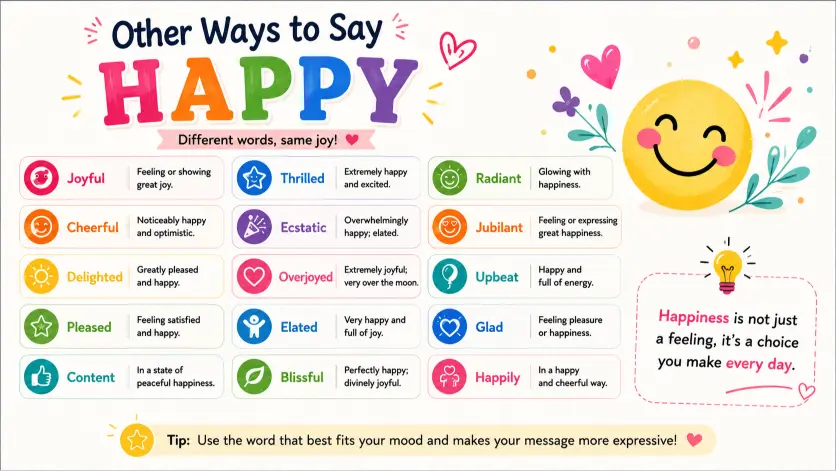
Happiness is one of the most wonderful feelings to express, but using the word “happy” repeatedly can make your conversations and writing sound less engaging. For you are sharing exciting news, writing a heartfelt message, creating social media captions, or communicating at work, choosing the right words can help you express your emotions more naturally. Learning how to say happy in other ways gives you more options to describe positive feelings, celebrate special moments, and make your English vocabulary more expressive.
In this guide, you will discover 30 alternatives to “happy,” including words such as delighted, joyful, cheerful, thrilled, content, and pleased. Each expression carries a slightly different meaning and emotional intensity, making context important when choosing the best word. Based on standard English usage and practical language-learning principles, this article provides clear explanations and example sentences to help you understand each alternative. You will also learn which expressions work best in formal writing, casual conversations, professional emails, and friendly messages, helping you communicate happiness with greater clarity, confidence, and variety.
Quick Categories: Choose the Right Expression
Formal alternatives to “happy”
- Delighted
- Pleased
- Gratified
- Elated
Pro tip: Use “pleased” or “delighted” in formal correspondence when acknowledging positive news or expressing appreciation.
Casual alternatives
- Glad
- Excited
- Thrilled
- Over the moon
Pro tip: Choose “glad” for everyday conversations and “thrilled” when you want to communicate stronger excitement.
Professional alternatives
- Pleased with the outcome
- Satisfied with the results
- Encouraged by the progress
- Grateful for the opportunity
Pro tip: In business communication, connect your positive emotion to a result, achievement, or opportunity.
Informal expressions
- On cloud nine
- Walking on air
- Beaming with joy
- In high spirits
Pro tip: These informal expressions in English are useful with friends, family, and familiar colleagues, but some may sound too conversational in formal reports.
“Strong English speakers do not simply name an emotion. They choose words that show its intensity and context.”
Common Mistakes When Using “Happy” and Its Alternatives
Understanding synonyms is only the first step. You also need to use them naturally and correctly.
- Using “excited” for every type of happiness. Excitement usually suggests anticipation or enthusiasm. Example: “I am excited about my upcoming holiday.”
- Confusing “satisfied” with “thrilled.” Satisfied means content with a result, while thrilled communicates intense excitement. Example: “I am satisfied with the report.”
- Using informal idioms in formal emails. Expressions such as “on cloud nine” may sound too casual in official communication. Example: “I am delighted to accept the invitation.”
- Choosing adjectives with the wrong grammar. Say “I am delighted,” not “I am delight.” Example: “I am delighted to meet you.”
- Repeating the same expression too often. Using several suitable alternatives makes your speech more expressive. Example: “I was pleased with the results and thrilled by the recognition.”
What Does “Happy” Mean?
Happy is an adjective that describes a feeling of pleasure, contentment, satisfaction, or joy. It can refer to a temporary emotional reaction or a more general sense of well-being.
In grammar, adjectives such as happy, delighted, pleased, and thrilled commonly follow linking verbs such as be, feel, and seem. The word happy can also appear before a noun, as in “a happy occasion.”
Example: “I am happy with the progress we have made.”
The best synonym depends on the reason for the emotion and how strongly you feel it.
When to Use “Happy” and Its Alternatives
Different expressions work better in different settings.
- Everyday conversations: Use glad, happy, or pleased when sharing ordinary positive experiences.
- Celebrations: Choose thrilled, overjoyed, or elated for significant achievements and exciting news.
- Workplace communication: Use pleased, satisfied, or encouraged when discussing results, teamwork, or professional milestones.
- Formal writing: Choose delighted, gratified, or pleased when writing invitations, acknowledgments, and official correspondence.
- Personal messages: Use over the moon or on cloud nine to express intense happiness in a friendly tone.
- Academic settings: Use satisfied or encouraged to describe progress and outcomes accurately.
Spoken vs. written English
In spoken English, contractions and natural expressions such as “I’m thrilled” sound friendly and conversational. In written English, especially professional writing, expressions such as “I am pleased with the outcome” often provide greater clarity and polish.
Formal vs. informal English
Formal English favors precise words such as delighted, pleased, and gratified. Informal English allows more expressive idioms, including walking on air and over the moon. Always consider your audience before selecting an expression.
Is It Professional or Polite to Say “Happy”?
Polite? Yes.
Professional? Yes, in appropriate contexts.
The word happy is not inherently unprofessional. It works well in many business settings, although a more specific alternative can sound more polished when acknowledging achievements or communicating with clients.
Business example: “I am happy to confirm that your application has been approved.”
A slightly more formal alternative is: “I am pleased to confirm that your application has been approved.”
Both are correct. The second emphasizes professional courtesy, while the first sounds straightforward and approachable.
Pros and Cons of Using “Happy”
Pros
- Simple and natural: Most English speakers understand it immediately.
- Friendly tone: It communicates warmth and positivity.
- Common usage: It fits many everyday situations.
- Easy to understand: It works well for English learners and international communication.
Cons
- Too informal for some work situations: A more precise expression may be preferable in official documents.
- Overused: Repetition can make your writing sound less varied.
- Limited emotional range: It does not always communicate the intensity or source of your feelings.
- Not always suitable for formal writing: More specific vocabulary can improve precision and professionalism.
“Vocabulary becomes powerful when you match the strength of a word to the strength of your feeling.”
Other Ways to Say “Happy” With Examples
These alternatives will help you sound more fluent, confident, and natural in different situations.
Use them according to tone, context, and audience to express excitement, admiration, or approval.
1. Phrase: Delighted
- Meaning: Feeling great pleasure or happiness.
- Explanation: This polished adjective is especially useful when responding positively to news or an invitation.
- Example Sentence: “I am delighted to hear about your promotion.”
- Best Use: Formal correspondence
- Worst Use: Serious complaints
- Tone: Warm, polished, courteous
- Context Variability: Casual: “I’m delighted!” Professional: “We are delighted with the outcome.” Spoken: “I’m delighted to see you.”
2. Phrase: Glad
- Meaning: Feeling pleased about a situation or event.
- Explanation: Glad is a simple, natural alternative for everyday communication.
- Example Sentence: “I’m glad you could join us today.”
- Best Use: Daily conversations
- Worst Use: Highly ceremonial writing
- Tone: Friendly, natural, positive
- Context Variability: Casual: “Glad you’re here.” Professional: “I’m glad we resolved the issue.” Spoken: “I’m glad to hear that.”
3. Phrase: Pleased
- Meaning: Feeling satisfaction or approval.
- Explanation: Pleased works well in professional messages and polite conversations.
- Example Sentence: “We are pleased with the team’s performance.”
- Best Use: Workplace communication
- Worst Use: Intense celebrations
- Tone: Professional, courteous, measured
- Context Variability: Casual: “I’m pleased for you.” Professional: “We are pleased with the results.” Spoken: “I’m pleased to meet you.”
4. Phrase: Joyful
- Meaning: Feeling or expressing great happiness.
- Explanation: Joyful emphasizes a strong, positive emotional state.
- Example Sentence: “It was a joyful occasion for the entire family.”
- Best Use: Celebratory writing
- Worst Use: Routine business updates
- Tone: Warm, expressive, uplifting
- Context Variability: Casual: “What a joyful day!” Professional: “The event created a joyful atmosphere.” Spoken: “I feel joyful today.”
5. Phrase: Thrilled
- Meaning: Extremely excited and happy.
- Explanation: Thrilled communicates stronger enthusiasm than the ordinary word happy.
- Example Sentence: “I’m thrilled to have been selected for the position.”
- Best Use: Exciting announcements
- Worst Use: Minor routine updates
- Tone: Enthusiastic, energetic, positive
- Context Variability: Casual: “I’m thrilled!” Professional: “We are thrilled to welcome you.” Spoken: “I’m thrilled about the opportunity.”
6. Phrase: Overjoyed
- Meaning: Experiencing an exceptionally high level of happiness.
- Explanation: Use overjoyed for important personal milestones or wonderful news.
- Example Sentence: “Her family was overjoyed when she graduated.”
- Best Use: Major life events
- Worst Use: Minor achievements
- Tone: Intense, heartfelt, emotional
- Context Variability: Casual: “I’m overjoyed!” Professional: “We are overjoyed by this achievement.” Spoken: “I was overjoyed to hear the news.”
7. Phrase: Elated
- Meaning: Feeling extremely happy and excited.
- Explanation: Elated is a strong adjective often used after a major success.
- Example Sentence: “She felt elated after winning the competition.”
- Best Use: Significant achievements
- Worst Use: Routine greetings
- Tone: Elevated, enthusiastic, celebratory
- Context Variability: Casual: “I’m absolutely elated.” Professional: “The team was elated by the result.” Spoken: “I felt elated after the announcement.”
8. Phrase: Ecstatic
- Meaning: Feeling overwhelming happiness or excitement.
- Explanation: Ecstatic describes an exceptionally intense emotional response.
- Example Sentence: “They were ecstatic about their wedding announcement.”
- Best Use: Extraordinary good news
- Worst Use: Neutral status reports
- Tone: Intense, exuberant, emotional
- Context Variability: Casual: “I’m ecstatic!” Professional: “The team was ecstatic about the award.” Spoken: “I’m ecstatic to be here.”
9. Phrase: Cheerful
- Meaning: Feeling or showing happiness and optimism.
- Explanation: Cheerful often describes someone’s general mood or manner.
- Example Sentence: “Her cheerful attitude made the meeting more enjoyable.”
- Best Use: Describing positive moods
- Worst Use: Expressing grief
- Tone: Bright, friendly, optimistic
- Context Variability: Casual: “You look cheerful.” Professional: “He maintained a cheerful attitude.” Spoken: “I’m feeling cheerful today.”
10. Phrase: Content
- Meaning: Feeling satisfied with your circumstances.
- Explanation: Content describes peaceful satisfaction rather than intense excitement.
- Example Sentence: “She felt content with the life she had built.”
- Best Use: Personal reflection
- Worst Use: High-energy celebrations
- Tone: Calm, reflective, satisfied
- Context Variability: Casual: “I’m content with that.” Professional: “We are content with the current arrangement.” Spoken: “I feel content today.”
11. Phrase: Satisfied
- Meaning: Feeling that something meets your expectations.
- Explanation: Satisfied focuses on fulfillment or approval rather than emotional excitement.
- Example Sentence: “I’m satisfied with the final version of the report.”
- Best Use: Evaluating outcomes
- Worst Use: Expressing intense joy
- Tone: Measured, practical, approving
- Context Variability: Casual: “I’m satisfied with it.” Professional: “We are satisfied with the results.” Spoken: “I’m satisfied with how it went.”
12. Phrase: Gratified
- Meaning: Feeling pleasure because something positive has happened.
- Explanation: Gratified often reflects satisfaction after effort, recognition, or achievement.
- Example Sentence: “I was gratified to learn that my work had helped the team.”
- Best Use: Reflective professional writing
- Worst Use: Casual greetings
- Tone: Thoughtful, formal, appreciative
- Context Variability: Casual: “I’m gratified by that.” Professional: “We are gratified by your feedback.” Spoken: “I felt gratified by their response.”
13. Phrase: Optimistic
- Meaning: Expecting positive outcomes in the future.
- Explanation: Optimistic expresses positive expectations rather than happiness alone.
- Example Sentence: “I’m optimistic about our chances of success.”
- Best Use: Future planning
- Worst Use: Describing completed joy
- Tone: Hopeful, confident, forward-looking
- Context Variability: Casual: “I’m optimistic about it.” Professional: “We remain optimistic about the project.” Spoken: “I feel optimistic about tomorrow.”
14. Phrase: Enthusiastic
- Meaning: Showing strong interest, eagerness, or excitement.
- Explanation: Enthusiastic works when happiness comes from being interested in an activity or opportunity.
- Example Sentence: “The students were enthusiastic about the new program.”
- Best Use: Projects and activities
- Worst Use: Expressing quiet contentment
- Tone: Energetic, engaged, positive
- Context Variability: Casual: “I’m enthusiastic about it.” Professional: “We are enthusiastic about the proposal.” Spoken: “I’m enthusiastic about learning.”
15. Phrase: Appreciative
- Meaning: Feeling or showing recognition and gratitude for something valuable.
- Explanation: Appreciative is especially useful when happiness is connected to another person’s effort or kindness.
- Example Sentence: “I’m appreciative of the support you’ve given me.”
- Best Use: Expressing gratitude
- Worst Use: Describing pure excitement
- Tone: Respectful, warm, thankful
- Context Variability: Casual: “I’m really appreciative.” Professional: “We are appreciative of your collaboration.” Spoken: “I’m appreciative of your help.”
16. Phrase: Excited
- Meaning: Feeling enthusiastic about something that is happening or will happen.
- Explanation: Excited is one of the most versatile alternatives when happiness includes anticipation.
- Example Sentence: “I’m excited to start my new job next week.”
- Best Use: Upcoming events
- Worst Use: Serious formal complaints
- Tone: Energetic, positive, eager
- Context Variability: Casual: “I’m so excited!” Professional: “We are excited to launch the product.” Spoken: “I’m excited about the trip.”
17. Phrase: Over the moon
- Meaning: Extremely happy about something.
- Explanation: This idiom expresses intense happiness in a natural, conversational way.
- Example Sentence: “She was over the moon when she received the scholarship.”
- Best Use: Personal celebrations
- Worst Use: Formal reports
- Tone: Informal, enthusiastic, expressive
- Context Variability: Casual: “I’m over the moon!” Professional: “The team was over the moon about the win” in a relaxed workplace conversation. Spoken: “I’m over the moon about your news.”
18. Phrase: On cloud nine
- Meaning: Feeling exceptionally happy.
- Explanation: This familiar idiom describes a state of great excitement or satisfaction.
- Example Sentence: “He was on cloud nine after getting engaged.”
- Best Use: Personal milestones
- Worst Use: Official correspondence
- Tone: Playful, cheerful, informal
- Context Variability: Casual: “I’m on cloud nine.” Professional: “She was on cloud nine after the award” in an informal team chat. Spoken: “I’ve been on cloud nine all day.”
19. Phrase: Walking on air
- Meaning: Feeling extremely happy, almost as if you are floating.
- Explanation: Use this idiom to describe the lasting excitement that follows wonderful news.
- Example Sentence: “He was walking on air after his first successful performance.”
- Best Use: Personal achievements
- Worst Use: Formal business reports
- Tone: Figurative, warm, expressive
- Context Variability: Casual: “I’m walking on air.” Professional: “She was walking on air after the recognition” in a friendly office conversation. Spoken: “I’ve been walking on air since yesterday.”
20. Phrase: Beaming with joy
- Meaning: Showing happiness through a bright smile.
- Explanation: This phrase emphasizes visible signs of happiness rather than simply describing an internal feeling.
- Example Sentence: “She was beaming with joy as she accepted her certificate.”
- Best Use: Descriptive storytelling
- Worst Use: Concise business reports
- Tone: Vivid, warm, celebratory
- Context Variability: Casual: “He was beaming with joy.” Professional: “The award recipient was beaming with joy.” Spoken: “You look like you’re beaming with joy.”
21. Phrase: In high spirits
- Meaning: Feeling cheerful, lively, and positive.
- Explanation: This expression describes a generally upbeat mood, especially in social situations.
- Example Sentence: “Everyone was in high spirits during the celebration.”
- Best Use: Social gatherings
- Worst Use: Serious discussions
- Tone: Cheerful, lively, sociable
- Context Variability: Casual: “We’re in high spirits.” Professional: “The team was in high spirits after the successful launch.” Spoken: “Everyone seems to be in high spirits.”
22. Phrase: On top of the world
- Meaning: Feeling extremely happy, confident, or successful.
- Explanation: This idiom often expresses the satisfaction that comes from achieving an important goal.
- Example Sentence: “After completing her first marathon, she felt on top of the world.”
- Best Use: Celebrating success
- Worst Use: Formal evaluations
- Tone: Confident, triumphant, enthusiastic
- Context Variability: Casual: “I feel on top of the world.” Professional: “He felt on top of the world after the promotion” in a personal conversation. Spoken: “I’m on top of the world today.”
23. Phrase: Blessed
- Meaning: Feeling fortunate or grateful for something valuable in life.
- Explanation: Blessed expresses happiness connected to good fortune, relationships, or meaningful experiences and can carry religious meaning.
- Example Sentence: “I feel blessed to have such supportive friends.”
- Best Use: Personal gratitude
- Worst Use: Neutral technical reports
- Tone: Grateful, reflective, heartfelt
- Context Variability: Casual: “I feel so blessed.” Professional: “I’m grateful for the opportunity” is often more neutral. Spoken: “I feel blessed to be here.”
24. Phrase: Thankful
- Meaning: Feeling gratitude for a positive experience or someone’s help.
- Explanation: Thankful is useful when your happiness comes from recognizing something you value.
- Example Sentence: “I’m thankful for the encouragement my colleagues provided.”
- Best Use: Expressing gratitude
- Worst Use: Describing excitement alone
- Tone: Sincere, appreciative, warm
- Context Variability: Casual: “I’m thankful for you.” Professional: “We are thankful for your continued support.” Spoken: “I’m thankful everything worked out.”
25. Phrase: Hopeful
- Meaning: Feeling that something good may happen.
- Explanation: Hopeful communicates positive expectations, although the desired outcome has not yet occurred.
- Example Sentence: “I’m hopeful that the negotiations will end successfully.”
- Best Use: Uncertain outcomes
- Worst Use: Confirmed achievements
- Tone: Encouraging, positive, thoughtful
- Context Variability: Casual: “I’m hopeful about it.” Professional: “We are hopeful about the project’s future.” Spoken: “I’m hopeful things will improve.”
26. Phrase: Deliriously happy
- Meaning: Experiencing overwhelming happiness.
- Explanation: This expressive phrase describes an unusually intense emotional response.
- Example Sentence: “They were deliriously happy when they welcomed their baby.”
- Best Use: Major life events
- Worst Use: Formal business emails
- Tone: Intense, emotional, expressive
- Context Variability: Casual: “I’m deliriously happy.” Professional: Usually choose “extremely pleased.” Spoken: “She was deliriously happy about the news.”
27. Phrase: Tickled pink
- Meaning: Very pleased or amused.
- Explanation: This informal idiom is useful when a pleasant surprise makes someone particularly happy.
- Example Sentence: “My grandmother was tickled pink by the thoughtful gift.”
- Best Use: Lighthearted conversations
- Worst Use: Formal business documents
- Tone: Playful, affectionate, informal
- Context Variability: Casual: “I’m tickled pink!” Professional: “She was tickled pink by the recognition” in a relaxed conversation. Spoken: “You’ll be tickled pink when you see it.”
28. Phrase: In seventh heaven
- Meaning: Feeling extremely happy or content.
- Explanation: This idiom describes a wonderful emotional state, often associated with love or a special experience.
- Example Sentence: “He was in seventh heaven during his dream vacation.”
- Best Use: Romantic occasions
- Worst Use: Formal reports
- Tone: Romantic, expressive, joyful
- Context Variability: Casual: “I’m in seventh heaven.” Professional: “She was in seventh heaven after the award” in an informal conversation. Spoken: “I’m in seventh heaven with my new puppy.”
29. Phrase: Fulfilled
- Meaning: Feeling satisfied because something meaningful has been achieved.
- Explanation: Fulfilled describes deeper happiness associated with purpose, personal growth, or meaningful work.
- Example Sentence: “She feels fulfilled by helping students develop their skills.”
- Best Use: Personal reflection
- Worst Use: Brief congratulations
- Tone: Thoughtful, meaningful, mature
- Context Variability: Casual: “I feel fulfilled.” Professional: “I find my role professionally fulfilling.” Spoken: “I feel fulfilled by the work I do.”
30. Phrase: At peace
- Meaning: Feeling calm, comfortable, and free from emotional conflict.
- Explanation: At peace expresses quiet contentment rather than excitement or intense joy.
- Example Sentence: “After making her decision, she finally felt at peace.”
- Best Use: Calm reflection
- Worst Use: Energetic celebrations
- Tone: Calm, reassuring, reflective
- Context Variability: Casual: “I feel at peace.” Professional: “I’m comfortable with the decision” is often more precise. Spoken: “I feel at peace with my choice.”
“Happiness has many shades. Use thrilled for excitement, content for calm satisfaction, and fulfilled for meaningful achievement.”
Mini Quiz: Test Your English
Choose the most suitable expression for each situation.
1. You are writing a formal email to accept an invitation. Which phrase fits best?
I’m over the moon
I am delighted to accept
I’m tickled pink
2. You have just won an important competition. Which word communicates intense happiness?
Elated
Content
Pleased
3. You feel calm and satisfied with your current life. Which word fits best?
Ecstatic
Content
Thrilled
4. Your friend receives wonderful news and cannot stop smiling. Which expression is most natural?
In high spirits
Satisfied with the results
Gratified by the outcome
Reset quiz
Comparison Table: Top 10 Alternatives
| Phrase | Tone | Best Use |
| Delighted | Polished, warm | Formal emails |
| Glad | Friendly, natural | Everyday conversations |
| Pleased | Courteous, measured | Workplace communication |
| Joyful | Warm, expressive | Celebrations |
| Thrilled | Energetic, enthusiastic | Exciting news |
| Overjoyed | Intense, heartfelt | Major milestones |
| Elated | Elevated, celebratory | Significant achievements |
| Satisfied | Practical, measured | Evaluating results |
| Content | Calm, reflective | Personal well-being |
| Fulfilled | Meaningful, thoughtful | Personal growth |
See Also: Improve Your English Vocabulary
- See also: Other Ways to Say “Excited” for more expressions that communicate enthusiasm, anticipation, and positive emotions.
- See also: Professional English Communication Guide for practical advice on writing polished emails, choosing courteous expressions, and communicating confidently at work.
FAQs
1. What are the best alternatives to “happy” in English?
The most versatile alternatives are glad, pleased, delighted, joyful, and thrilled. Choose based on how intense your emotion is and how formal the situation feels.
2. How can I say “happy” professionally?
Use expressions such as “I am pleased with the results,” “I am delighted to accept,” or “I appreciate the opportunity.” These phrases communicate positivity while maintaining a professional tone.
3. What is a stronger word for “happy”?
Ecstatic, overjoyed, and elated express more intense happiness than the ordinary word happy. They are best suited to significant achievements or exciting news.
4. What is a casual way to say “very happy”?
You can say “over the moon,” “on cloud nine,” or “walking on air.” These informal idioms sound natural in friendly conversations but are generally less suitable for formal reports.
5. How can English learners improve their vocabulary for happiness?
Learn synonyms in context, write example sentences, and practice using different expressions in conversations. Focus on their emotional intensity, grammatical patterns, and level of formality.
Conclusion
Learning how to say happy in other ways helps you communicate with greater precision, confidence, and fluency. Words such as delighted, thrilled, pleased, and fulfilled describe different kinds of happiness, while expressions such as on cloud nine add personality to informal conversations. Understanding these differences also helps you choose appropriate language for professional emails, personal messages, celebrations, and everyday discussions.
Make vocabulary practice part of your daily routine. Choose three alternatives each day, write an original sentence for each, and use them in a conversation or short paragraph. Pay attention to your audience, emotional intensity, and level of formality. With consistent practice, you can express happiness naturally and develop stronger English communication skills.









