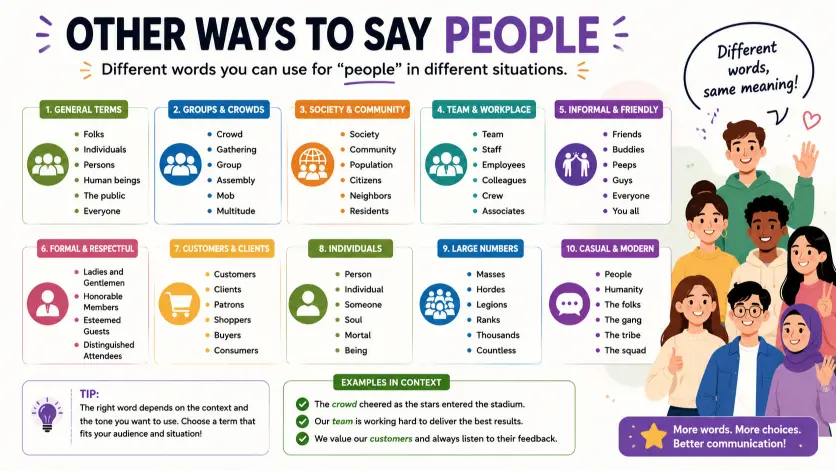
conversation? Although it is a common and useful word, repeating it too often can make your writing sound less engaging. Learning other ways to say people helps you communicate more clearly, express your ideas naturally, and choose words that fit different situations. For you are an English learner, student, blogger, or professional, expanding your vocabulary can make a noticeable difference in your communication skills.
In this guide, you will discover 30 alternatives to “people,” including words such as individuals, persons, individuals, citizens, residents, participants, and audiences. Each alternative has its own meaning and context, so choosing the right word matters. Following established English usage and practical language-learning principles, this article explains how these synonyms work in formal writing, casual conversations, academic assignments, and professional communication. You will also find useful examples to help you understand when each expression is appropriate. By the end, you will have practical vocabulary choices to make your English clearer, more precise, and more effective
Quick Categories
Formal alternatives to “people”
- Individuals: Suitable for academic, legal, and formal writing.
- Persons: Often used in legal, official, or administrative contexts.
- Human beings: Emphasizes humanity or human nature.
- Members of society: Refers to people as part of a broader social group.
Pro Tip
Use “individuals” in research and formal reports when focusing on people separately. Use “members of society” when discussing shared responsibilities or social issues.
Casual alternatives
- Folks: A friendly word for a group of people.
- Everyone: Refers to all the people in a particular group or situation.
- Everybody: A natural alternative in everyday conversation.
- A bunch of people: An informal expression for a group.
Pro Tip
Choose “folks” for a warm, conversational tone. In casual English, “everyone” is often more natural than repeatedly saying “people.”
Professional alternatives
- Team members: People working together on a team.
- Employees: People who work for an organization.
- Colleagues: People you work with, particularly in a professional setting.
- Stakeholders: People or groups with an interest in a decision or project.
Pro Tip
Be specific in business communication. “Stakeholders,” “employees,” and “customers” describe different groups, so choose the term that accurately reflects your meaning.
Informal expressions
- Guys: An informal way to address or refer to a group; usage varies by audience.
- Crowd: A group gathered in one place or sharing an interest.
- The gang: A familiar expression for a close-knit group.
- The group: A neutral expression for people considered together.
Pro Tip
Use informal expressions with friends and familiar audiences. For professional emails, reports, and formal presentations, prefer precise and neutral vocabulary.
“Good vocabulary is not about choosing the fanciest word. It is about choosing the word that communicates your meaning most accurately.”
What Does “People” Mean?
People is a plural noun that generally refers to human beings collectively or to the members of a particular group or community.
It can describe individuals in general, a specific population, or people connected by a shared activity, location, or purpose.
Example: Many people prefer learning new skills through practical experience.
Grammar explanation
- People is normally plural when it means human beings: “People are waiting outside.”
- Person is the usual singular form: “One person is waiting outside.”
- Peoples can refer to distinct ethnic, cultural, or national groups: “The history of Indigenous peoples is diverse.”
- People can also refer to a particular population or community: “The people of the region welcomed the visitors.”
In formal writing, remember that the verb should agree with the intended meaning. When “people” refers to human beings, use a plural verb.
When to Use “People”
The word works in many contexts, but alternatives can make your meaning more precise.
- Everyday conversations: Use “people,” “everyone,” “everybody,” or “folks.”
- Academic writing: Choose “individuals,” “participants,” or “human beings,” depending on the subject.
- Workplace communication: Use “employees,” “team members,” or “colleagues.”
- Customer service: Use “customers,” “clients,” or “users.”
- Public announcements: Use “the public,” “attendees,” or “members of the community.”
- Research and surveys: Use “respondents,” “participants,” or “subjects” where appropriate.
- Social discussions: Use “community members,” “citizens,” or “members of society” when those terms fit.
- Creative writing: Use “crowd,” “villagers,” “visitors,” or “the group” to add detail.
Spoken vs. written English
| Situation | Natural choices |
| Everyday speech | People, everyone, folks |
| Academic essays | Individuals, participants |
| Business reports | Employees, stakeholders |
| Formal notices | Persons, members of the public |
| Friendly messages | Everyone, folks, the group |
“Specific words help readers understand exactly who you mean, without making your sentences longer.”
Is It Professional or Polite to Say “People”?
Polite? Yes.
Professional? Yes, when used appropriately.
“People” is a neutral, widely accepted word. It is not inherently unprofessional or impolite. However, it may be too general when your audience needs to know which group you mean.
Business-style example:
“People from the marketing department will attend the meeting.”
More precise alternative:
“Marketing team members will attend the meeting.”
The second sentence identifies the group more clearly. However, the original is perfectly understandable and appropriate in many workplace situations.
The goal is not to avoid “people” completely. Instead, choose a more specific term when it improves clarity, accuracy, or tone.
Pros and Cons of Using “People”
Pros
- Simple and natural: Easy to use in everyday conversations and writing.
- Friendly tone: Sounds neutral and approachable.
- Common usage: Widely understood by English speakers.
- Easy to understand: Works across many everyday situations.
Cons
- Can be too general: Readers may not know which group you mean.
- May become repetitive: Repeated use can weaken longer articles or reports.
- Limited descriptive detail: It does not explain people’s roles or relationships.
- Less precise in specialized writing: Terms such as “participants” or “employees” may be more accurate.
Other Ways to Say People (With Examples)
These alternatives will help you sound more fluent, confident, and natural in different situations.
Choose each expression according to tone, context, and audience. Although the phrase “express excitement in English” usually relates to emotions, precise vocabulary also helps you express approval, concern, respect, and other reactions more effectively.
30 alternatives with meanings and examples
1. Phrase: Individuals
- Meaning: Separate human beings considered one at a time.
- Explanation: This is a formal, versatile replacement when focusing on people individually.
- Example Sentence: Individuals should have equal access to educational opportunities.
- Best Use: Academic writing
- Worst Use: Very casual banter
- Tone: Formal, neutral, precise
- Context Variability: Casual: “Each individual matters.” Professional: “Individuals must complete the form.” Spoken: “Every individual has different needs.”
2. Phrase: Persons
- Meaning: Human beings, particularly in official or formal contexts.
- Explanation: This word commonly appears in legal documents, regulations, and administrative notices.
- Example Sentence: All persons entering the building must show identification.
- Best Use: Official notices
- Worst Use: Friendly conversation
- Tone: Formal, official, precise
- Context Variability: Casual: “Three persons arrived” sounds stiff. Professional: “Authorized persons only.” Spoken: “The persons involved have been contacted.”
3. Phrase: Human beings
- Meaning: Members of the human species.
- Explanation: Use this expression when emphasizing humanity, behavior, or human nature.
- Example Sentence: Human beings need social connections to thrive.
- Best Use: General discussion
- Worst Use: Short business emails
- Tone: Neutral, thoughtful, descriptive
- Context Variability: Casual: “We are all human beings.” Professional: “Human beings respond differently to stress.” Spoken: “Human beings learn through experience.”
4. Phrase: Folks
- Meaning: People considered as a group.
- Explanation: This friendly alternative works well in conversational English and approachable communication.
- Example Sentence: Thanks to everyone who helped organize the event, folks.
- Best Use: Friendly conversations
- Worst Use: Legal documents
- Tone: Warm, friendly, informal
- Context Variability: Casual: “How are you folks?” Professional: “Welcome, folks” in an informal presentation. Spoken: “Folks are arriving now.”
5. Phrase: Everyone
- Meaning: Every person in a particular group or situation.
- Explanation: Use it when referring inclusively to all the relevant people.
- Example Sentence: Everyone is welcome to attend the workshop.
- Best Use: Group announcements
- Worst Use: Partial groups
- Tone: Inclusive, neutral, friendly
- Context Variability: Casual: “Everyone is invited.” Professional: “Everyone must submit feedback.” Spoken: “Is everyone ready?”
6. Phrase: Everybody
- Meaning: Every person in the relevant group.
- Explanation: It has almost the same meaning as “everyone” and is common in everyday speech.
- Example Sentence: Everybody enjoyed the team celebration.
- Best Use: Everyday conversation
- Worst Use: Technical precision
- Tone: Conversational, friendly, neutral
- Context Variability: Casual: “Everybody knows that.” Professional: “Everybody received the notice.” Spoken: “Is everybody here?”
7. Phrase: The public
- Meaning: People in general, especially outside a particular organization.
- Explanation: Use this phrase when discussing public information, services, opinions, or access.
- Example Sentence: The public can submit comments on the proposed changes.
- Best Use: Public communication
- Worst Use: Small private teams
- Tone: Formal, neutral, civic
- Context Variability: Casual: “The public was curious.” Professional: “The information is available to the public.” Spoken: “We need to inform the public.”
8. Phrase: Members of society
- Meaning: People who form part of a society.
- Explanation: This expression is useful when discussing social duties, behavior, or shared values.
- Example Sentence: Members of society can contribute to positive change.
- Best Use: Social discussions
- Worst Use: Casual greetings
- Tone: Formal, reflective, educational
- Context Variability: Casual: “We all play a part in society.” Professional: “Members of society benefit from accessible services.” Spoken: “Members of society share certain responsibilities.”
9. Phrase: Members of the community
- Meaning: People belonging to or connected with a particular community.
- Explanation: It emphasizes a shared location, interest, identity, or community connection.
- Example Sentence: Members of the community participated in the cleanup.
- Best Use: Community projects
- Worst Use: Unrelated audiences
- Tone: Inclusive, respectful, constructive
- Context Variability: Casual: “Community members joined us.” Professional: “Members of the community were consulted.” Spoken: “We invited members of the community.”
10. Phrase: Team members
- Meaning: People who belong to the same team.
- Explanation: This phrase identifies people’s shared role in a team or collaborative activity.
- Example Sentence: Team members will review the proposal tomorrow.
- Best Use: Workplace communication
- Worst Use: General populations
- Tone: Professional, collaborative, neutral
- Context Variability: Casual: “Our team members are here.” Professional: “Team members will receive individual assignments.” Spoken: “The team members worked together.”
11. Phrase: Employees
- Meaning: People employed by an organization or employer.
- Explanation: Use this term when discussing staff, workplace policies, or employment matters.
- Example Sentence: Employees must complete the annual training.
- Best Use: HR communication
- Worst Use: Unpaid volunteers
- Tone: Professional, specific, neutral
- Context Variability: Casual: “The employees went to lunch.” Professional: “Employees are eligible for benefits.” Spoken: “Employees will receive an update.”
12. Phrase: Colleagues
- Meaning: People you work with, usually in a professional or occupational setting.
- Explanation: This term highlights working relationships rather than employment status alone.
- Example Sentence: My colleagues helped me prepare the presentation.
- Best Use: Workplace conversations
- Worst Use: Unrelated strangers
- Tone: Professional, respectful, collegial
- Context Variability: Casual: “I met my colleagues for lunch.” Professional: “Colleagues reviewed the report.” Spoken: “I will discuss it with my colleagues.”
13. Phrase: Stakeholders
- Meaning: People or groups with an interest in or affected by a decision or project.
- Explanation: This term is especially useful in business, management, policy, and project planning.
- Example Sentence: We consulted stakeholders before changing the service.
- Best Use: Project discussions
- Worst Use: Ordinary social gatherings
- Tone: Professional, strategic, precise
- Context Variability: Casual: “Everyone involved shared ideas.” Professional: “Stakeholders approved the proposal.” Spoken: “We need feedback from our stakeholders.”
14. Phrase: Participants
- Meaning: People who take part in an activity, event, study, or program.
- Explanation: Use it when involvement in a particular activity defines the group.
- Example Sentence: Participants completed the survey after the session.
- Best Use: Research studies
- Worst Use: Uninvolved observers
- Tone: Neutral, formal, descriptive
- Context Variability: Casual: “The participants had fun.” Professional: “Participants must register in advance.” Spoken: “Participants can ask questions at the end.”
15. Phrase: Attendees
- Meaning: People who attend an event, meeting, or gathering.
- Explanation: This word identifies people by their presence at an event.
- Example Sentence: Attendees received a copy of the conference schedule.
- Best Use: Event communication
- Worst Use: Non-attendees
- Tone: Professional, neutral, informative
- Context Variability: Casual: “The attendees enjoyed the party.” Professional: “Attendees should arrive early.” Spoken: “We welcomed all attendees.”
16. Phrase: Customers
- Meaning: People who buy goods or services from a business.
- Explanation: Choose this term when discussing purchasing, sales, service, or customer experience.
- Example Sentence: Customers can contact support for assistance.
- Best Use: Business communication
- Worst Use: Non-buying audiences
- Tone: Professional, commercial, direct
- Context Variability: Casual: “Customers liked the new menu.” Professional: “Customers reported shorter waiting times.” Spoken: “We value our customers.”
17. Phrase: Clients
- Meaning: People or organizations receiving professional services.
- Explanation: This word is common in consulting, law, design, finance, and other service-based industries.
- Example Sentence: Our clients expect clear communication throughout the project.
- Best Use: Professional services
- Worst Use: General crowds
- Tone: Professional, respectful, service-oriented
- Context Variability: Casual: “My clients are happy.” Professional: “Clients will receive a progress report.” Spoken: “I will contact the clients today.”
18. Phrase: Users
- Meaning: People who use a product, service, system, or platform.
- Explanation: This is particularly useful in technology, product design, and digital communication.
- Example Sentence: Users can change their privacy settings at any time.
- Best Use: Product documentation
- Worst Use: Unrelated populations
- Tone: Technical, neutral, precise
- Context Variability: Casual: “Users liked the update.” Professional: “Users reported a navigation issue.” Spoken: “We designed this feature for users.”
19. Phrase: Residents
- Meaning: People who live in a particular place.
- Explanation: Use this term for people connected by where they live, rather than by citizenship or employment.
- Example Sentence: Residents were invited to the town hall meeting.
- Best Use: Local announcements
- Worst Use: Temporary visitors
- Tone: Neutral, civic, informative
- Context Variability: Casual: “Residents gathered outside.” Professional: “Residents may apply for assistance.” Spoken: “Residents raised concerns about traffic.”
20. Phrase: Citizens
- Meaning: People who hold citizenship in a particular country or political community.
- Explanation: Use it when citizenship, civic rights, or public responsibilities are specifically relevant.
- Example Sentence: Citizens can participate in public consultations.
- Best Use: Civic discussions
- Worst Use: Mixed-status populations
- Tone: Formal, civic, specific
- Context Variability: Casual: “Citizens attended the meeting.” Professional: “Citizens submitted written comments.” Spoken: “Citizens have different responsibilities and rights.”
21. Phrase: The audience
- Meaning: People who watch, listen to, or read a presentation or piece of content.
- Explanation: It is useful when the group is defined by receiving a message or performance.
- Example Sentence: The audience responded positively to the speaker.
- Best Use: Presentations
- Worst Use: Unrelated populations
- Tone: Neutral, descriptive, professional
- Context Variability: Casual: “The audience loved the show.” Professional: “The audience consists of industry specialists.” Spoken: “We invited questions from the audience.”
22. Phrase: The crowd
- Meaning: A large group of people gathered in one place.
- Explanation: This term emphasizes a gathering and often suggests a sizable group.
- Example Sentence: The crowd cheered as the performers took the stage.
- Best Use: Public gatherings
- Worst Use: Small work teams
- Tone: Descriptive, neutral, vivid
- Context Variability: Casual: “The crowd was excited.” Professional: “The crowd exceeded expectations.” Spoken: “A crowd gathered near the entrance.”
23. Phrase: The group
- Meaning: A collection of people considered together.
- Explanation: It is a neutral option when the people share a task, purpose, or situation.
- Example Sentence: The group agreed to meet again next week.
- Best Use: General discussions
- Worst Use: Unspecified references
- Tone: Neutral, simple, flexible
- Context Variability: Casual: “The group went for coffee.” Professional: “The group reviewed the findings.” Spoken: “Our group is ready to begin.”
24. Phrase: The gang
- Meaning: An informal expression for a familiar group of friends or associates.
- Explanation: In friendly conversation, it can suggest closeness, but it may also refer to a criminal group.
- Example Sentence: I am meeting the gang for dinner tonight.
- Best Use: Close friendships
- Worst Use: Formal reports
- Tone: Familiar, playful, informal
- Context Variability: Casual: “The gang is coming over.” Professional: “The team is meeting today” is safer. Spoken: “Let’s get the gang together.”
25. Phrase: Guys
- Meaning: An informal term for people, often used when addressing a group.
- Explanation: It is common in casual conversation, but not every audience finds it inclusive or appropriate.
- Example Sentence: Hi, guys, are we ready to start?
- Best Use: Informal groups
- Worst Use: Formal announcements
- Tone: Casual, familiar, conversational
- Context Variability: Casual: “What are you guys doing?” Professional: “Hello, everyone” is often better. Spoken: “Are you guys coming?”
26. Phrase: The population
- Meaning: The people living in a particular area or belonging to a defined group.
- Explanation: This term is useful in demographic, scientific, public health, and statistical discussions.
- Example Sentence: The population of the city has grown steadily.
- Best Use: Statistical reports
- Worst Use: Friendly greetings
- Tone: Analytical, formal, objective
- Context Variability: Casual: “The city has more residents now.” Professional: “The population was surveyed.” Spoken: “The population is changing.”
27. Phrase: The workforce
- Meaning: People engaged in or available for work, especially within an organization or economy.
- Explanation: Use it when discussing employment, labor, staffing, or workplace trends.
- Example Sentence: The workforce needs training in new digital tools.
- Best Use: Employment reports
- Worst Use: Social gatherings
- Tone: Professional, economic, analytical
- Context Variability: Casual: “Many workers need training.” Professional: “The workforce is adapting to automation.” Spoken: “We need to support the workforce.”
28. Phrase: Volunteers
- Meaning: People who freely offer their time or services, usually without financial payment.
- Explanation: This term identifies people by their voluntary contribution to a cause or activity.
- Example Sentence: Volunteers helped distribute supplies to local families.
- Best Use: Community projects
- Worst Use: Paid staff generally
- Tone: Positive, appreciative, specific
- Context Variability: Casual: “Volunteers helped us clean up.” Professional: “Volunteers must attend orientation.” Spoken: “We need more volunteers.”
29. Phrase: Representatives
- Meaning: People who speak or act on behalf of others or an organization.
- Explanation: Use this term when the people have an authorized representative role.
- Example Sentence: Representatives from several organizations attended the discussion.
- Best Use: Official meetings
- Worst Use: Unrelated individuals
- Tone: Formal, professional, authoritative
- Context Variability: Casual: “Representatives joined the call.” Professional: “Company representatives presented the proposal.” Spoken: “Please contact your representatives.”
30. Phrase: Human population
- Meaning: The total number or collective group of human beings in a defined area or context.
- Explanation: This expression suits scientific, environmental, demographic, and research-based discussions.
- Example Sentence: Researchers examined how climate change affects the human population.
- Best Use: Scientific writing
- Worst Use: Casual conversation
- Tone: Academic, analytical, objective
- Context Variability: Casual: “People are affected by climate change.” Professional: “The study examined the human population.” Spoken: “The human population continues to grow.”
Common Mistakes When Using Alternatives to “People”
Choosing a synonym requires more than replacing one word with another. The meaning, grammar, and context must remain accurate.
1. Using “persons” in every situation. It can sound unnecessarily formal in everyday conversation. Example: “Three persons came over for dinner.” Better: “Three people came over for dinner.”
2. Using “citizens” when you mean everyone. Not everyone living in a country is necessarily a citizen. Example: “All citizens must follow the building’s visitor rules.” Better: “All visitors must follow the building’s visitor rules.”
3. Using “stakeholders” for every group. Stakeholders have an interest in or are affected by a particular matter. Example: “The stakeholders at the concert enjoyed the music.” Better: “The concertgoers enjoyed the music.”
4. Using “employees” for volunteers. Employees generally work for an employer, while volunteers offer their time voluntarily. Example: “The employees helped at the charity event,” when they were unpaid volunteers. Better: “The volunteers helped at the charity event.”
5. Using “population” to describe a small gathering. Population usually refers to people within a defined area or group, not simply a few people in one room. Example: “The population in the meeting asked questions.” Better: “The attendees at the meeting asked questions.”
Mini Quiz: Test Your Vocabulary
Check your understanding by choosing the most appropriate expression for each situation.
1. You are writing a formal research report about people who completed a study. Which word fits best?
Folks
Participants
The gang
2. You are writing an email to people employed by your company. Which word is most precise?
Employees
The crowd
Citizens
3. You are announcing that every person in a workshop can ask questions. Which word fits best?
Stakeholders
Everyone
The workforce
4. You are describing people who live in a neighborhood. Which word is most accurate?
Residents
Customers
Attendees
0 of 4 answered
Reset quiz
Comparison Table: Top 10 Alternatives
| Phrase | Tone | Best Use |
| Individuals | Formal | Academic writing |
| Persons | Official | Legal notices |
| Folks | Friendly | Casual conversations |
| Everyone | Inclusive | Group announcements |
| The public | Neutral | Public information |
| Team members | Professional | Workplace communication |
| Colleagues | Professional | Work relationships |
| Participants | Neutral | Research and events |
| Stakeholders | Businesslike | Project discussions |
| Residents | Informative | Local communities |
“Precision builds credibility. Identify the group first, then choose the word that describes it accurately.”
How to Choose the Right Alternative
Use this simple decision guide when selecting among the different expressions.
For academic writing
Choose “individuals,” “participants,” or “human beings,” depending on the research or argument.
For professional communication
Use “colleagues,” “employees,” “clients,” or “stakeholders” to identify people’s roles.
For everyday conversation
Prefer “everyone,” “folks,” or “the group,” according to the sentence and audience.
For communities and public issues
Choose “residents,” “members of the community,” “citizens,” or “the public” when the distinction is accurate.
See Also
- See also: Other Ways to Say “Everyone” for more vocabulary choices when referring to an entire group.
- See also: Professional English Phrases for Emails and Meetings to improve clarity and confidence in workplace communication.
Frequently Asked Questions
1. What are the best alternatives to “people”?
Some useful choices are individuals, human beings, everyone, folks, and members of the community. The best option depends on the context and intended meaning.
2. What is a formal word for “people”?
“Individuals” is a versatile formal alternative. “Persons” is common in legal or official contexts, while “participants” is suitable for research and organized activities.
3. How can I avoid repeating the word “people” in an essay?
Use precise alternatives such as individuals, participants, residents, or members of society when appropriate. You can also restructure sentences to avoid unnecessary repetition.
4. What is a professional way to say “people at work”?
Use “employees” for people employed by an organization, “colleagues” for people you work with, and “team members” for people belonging to a team.
5. Is “folks” appropriate in professional English?
Yes, in friendly presentations, approachable messages, or informal workplace conversations. For formal reports and official documents, neutral alternatives such as “employees,” “colleagues,” or “everyone” may be more suitable.
Conclusion
Learning different ways to refer to people can make your English more precise, expressive, and professional. Words such as “individuals,” “colleagues,” “participants,” and “residents” help you communicate specific meanings instead of relying on the same general term in every situation. The right vocabulary also makes academic writing, workplace communication, and everyday conversations easier to understand.
Make vocabulary practice part of your daily routine. Replace repeated words in your emails, essays, and conversations with suitable alternatives, and pay attention to how the tone changes. Remember that a synonym is useful only when it preserves your intended meaning. Choose accuracy over complexity, and let your audience and context guide your word choice.









