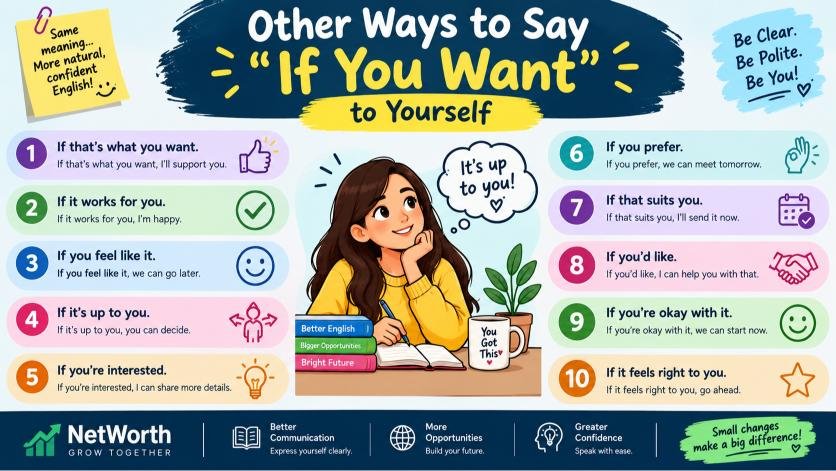
messages? Although this expression is polite and widely understood, using it too often can make your communication sound repetitive or less confident. For you are making a suggestion, offering help, inviting someone to join you, or giving another person the freedom to choose, finding the right alternative can make your English sound more natural and engaging. Fortunately, there are many expressions you can use instead, depending on your audience, intention, and level of formality. Learning these alternatives can help you communicate your ideas clearly while maintaining a friendly, respectful tone.
In this guide, you will discover 30 useful alternatives to “if you want,” complete with practical examples and explanations of when to use them. From casual phrases like “if you feel like it” to more professional options such as “if you would prefer,” you will learn how to adapt your language to different situations. Each expression offers a practical way to expand your vocabulary, reduce repetition, and improve your spoken and written English with greater confidence.
Formal alternatives to “if you want”
Use these expressions in formal emails, official invitations, customer communication, and respectful conversations.
- Should you wish: “Should you wish to discuss this further, please contact me.”
- If you so desire: “If you so desire, we can arrange a private consultation.”
- If you prefer: “If you prefer, I can send the report by email.”
- Should you prefer: “Should you prefer, we can reschedule the meeting.”
Pro Tip: “Should you wish” is formal and courteous, but it may sound stiff in a casual text. For everyday politeness, “if you’d like” is usually more natural.
Casual alternatives
These phrases sound natural with friends, family, and colleagues you know well.
- If you’d like: “We can grab lunch together if you’d like.”
- If you feel like it: “We can watch a movie tonight if you feel like it.”
- If that sounds good to you: “We could meet at six if that sounds good to you.”
- If you’re up for it: “We can go for a walk after work if you’re up for it.”
Pro Tip: Casual alternatives work best when you want to suggest an idea without making the other person feel obligated to accept.
Professional alternatives
Choose these expressions for workplace conversations, business emails, and client communication.
- If that works for you: “We can schedule the presentation for Thursday if that works for you.”
- If you would prefer: “If you would prefer, I can prepare a shorter version of the report.”
- Should you be interested: “Should you be interested, I can share further details about the proposal.”
- If you find it helpful: “I can provide a checklist if you find it helpful.”
Pro Tip: Professional communication should be both polite and clear. Instead of repeatedly writing “if you want,” identify the option you are offering and let the reader choose.
Informal expressions
Use these relaxed expressions in friendly conversations and informal messages.
- If you’re interested: “I found a great course if you’re interested.”
- If you’re keen: “We’re going hiking this weekend if you’re keen.”
- It’s up to you: “We can order pizza or cook at home. It’s up to you.”
- Whatever you prefer: “We can sit inside or outside, whatever you prefer.”
Pro Tip: “It’s up to you” gives the decision to the other person. Use it when you genuinely want them to choose, rather than when you need to communicate a specific preference.
“Polite language gives people options without making them feel pressured.”
Common mistakes when using “if you want”
The phrase is grammatically correct, but it can sound unclear, repetitive, or too casual when used in the wrong context.
1. Using it repeatedly: Repetition makes writing sound monotonous. Less effective: “If you want, I can help if you want.”
2. Using a casual phrase in a formal email: “If you’re up for it” may be too relaxed for a formal client message. Better: “If you would be interested, I would be happy to arrange a meeting.”
3. Confusing desire with preference: “If you prefer” focuses on choosing between options, while “if you want” focuses more broadly on desire or willingness. Example: “We can use the shorter version if you prefer.”
4. Making an offer sound like pressure: A suggestion can feel pushy if you do not make the choice genuinely optional. Better: “I can explain the process if that would be helpful.”
5. Using “if you want to” when the action is already implied: In some contexts, “if you want” is enough. Example: “I can send you the notes if you want.” When the action needs to be explicit, use: “If you want to review the notes, I can send them.”
What does “if you want” mean?
“If you want” is a conditional expression used to refer to someone’s desire, willingness, or choice. It often introduces an offer, suggestion, invitation, or optional action.
Grammar: “If” introduces a condition, and “you want” uses the subject “you” with the verb “want.” The phrase can stand at the end of a sentence when the intended action is clear.
Example: “I can help you prepare for the interview if you want.”
Compare “if you want” with “if you like.” Both can offer a choice, but “if you like” often emphasizes preference or enjoyment, while “if you want” emphasizes desire or willingness.
When to use “if you want”
Use the phrase when you want to:
- Offer help without insisting.
- Suggest an activity or plan.
- Invite someone to participate.
- Give someone freedom to choose.
- Share additional information if the other person is interested.
- Make a casual recommendation.
- Ask whether someone would like to take the next step.
Spoken vs. written English
- Spoken: “We can stop for coffee if you want.”
- Text message: “Want to join us?”
- Professional email: “I can provide additional details if you would like.”
- Formal writing: “Should you wish to receive further information, please contact our office.”
Formal vs. informal: “Should you wish” and “if you would like” are suitable for more formal settings. “If you’re up for it” is better suited to relaxed conversations. The best alternative depends on your audience and purpose.
Is it professional or polite to say “if you want”?
Polite? Yes.
Professional? Yes, in many situations.
“If you want” is not inherently unprofessional. It is common in conversation and can work in friendly workplace communication. However, “if you would like,” “if that works for you,” and “if you prefer” may sound more considerate in formal emails or client messages.
Business-style example:
“Please let me know if you would like me to arrange a follow-up meeting.”
This wording offers assistance while allowing the recipient to decide.
Pros and cons of using “if you want”
Pros
- Simple and natural: Easy to use in everyday English.
- Friendly tone: Makes suggestions feel relaxed.
- Common usage: Widely understood in ordinary conversation.
- Easy to understand: Clearly signals that an action is optional.
Cons
- May sound too informal for some work situations: A more polished alternative can suit formal correspondence better.
- Can be overused: Repeating the phrase makes writing less varied.
- Limited emotional range: It may not fully express warmth, enthusiasm, or consideration on its own.
- Not ideal for every formal document: Official notices and carefully worded proposals may require more precise language.
“The best alternative is not always the most formal one. It is the one that fits your audience and purpose.”
Other ways to say “if you want” with examples
These 30 alternatives will help you sound more fluent, confident, and natural in different situations.
Use them according to tone, context, and audience to make suggestions, offer choices, and communicate politely. Some phrases are close substitutes, while others work only in specific situations.
1. Phrase: If You’d Like
Meaning: If you would enjoy or welcome something.
Explanation: This is a friendly, polite alternative suitable for both personal and professional conversations.
Example Sentence: “I can review your application if you’d like.”
Best Use: Polite offers
Worst Use: Legal conditions
Tone: Friendly, courteous, natural
Context Variability:
- Casual: “We can get coffee if you’d like.”
- Professional: “I can arrange a follow-up call if you’d like.”
- Spoken: “I’ll show you around if you’d like.”
2. Phrase: If You Prefer
Meaning: If one option is more suitable to you than another.
Explanation: Use this when giving someone a choice between alternatives.
Example Sentence: “We can meet online if you prefer.”
Best Use: Offering choices
Worst Use: Unrelated conditions
Tone: Neutral, polite, considerate
Context Variability:
- Casual: “We can eat outside if you prefer.”
- Professional: “I can send a PDF if you prefer.”
- Spoken: “We can leave earlier if you prefer.”
3. Phrase: If You Wish
Meaning: If you want or choose to do something.
Explanation: This is a slightly formal alternative that emphasizes personal choice.
Example Sentence: “You may contact the coordinator if you wish.”
Best Use: Formal permission
Worst Use: Casual banter
Tone: Formal, courteous, restrained
Context Variability:
- Casual: “You can join us if you wish.”
- Professional: “You may request a review if you wish.”
- Spoken: “You can take a break if you wish.”
4. Phrase: If You Would Like
Meaning: If something appeals to you or you would welcome it.
Explanation: This longer form sounds courteous and works especially well in professional messages.
Example Sentence: “I would be happy to explain the process if you would like.”
Best Use: Business offers
Worst Use: Very quick exchanges
Tone: Polite, professional, warm
Context Variability:
- Casual: “I can save you a seat if you would like.”
- Professional: “I can provide additional documentation if you would like.”
- Spoken: “I can help you practice if you would like.”
5. Phrase: Should You Wish
Meaning: If you would like to do something.
Explanation: This formal construction is common in official correspondence and polished written English.
Example Sentence: “Should you wish to proceed, please confirm by Friday.”
Best Use: Formal correspondence
Worst Use: Friendly texting
Tone: Formal, respectful, polished
Context Variability:
- Casual: “You can come along if you want.”
- Professional: “Should you wish to proceed, we can begin next week.”
- Spoken: “Should you wish to speak, I am available afterward.”
6. Phrase: Should You Prefer
Meaning: If another option better matches your preference.
Explanation: Use this when offering a different arrangement in a formal setting.
Example Sentence: “Should you prefer, we can arrange a morning appointment.”
Best Use: Formal choices
Worst Use: Relaxed chats
Tone: Formal, considerate, measured
Context Variability:
- Casual: “We can sit inside if you prefer.”
- Professional: “Should you prefer, we can revise the schedule.”
- Spoken: “Should you prefer, we can discuss it privately.”
7. Phrase: If It Suits You
Meaning: If an option is convenient or acceptable for you.
Explanation: This phrase considers another person’s circumstances, particularly their schedule or preferences.
Example Sentence: “We could meet on Wednesday if it suits you.”
Best Use: Scheduling arrangements
Worst Use: Strong requirements
Tone: Courteous, thoughtful, neutral
Context Variability:
- Casual: “We can meet at the café if it suits you.”
- Professional: “The proposed deadline is Friday, if it suits you.”
- Spoken: “We can talk after lunch if it suits you.”
8. Phrase: If That Works for You
Meaning: If a proposed plan is acceptable and convenient.
Explanation: This natural phrase is especially useful for coordinating schedules and responsibilities.
Example Sentence: “I’ll send the revised draft tomorrow, if that works for you.”
Best Use: Work coordination
Worst Use: Unchangeable deadlines
Tone: Collaborative, polite, practical
Context Variability:
- Casual: “Let’s meet at seven if that works for you.”
- Professional: “We can finalize the report on Monday if that works for you.”
- Spoken: “I’ll call you this afternoon if that works for you.”
9. Phrase: If You’re Interested
Meaning: If something catches your attention or appeals to you.
Explanation: Use this to offer information or an opportunity without assuming the other person wants it.
Example Sentence: “I can share the course details if you’re interested.”
Best Use: Optional opportunities
Worst Use: Required instructions
Tone: Friendly, inviting, neutral
Context Variability:
- Casual: “There’s a new restaurant nearby if you’re interested.”
- Professional: “I can share the vacancy details if you’re interested.”
- Spoken: “I can show you the presentation if you’re interested.”
10. Phrase: If You’re Up for It
Meaning: If you feel willing or enthusiastic about doing something.
Explanation: This informal phrase works well for activities, plans, and social invitations.
Example Sentence: “We could go for a walk after work if you’re up for it.”
Best Use: Casual invitations
Worst Use: Formal notices
Tone: Relaxed, friendly, upbeat
Context Variability:
- Casual: “Let’s try the new café if you’re up for it.”
- Professional: “We could have an informal team lunch if you’re up for it.”
- Spoken: “We can keep practicing if you’re up for it.”
11. Phrase: If You Feel Like It
Meaning: If you are in the mood to do something.
Explanation: This phrase emphasizes someone’s current mood or inclination rather than a firm preference.
Example Sentence: “We can watch a film tonight if you feel like it.”
Best Use: Leisure plans
Worst Use: Urgent tasks
Tone: Casual, relaxed, gentle
Context Variability:
- Casual: “Come over later if you feel like it.”
- Professional: “We can continue the optional discussion if you feel like it.”
- Spoken: “Join us for dinner if you feel like it.”
12. Phrase: If You’re Keen
Meaning: If you are interested or enthusiastic about doing something.
Explanation: This expression is especially common in British, Australian, and other varieties of English influenced by them.
Example Sentence: “We’re planning a weekend hike if you’re keen.”
Best Use: Friendly invitations
Worst Use: Highly formal letters
Tone: Informal, enthusiastic, friendly
Context Variability:
- Casual: “Come play football if you’re keen.”
- Professional: “We can arrange an optional brainstorming session if you’re keen.”
- Spoken: “We could try the new activity if you’re keen.”
13. Phrase: If You’re Interested in Doing So
Meaning: If you would like to take the suggested action.
Explanation: This longer construction suits situations where the action needs to be stated clearly.
Example Sentence: “You can join the mentoring program if you’re interested in doing so.”
Best Use: Formal invitations
Worst Use: Quick replies
Tone: Professional, explicit, courteous
Context Variability:
- Casual: “You can come along if you want to.”
- Professional: “You may submit an application if you’re interested in doing so.”
- Spoken: “You can speak to the organizer if you’re interested in doing so.”
14. Phrase: If That Appeals to You
Meaning: If an idea or option seems attractive to you.
Explanation: Use this when suggesting an experience, opportunity, or plan that may match someone’s interests.
Example Sentence: “We could explore a more flexible schedule if that appeals to you.”
Best Use: Suggesting options
Worst Use: Simple instructions
Tone: Thoughtful, polished, inviting
Context Variability:
- Casual: “We could try kayaking if that appeals to you.”
- Professional: “We can explore a remote arrangement if that appeals to you.”
- Spoken: “There’s another option if that appeals to you.”
15. Phrase: If You’re Willing
Meaning: If you are prepared or ready to do something.
Explanation: This phrase focuses on readiness and consent, rather than simply wanting something.
Example Sentence: “We can improve the process if you’re willing to share your feedback.”
Best Use: Requesting cooperation
Worst Use: Pressure-sensitive requests
Tone: Direct, respectful, serious
Context Variability:
- Casual: “I can teach you if you’re willing to learn.”
- Professional: “We can review the plan if you’re willing to provide feedback.”
- Spoken: “I can help if you’re willing to try.”
16. Phrase: If You Choose To
Meaning: If you decide to take a particular action.
Explanation: This phrase highlights personal decision-making and can sound more deliberate than “if you want.”
Example Sentence: “You can submit your comments if you choose to.”
Best Use: Personal decisions
Worst Use: Warm invitations
Tone: Neutral, deliberate, respectful
Context Variability:
- Casual: “You can stay longer if you choose to.”
- Professional: “You may request a second review if you choose to.”
- Spoken: “You can participate if you choose to.”
17. Phrase: If You’re Comfortable With That
Meaning: If an arrangement feels acceptable and comfortable to you.
Explanation: This phrase is useful when discussing personal boundaries, sensitive topics, or potentially uncomfortable requests.
Example Sentence: “We can discuss your feedback privately if you’re comfortable with that.”
Best Use: Sensitive discussions
Worst Use: Routine instructions
Tone: Considerate, gentle, respectful
Context Variability:
- Casual: “I can ask them to join us if you’re comfortable with that.”
- Professional: “We can include your comments in the report if you’re comfortable with that.”
- Spoken: “I can explain the situation if you’re comfortable with that.”
18. Phrase: If You Find It Helpful
Meaning: If something provides value or assistance to you.
Explanation: This is a useful professional alternative when offering resources, advice, or additional support.
Example Sentence: “I can include a checklist if you find it helpful.”
Best Use: Offering resources
Worst Use: Personal demands
Tone: Helpful, professional, considerate
Context Variability:
- Casual: “I can send you the recipe if you find it helpful.”
- Professional: “I can attach a summary if you find it helpful.”
- Spoken: “I can give you an example if you find it helpful.”
19. Phrase: If It Helps
Meaning: If an action or piece of information makes a situation easier.
Explanation: This short phrase introduces an offer intended to solve a problem or reduce difficulty.
Example Sentence: “I can share my notes if it helps.”
Best Use: Practical assistance
Worst Use: Unrelated suggestions
Tone: Helpful, simple, reassuring
Context Variability:
- Casual: “I can give you a lift if it helps.”
- Professional: “I can provide a template if it helps.”
- Spoken: “I can explain it another way if it helps.”
20. Phrase: If You’d Find It Useful
Meaning: If you believe something would be useful to you.
Explanation: This phrase works well when offering optional information or tools in a professional setting.
Example Sentence: “I can prepare a short briefing if you’d find it useful.”
Best Use: Optional resources
Worst Use: Mandatory actions
Tone: Courteous, thoughtful, professional
Context Variability:
- Casual: “I can send you the address if you’d find it useful.”
- Professional: “I can prepare a comparison chart if you’d find it useful.”
- Spoken: “I can walk you through the steps if you’d find it useful.”
21. Phrase: If You Have a Preference
Meaning: If you favor one option over another.
Explanation: This expression is suitable when asking someone to choose among several arrangements.
Example Sentence: “Please tell me if you have a preference for the meeting time.”
Best Use: Decision-making
Worst Use: Unrelated offers
Tone: Neutral, professional, considerate
Context Variability:
- Casual: “Tell me if you have a preference for dinner.”
- Professional: “Let us know if you have a preference for the presentation format.”
- Spoken: “Do you have a preference for where we sit?”
22. Phrase: If You’d Be Interested
Meaning: If an opportunity or activity would interest you.
Explanation: This is a polite way to introduce an invitation, proposal, or possible next step.
Example Sentence: “I can arrange a demonstration if you’d be interested.”
Best Use: Professional invitations
Worst Use: Immediate commands
Tone: Polite, inviting, professional
Context Variability:
- Casual: “I can show you the new game if you’d be interested.”
- Professional: “We can arrange a product demonstration if you’d be interested.”
- Spoken: “I can introduce you to the team if you’d be interested.”
23. Phrase: If You’re Inclined To
Meaning: If you feel willing or naturally disposed to do something.
Explanation: This relatively formal expression describes someone’s inclination to take an action.
Example Sentence: “If you’re inclined to contribute, we welcome your suggestions.”
Best Use: Formal suggestions
Worst Use: Everyday texting
Tone: Formal, measured, thoughtful
Context Variability:
- Casual: “You can join us if you feel like it.”
- Professional: “If you’re inclined to contribute, please share your recommendations.”
- Spoken: “You can offer your opinion if you’re inclined to.”
24. Phrase: If It’s Convenient for You
Meaning: If an action fits your schedule or circumstances.
Explanation: Use this phrase when coordinating meetings, calls, appointments, or other arrangements.
Example Sentence: “I can call tomorrow morning if it’s convenient for you.”
Best Use: Scheduling calls
Worst Use: Emergency action
Tone: Courteous, practical, professional
Context Variability:
- Casual: “I can stop by later if it’s convenient for you.”
- Professional: “We can arrange a review next week if it’s convenient for you.”
- Spoken: “I can call after lunch if it’s convenient for you.”
25. Phrase: At Your Discretion
Meaning: According to your own judgment or decision.
Explanation: This formal expression gives someone authority to decide, rather than simply asking whether they want something.
Example Sentence: “You may share the supplementary material at your discretion.”
Best Use: Formal decisions
Worst Use: Friendly invitations
Tone: Formal, authoritative, restrained
Context Variability:
- Casual: “It’s your choice whether to share it.”
- Professional: “You may distribute the additional materials at your discretion.”
- Spoken: “You can decide how to proceed.”
26. Phrase: At Your Convenience
Meaning: At a time that suits your schedule.
Explanation: This phrase focuses on timing and availability, so it is not a direct substitute in every sentence.
Example Sentence: “Please review the attached document at your convenience.”
Best Use: Flexible scheduling
Worst Use: Immediate deadlines
Tone: Polite, professional, flexible
Context Variability:
- Casual: “Call me when it suits you.”
- Professional: “Please arrange the follow-up at your convenience.”
- Spoken: “We can discuss the details whenever it suits you.”
27. Phrase: If You See Fit
Meaning: If you believe an action is appropriate.
Explanation: This expression gives the other person discretion to decide whether an action is suitable.
Example Sentence: “You may include the additional section if you see fit.”
Best Use: Editorial decisions
Worst Use: Simple invitations
Tone: Formal, measured, professional
Context Variability:
- Casual: “Add it if you think it belongs.”
- Professional: “Please revise the recommendations if you see fit.”
- Spoken: “You can make changes if you see fit.”
28. Phrase: If You Think It’s Appropriate
Meaning: If you believe an action is suitable for the circumstances.
Explanation: This phrase is useful when someone needs to judge the appropriateness of a decision.
Example Sentence: “You can contact the department directly if you think it’s appropriate.”
Best Use: Sensitive decisions
Worst Use: Simple preferences
Tone: Careful, respectful, professional
Context Variability:
- Casual: “You can invite them if you think it’s appropriate.”
- Professional: “You may escalate the matter if you think it’s appropriate.”
- Spoken: “We can discuss it with the manager if you think it’s appropriate.”
29. Phrase: Feel Free To
Meaning: You are welcome to do something without needing further permission.
Explanation: This phrase offers permission or encouragement, but it is not always interchangeable with “if you want.”
Example Sentence: “Feel free to contact me if you have any questions.”
Best Use: Open invitations
Worst Use: Restricted actions
Tone: Welcoming, friendly, reassuring
Context Variability:
- Casual: “Feel free to bring a friend.”
- Professional: “Feel free to contact our support team.”
- Spoken: “Feel free to ask questions at any time.”
30. Phrase: It’s Entirely Up to You
Meaning: The decision belongs completely to the other person.
Explanation: Use this expression when you genuinely want someone else to make the final choice.
Example Sentence: “We can present either version; it’s entirely up to you.”
Best Use: Final decisions
Worst Use: Required procedures
Tone: Respectful, flexible, reassuring
Context Variability:
- Casual: “We can stay in or go out; it’s entirely up to you.”
- Professional: “Both proposals are viable, so the final choice is entirely up to you.”
- Spoken: “You can decide when you’re ready; it’s entirely up to you.”
Scroll-stopping pull quotes
“If you’d like”
A natural choice when you want to sound polite without sounding stiff.
“If that works for you”
A collaborative phrase for meetings, deadlines, and shared plans.
“Should you wish”
A more formal option for official correspondence and professional offers.
“It’s entirely up to you”
Use it when you want to emphasize that the other person has the final say.
Mini quiz: Test your understanding
1. You are emailing a client about a possible meeting. Which phrase is most suitable?
If you’re up for it
Should you wish
Whatever you fancy
2. You are inviting a friend to go hiking. Which sounds most natural?
At your discretion
If you’re up for it
Should you prefer
3. You want to offer a colleague another meeting time. What should you say?
If that works for you
At your discretion
If you’re inclined to
4. Which phrase emphasizes that the other person makes the final decision?
If it helps
If you’re interested
It’s entirely up to you
0 of 4 answered
Try again
Comparison table: Top 10 alternatives
| Phrase | Tone | Best Use |
| If you’d like | Polite, friendly | Everyday offers |
| If you prefer | Neutral, considerate | Offering choices |
| If you would like | Courteous, professional | Business emails |
| Should you wish | Formal, polished | Official correspondence |
| If that works for you | Collaborative, practical | Scheduling |
| If it suits you | Courteous, thoughtful | Making arrangements |
| If you’re interested | Friendly, inviting | Sharing opportunities |
| If you’re up for it | Relaxed, upbeat | Casual invitations |
| If you find it helpful | Helpful, professional | Offering resources |
| It’s entirely up to you | Respectful, flexible | Giving someone a decision |
FAQs
1. What is the most polite alternative to “if you want”?
“If you would like” is a polite, natural choice. In more formal correspondence, “should you wish” can sound appropriate.
2. How do you say “if you want” professionally?
Try “if that works for you,” “if you prefer,” or “if you would like.” Choose the phrase that matches your purpose, whether you are offering help, arranging a meeting, or giving someone options.
3. Is “if you want” rude?
No. It is generally a neutral, common expression. Depending on tone and context, however, it can sound abrupt or dismissive. A warmer alternative may help when making a sensitive offer.
4. What is a casual way to say “if you want”?
“If you feel like it,” “if you’re up for it,” and “if you’d like” are natural choices for informal conversations. For example, “We can grab lunch if you’re up for it.”
5. What is the difference between “if you want” and “if you prefer”?
“If you want” focuses on desire or willingness. “If you prefer” focuses on choosing one option over another. For example, “You can join us if you want” expresses willingness, while “We can meet online if you prefer” offers a choice.
See also
- Other Ways to Say “If You Like”: Learn how to offer choices and express preferences naturally.
- Professional English: Polite Phrases for Business Emails: Improve your workplace communication with clear, respectful wording.
Conclusion
Learning other ways to say if you want helps you communicate more naturally in conversations, emails, and professional settings. Expressions such as “if you’d like,” “if you prefer,” and “if that works for you” offer variety while keeping your meaning clear.
Practice one or two alternatives each day. Pay attention to the relationship, setting, and purpose before choosing a phrase. The goal is not to use the most complicated English, but to sound clear, confident, and considerate.
Meta description
Other Ways to Say If You Want (30+ Examples)
Quick Answer
The phrase “if you want” expresses willingness, offers a choice, or suggests an optional action. Learning alternatives helps you sound more polite, professional, and natural in different situations.
Top alternatives: If you’d like, if you prefer, should you wish, if that works for you, if you’re interested.
Introduction
The phrase “if you want” is common in everyday English. People use it to offer help, suggest an idea, invite someone to participate, or let another person decide what happens next. Although it sounds natural in casual conversation, repeating it too often can make your speech and writing feel less varied.
Learning alternatives to “if you want” helps you communicate with greater confidence in personal conversations, workplace discussions, emails, and professional messages. For example, “If you’d like” sounds friendly and polite, while “should you wish” is more formal. Choosing the right phrase depends on your relationship with the listener, the situation, and the level of formality you need.
This guide explores 30 useful other ways to say if you want, with meanings, realistic examples, tone guidance, and common mistakes. You will also learn how to choose professional reaction phrases and informal expressions in English. While the phrase does not directly express excitement in English, it can communicate enthusiasm when paired with a warm invitation or positive suggestion.
“Fluent English is not just about choosing the right words. It is about choosing words that fit the situation.”
Formal alternatives to “if you want”
Use these expressions in formal emails, official invitations, customer communication, and respectful conversations.
- Should you wish: “Should you wish to discuss this further, please contact me.”
- If you so desire: “If you so desire, we can arrange a private consultation.”
- If you prefer: “If you prefer, I can send the report by email.”
- Should you prefer: “Should you prefer, we can reschedule the meeting.”
Pro Tip: “Should you wish” is formal and courteous, but it may sound stiff in a casual text. For everyday politeness, “if you’d like” is usually more natural.
Casual alternatives
These phrases sound natural with friends, family, and colleagues you know well.
- If you’d like: “We can grab lunch together if you’d like.”
- If you feel like it: “We can watch a movie tonight if you feel like it.”
- If that sounds good to you: “We could meet at six if that sounds good to you.”
- If you’re up for it: “We can go for a walk after work if you’re up for it.”
Pro Tip: Casual alternatives work best when you want to suggest an idea without making the other person feel obligated to accept.
Professional alternatives
Choose these expressions for workplace conversations, business emails, and client communication.
- If that works for you: “We can schedule the presentation for Thursday if that works for you.”
- If you would prefer: “If you would prefer, I can prepare a shorter version of the report.”
- Should you be interested: “Should you be interested, I can share further details about the proposal.”
- If you find it helpful: “I can provide a checklist if you find it helpful.”
Pro Tip: Professional communication should be both polite and clear. Instead of repeatedly writing “if you want,” identify the option you are offering and let the reader choose.
Informal expressions
Use these relaxed expressions in friendly conversations and informal messages.
- If you’re interested: “I found a great course if you’re interested.”
- If you’re keen: “We’re going hiking this weekend if you’re keen.”
- It’s up to you: “We can order pizza or cook at home. It’s up to you.”
- Whatever you prefer: “We can sit inside or outside, whatever you prefer.”
Pro Tip: “It’s up to you” gives the decision to the other person. Use it when you genuinely want them to choose, rather than when you need to communicate a specific preference.
“Polite language gives people options without making them feel pressured.”
Common mistakes when using “if you want”
The phrase is grammatically correct, but it can sound unclear, repetitive, or too casual when used in the wrong context.
1. Using it repeatedly: Repetition makes writing sound monotonous. Less effective: “If you want, I can help if you want.”
2. Using a casual phrase in a formal email: “If you’re up for it” may be too relaxed for a formal client message. Better: “If you would be interested, I would be happy to arrange a meeting.”
3. Confusing desire with preference: “If you prefer” focuses on choosing between options, while “if you want” focuses more broadly on desire or willingness. Example: “We can use the shorter version if you prefer.”
4. Making an offer sound like pressure: A suggestion can feel pushy if you do not make the choice genuinely optional. Better: “I can explain the process if that would be helpful.”
5. Using “if you want to” when the action is already implied: In some contexts, “if you want” is enough. Example: “I can send you the notes if you want.” When the action needs to be explicit, use: “If you want to review the notes, I can send them.”
What does “if you want” mean?
“If you want” is a conditional expression used to refer to someone’s desire, willingness, or choice. It often introduces an offer, suggestion, invitation, or optional action.
Grammar: “If” introduces a condition, and “you want” uses the subject “you” with the verb “want.” The phrase can stand at the end of a sentence when the intended action is clear.
Example: “I can help you prepare for the interview if you want.”
Compare “if you want” with “if you like.” Both can offer a choice, but “if you like” often emphasizes preference or enjoyment, while “if you want” emphasizes desire or willingness.
When to use “if you want”
Use the phrase when you want to:
- Offer help without insisting.
- Suggest an activity or plan.
- Invite someone to participate.
- Give someone freedom to choose.
- Share additional information if the other person is interested.
- Make a casual recommendation.
- Ask whether someone would like to take the next step.
Spoken vs. written English
- Spoken: “We can stop for coffee if you want.”
- Text message: “Want to join us?”
- Professional email: “I can provide additional details if you would like.”
- Formal writing: “Should you wish to receive further information, please contact our office.”
Formal vs. informal: “Should you wish” and “if you would like” are suitable for more formal settings. “If you’re up for it” is better suited to relaxed conversations. The best alternative depends on your audience and purpose.
Is it professional or polite to say “if you want”?
Polite? Yes.
Professional? Yes, in many situations.
“If you want” is not inherently unprofessional. It is common in conversation and can work in friendly workplace communication. However, “if you would like,” “if that works for you,” and “if you prefer” may sound more considerate in formal emails or client messages.
Business-style example:
“Please let me know if you would like me to arrange a follow-up meeting.”
This wording offers assistance while allowing the recipient to decide.
Pros and cons of using “if you want”
Pros
- Simple and natural: Easy to use in everyday English.
- Friendly tone: Makes suggestions feel relaxed.
- Common usage: Widely understood in ordinary conversation.
- Easy to understand: Clearly signals that an action is optional.
Cons
- May sound too informal for some work situations: A more polished alternative can suit formal correspondence better.
- Can be overused: Repeating the phrase makes writing less varied.
- Limited emotional range: It may not fully express warmth, enthusiasm, or consideration on its own.
- Not ideal for every formal document: Official notices and carefully worded proposals may require more precise language.
“The best alternative is not always the most formal one. It is the one that fits your audience and purpose.”
Other ways to say “if you want” with examples
These 30 alternatives will help you sound more fluent, confident, and natural in different situations.
Use them according to tone, context, and audience to make suggestions, offer choices, and communicate politely. Some phrases are close substitutes, while others work only in specific situations.
1. Phrase: If You’d Like
Meaning: If you would enjoy or welcome something.
Explanation: This is a friendly, polite alternative suitable for both personal and professional conversations.
Example Sentence: “I can review your application if you’d like.”
Best Use: Polite offers
Worst Use: Legal conditions
Tone: Friendly, courteous, natural
Context Variability:
- Casual: “We can get coffee if you’d like.”
- Professional: “I can arrange a follow-up call if you’d like.”
- Spoken: “I’ll show you around if you’d like.”
2. Phrase: If You Prefer
Meaning: If one option is more suitable to you than another.
Explanation: Use this when giving someone a choice between alternatives.
Example Sentence: “We can meet online if you prefer.”
Best Use: Offering choices
Worst Use: Unrelated conditions
Tone: Neutral, polite, considerate
Context Variability:
- Casual: “We can eat outside if you prefer.”
- Professional: “I can send a PDF if you prefer.”
- Spoken: “We can leave earlier if you prefer.”
3. Phrase: If You Wish
Meaning: If you want or choose to do something.
Explanation: This is a slightly formal alternative that emphasizes personal choice.
Example Sentence: “You may contact the coordinator if you wish.”
Best Use: Formal permission
Worst Use: Casual banter
Tone: Formal, courteous, restrained
Context Variability:
- Casual: “You can join us if you wish.”
- Professional: “You may request a review if you wish.”
- Spoken: “You can take a break if you wish.”
4. Phrase: If You Would Like
Meaning: If something appeals to you or you would welcome it.
Explanation: This longer form sounds courteous and works especially well in professional messages.
Example Sentence: “I would be happy to explain the process if you would like.”
Best Use: Business offers
Worst Use: Very quick exchanges
Tone: Polite, professional, warm
Context Variability:
- Casual: “I can save you a seat if you would like.”
- Professional: “I can provide additional documentation if you would like.”
- Spoken: “I can help you practice if you would like.”
5. Phrase: Should You Wish
Meaning: If you would like to do something.
Explanation: This formal construction is common in official correspondence and polished written English.
Example Sentence: “Should you wish to proceed, please confirm by Friday.”
Best Use: Formal correspondence
Worst Use: Friendly texting
Tone: Formal, respectful, polished
Context Variability:
- Casual: “You can come along if you want.”
- Professional: “Should you wish to proceed, we can begin next week.”
- Spoken: “Should you wish to speak, I am available afterward.”
6. Phrase: Should You Prefer
Meaning: If another option better matches your preference.
Explanation: Use this when offering a different arrangement in a formal setting.
Example Sentence: “Should you prefer, we can arrange a morning appointment.”
Best Use: Formal choices
Worst Use: Relaxed chats
Tone: Formal, considerate, measured
Context Variability:
- Casual: “We can sit inside if you prefer.”
- Professional: “Should you prefer, we can revise the schedule.”
- Spoken: “Should you prefer, we can discuss it privately.”
7. Phrase: If It Suits You
Meaning: If an option is convenient or acceptable for you.
Explanation: This phrase considers another person’s circumstances, particularly their schedule or preferences.
Example Sentence: “We could meet on Wednesday if it suits you.”
Best Use: Scheduling arrangements
Worst Use: Strong requirements
Tone: Courteous, thoughtful, neutral
Context Variability:
- Casual: “We can meet at the café if it suits you.”
- Professional: “The proposed deadline is Friday, if it suits you.”
- Spoken: “We can talk after lunch if it suits you.”
8. Phrase: If That Works for You
Meaning: If a proposed plan is acceptable and convenient.
Explanation: This natural phrase is especially useful for coordinating schedules and responsibilities.
Example Sentence: “I’ll send the revised draft tomorrow, if that works for you.”
Best Use: Work coordination
Worst Use: Unchangeable deadlines
Tone: Collaborative, polite, practical
Context Variability:
- Casual: “Let’s meet at seven if that works for you.”
- Professional: “We can finalize the report on Monday if that works for you.”
- Spoken: “I’ll call you this afternoon if that works for you.”
9. Phrase: If You’re Interested
Meaning: If something catches your attention or appeals to you.
Explanation: Use this to offer information or an opportunity without assuming the other person wants it.
Example Sentence: “I can share the course details if you’re interested.”
Best Use: Optional opportunities
Worst Use: Required instructions
Tone: Friendly, inviting, neutral
Context Variability:
- Casual: “There’s a new restaurant nearby if you’re interested.”
- Professional: “I can share the vacancy details if you’re interested.”
- Spoken: “I can show you the presentation if you’re interested.”
10. Phrase: If You’re Up for It
Meaning: If you feel willing or enthusiastic about doing something.
Explanation: This informal phrase works well for activities, plans, and social invitations.
Example Sentence: “We could go for a walk after work if you’re up for it.”
Best Use: Casual invitations
Worst Use: Formal notices
Tone: Relaxed, friendly, upbeat
Context Variability:
- Casual: “Let’s try the new café if you’re up for it.”
- Professional: “We could have an informal team lunch if you’re up for it.”
- Spoken: “We can keep practicing if you’re up for it.”
11. Phrase: If You Feel Like It
Meaning: If you are in the mood to do something.
Explanation: This phrase emphasizes someone’s current mood or inclination rather than a firm preference.
Example Sentence: “We can watch a film tonight if you feel like it.”
Best Use: Leisure plans
Worst Use: Urgent tasks
Tone: Casual, relaxed, gentle
Context Variability:
- Casual: “Come over later if you feel like it.”
- Professional: “We can continue the optional discussion if you feel like it.”
- Spoken: “Join us for dinner if you feel like it.”
12. Phrase: If You’re Keen
Meaning: If you are interested or enthusiastic about doing something.
Explanation: This expression is especially common in British, Australian, and other varieties of English influenced by them.
Example Sentence: “We’re planning a weekend hike if you’re keen.”
Best Use: Friendly invitations
Worst Use: Highly formal letters
Tone: Informal, enthusiastic, friendly
Context Variability:
- Casual: “Come play football if you’re keen.”
- Professional: “We can arrange an optional brainstorming session if you’re keen.”
- Spoken: “We could try the new activity if you’re keen.”
13. Phrase: If You’re Interested in Doing So
Meaning: If you would like to take the suggested action.
Explanation: This longer construction suits situations where the action needs to be stated clearly.
Example Sentence: “You can join the mentoring program if you’re interested in doing so.”
Best Use: Formal invitations
Worst Use: Quick replies
Tone: Professional, explicit, courteous
Context Variability:
- Casual: “You can come along if you want to.”
- Professional: “You may submit an application if you’re interested in doing so.”
- Spoken: “You can speak to the organizer if you’re interested in doing so.”
14. Phrase: If That Appeals to You
Meaning: If an idea or option seems attractive to you.
Explanation: Use this when suggesting an experience, opportunity, or plan that may match someone’s interests.
Example Sentence: “We could explore a more flexible schedule if that appeals to you.”
Best Use: Suggesting options
Worst Use: Simple instructions
Tone: Thoughtful, polished, inviting
Context Variability:
- Casual: “We could try kayaking if that appeals to you.”
- Professional: “We can explore a remote arrangement if that appeals to you.”
- Spoken: “There’s another option if that appeals to you.”
15. Phrase: If You’re Willing
Meaning: If you are prepared or ready to do something.
Explanation: This phrase focuses on readiness and consent, rather than simply wanting something.
Example Sentence: “We can improve the process if you’re willing to share your feedback.”
Best Use: Requesting cooperation
Worst Use: Pressure-sensitive requests
Tone: Direct, respectful, serious
Context Variability:
- Casual: “I can teach you if you’re willing to learn.”
- Professional: “We can review the plan if you’re willing to provide feedback.”
- Spoken: “I can help if you’re willing to try.”
16. Phrase: If You Choose To
Meaning: If you decide to take a particular action.
Explanation: This phrase highlights personal decision-making and can sound more deliberate than “if you want.”
Example Sentence: “You can submit your comments if you choose to.”
Best Use: Personal decisions
Worst Use: Warm invitations
Tone: Neutral, deliberate, respectful
Context Variability:
- Casual: “You can stay longer if you choose to.”
- Professional: “You may request a second review if you choose to.”
- Spoken: “You can participate if you choose to.”
17. Phrase: If You’re Comfortable With That
Meaning: If an arrangement feels acceptable and comfortable to you.
Explanation: This phrase is useful when discussing personal boundaries, sensitive topics, or potentially uncomfortable requests.
Example Sentence: “We can discuss your feedback privately if you’re comfortable with that.”
Best Use: Sensitive discussions
Worst Use: Routine instructions
Tone: Considerate, gentle, respectful
Context Variability:
- Casual: “I can ask them to join us if you’re comfortable with that.”
- Professional: “We can include your comments in the report if you’re comfortable with that.”
- Spoken: “I can explain the situation if you’re comfortable with that.”
18. Phrase: If You Find It Helpful
Meaning: If something provides value or assistance to you.
Explanation: This is a useful professional alternative when offering resources, advice, or additional support.
Example Sentence: “I can include a checklist if you find it helpful.”
Best Use: Offering resources
Worst Use: Personal demands
Tone: Helpful, professional, considerate
Context Variability:
- Casual: “I can send you the recipe if you find it helpful.”
- Professional: “I can attach a summary if you find it helpful.”
- Spoken: “I can give you an example if you find it helpful.”
19. Phrase: If It Helps
Meaning: If an action or piece of information makes a situation easier.
Explanation: This short phrase introduces an offer intended to solve a problem or reduce difficulty.
Example Sentence: “I can share my notes if it helps.”
Best Use: Practical assistance
Worst Use: Unrelated suggestions
Tone: Helpful, simple, reassuring
Context Variability:
- Casual: “I can give you a lift if it helps.”
- Professional: “I can provide a template if it helps.”
- Spoken: “I can explain it another way if it helps.”
20. Phrase: If You’d Find It Useful
Meaning: If you believe something would be useful to you.
Explanation: This phrase works well when offering optional information or tools in a professional setting.
Example Sentence: “I can prepare a short briefing if you’d find it useful.”
Best Use: Optional resources
Worst Use: Mandatory actions
Tone: Courteous, thoughtful, professional
Context Variability:
- Casual: “I can send you the address if you’d find it useful.”
- Professional: “I can prepare a comparison chart if you’d find it useful.”
- Spoken: “I can walk you through the steps if you’d find it useful.”
21. Phrase: If You Have a Preference
Meaning: If you favor one option over another.
Explanation: This expression is suitable when asking someone to choose among several arrangements.
Example Sentence: “Please tell me if you have a preference for the meeting time.”
Best Use: Decision-making
Worst Use: Unrelated offers
Tone: Neutral, professional, considerate
Context Variability:
- Casual: “Tell me if you have a preference for dinner.”
- Professional: “Let us know if you have a preference for the presentation format.”
- Spoken: “Do you have a preference for where we sit?”
22. Phrase: If You’d Be Interested
Meaning: If an opportunity or activity would interest you.
Explanation: This is a polite way to introduce an invitation, proposal, or possible next step.
Example Sentence: “I can arrange a demonstration if you’d be interested.”
Best Use: Professional invitations
Worst Use: Immediate commands
Tone: Polite, inviting, professional
Context Variability:
- Casual: “I can show you the new game if you’d be interested.”
- Professional: “We can arrange a product demonstration if you’d be interested.”
- Spoken: “I can introduce you to the team if you’d be interested.”
23. Phrase: If You’re Inclined To
Meaning: If you feel willing or naturally disposed to do something.
Explanation: This relatively formal expression describes someone’s inclination to take an action.
Example Sentence: “If you’re inclined to contribute, we welcome your suggestions.”
Best Use: Formal suggestions
Worst Use: Everyday texting
Tone: Formal, measured, thoughtful
Context Variability:
- Casual: “You can join us if you feel like it.”
- Professional: “If you’re inclined to contribute, please share your recommendations.”
- Spoken: “You can offer your opinion if you’re inclined to.”
24. Phrase: If It’s Convenient for You
Meaning: If an action fits your schedule or circumstances.
Explanation: Use this phrase when coordinating meetings, calls, appointments, or other arrangements.
Example Sentence: “I can call tomorrow morning if it’s convenient for you.”
Best Use: Scheduling calls
Worst Use: Emergency action
Tone: Courteous, practical, professional
Context Variability:
- Casual: “I can stop by later if it’s convenient for you.”
- Professional: “We can arrange a review next week if it’s convenient for you.”
- Spoken: “I can call after lunch if it’s convenient for you.”
25. Phrase: At Your Discretion
Meaning: According to your own judgment or decision.
Explanation: This formal expression gives someone authority to decide, rather than simply asking whether they want something.
Example Sentence: “You may share the supplementary material at your discretion.”
Best Use: Formal decisions
Worst Use: Friendly invitations
Tone: Formal, authoritative, restrained
Context Variability:
- Casual: “It’s your choice whether to share it.”
- Professional: “You may distribute the additional materials at your discretion.”
- Spoken: “You can decide how to proceed.”
26. Phrase: At Your Convenience
Meaning: At a time that suits your schedule.
Explanation: This phrase focuses on timing and availability, so it is not a direct substitute in every sentence.
Example Sentence: “Please review the attached document at your convenience.”
Best Use: Flexible scheduling
Worst Use: Immediate deadlines
Tone: Polite, professional, flexible
Context Variability:
- Casual: “Call me when it suits you.”
- Professional: “Please arrange the follow-up at your convenience.”
- Spoken: “We can discuss the details whenever it suits you.”
27. Phrase: If You See Fit
Meaning: If you believe an action is appropriate.
Explanation: This expression gives the other person discretion to decide whether an action is suitable.
Example Sentence: “You may include the additional section if you see fit.”
Best Use: Editorial decisions
Worst Use: Simple invitations
Tone: Formal, measured, professional
Context Variability:
- Casual: “Add it if you think it belongs.”
- Professional: “Please revise the recommendations if you see fit.”
- Spoken: “You can make changes if you see fit.”
28. Phrase: If You Think It’s Appropriate
Meaning: If you believe an action is suitable for the circumstances.
Explanation: This phrase is useful when someone needs to judge the appropriateness of a decision.
Example Sentence: “You can contact the department directly if you think it’s appropriate.”
Best Use: Sensitive decisions
Worst Use: Simple preferences
Tone: Careful, respectful, professional
Context Variability:
- Casual: “You can invite them if you think it’s appropriate.”
- Professional: “You may escalate the matter if you think it’s appropriate.”
- Spoken: “We can discuss it with the manager if you think it’s appropriate.”
29. Phrase: Feel Free To
Meaning: You are welcome to do something without needing further permission.
Explanation: This phrase offers permission or encouragement, but it is not always interchangeable with “if you want.”
Example Sentence: “Feel free to contact me if you have any questions.”
Best Use: Open invitations
Worst Use: Restricted actions
Tone: Welcoming, friendly, reassuring
Context Variability:
- Casual: “Feel free to bring a friend.”
- Professional: “Feel free to contact our support team.”
- Spoken: “Feel free to ask questions at any time.”
30. Phrase: It’s Entirely Up to You
Meaning: The decision belongs completely to the other person.
Explanation: Use this expression when you genuinely want someone else to make the final choice.
Example Sentence: “We can present either version; it’s entirely up to you.”
Best Use: Final decisions
Worst Use: Required procedures
Tone: Respectful, flexible, reassuring
Context Variability:
- Casual: “We can stay in or go out; it’s entirely up to you.”
- Professional: “Both proposals are viable, so the final choice is entirely up to you.”
- Spoken: “You can decide when you’re ready; it’s entirely up to you.”
Scroll-stopping pull quotes
“If you’d like”
A natural choice when you want to sound polite without sounding stiff.
“If that works for you”
A collaborative phrase for meetings, deadlines, and shared plans.
“Should you wish”
A more formal option for official correspondence and professional offers.
“It’s entirely up to you”
Use it when you want to emphasize that the other person has the final say.
Mini quiz: Test your understanding
1. You are emailing a client about a possible meeting. Which phrase is most suitable?
If you’re up for it
Should you wish
Whatever you fancy
2. You are inviting a friend to go hiking. Which sounds most natural?
At your discretion
If you’re up for it
Should you prefer
3. You want to offer a colleague another meeting time. What should you say?
If that works for you
At your discretion
If you’re inclined to
4. Which phrase emphasizes that the other person makes the final decision?
If it helps
If you’re interested
It’s entirely up to you
0 of 4 answered
Try again
Comparison table: Top 10 alternatives
| Phrase | Tone | Best Use |
| If you’d like | Polite, friendly | Everyday offers |
| If you prefer | Neutral, considerate | Offering choices |
| If you would like | Courteous, professional | Business emails |
| Should you wish | Formal, polished | Official correspondence |
| If that works for you | Collaborative, practical | Scheduling |
| If it suits you | Courteous, thoughtful | Making arrangements |
| If you’re interested | Friendly, inviting | Sharing opportunities |
| If you’re up for it | Relaxed, upbeat | Casual invitations |
| If you find it helpful | Helpful, professional | Offering resources |
| It’s entirely up to you | Respectful, flexible | Giving someone a decision |
FAQs
1. What is the most polite alternative to “if you want”?
“If you would like” is a polite, natural choice. In more formal correspondence, “should you wish” can sound appropriate.
2. How do you say “if you want” professionally?
Try “if that works for you,” “if you prefer,” or “if you would like.” Choose the phrase that matches your purpose, whether you are offering help, arranging a meeting, or giving someone options.
3. Is “if you want” rude?
No. It is generally a neutral, common expression. Depending on tone and context, however, it can sound abrupt or dismissive. A warmer alternative may help when making a sensitive offer.
4. What is a casual way to say “if you want”?
“If you feel like it,” “if you’re up for it,” and “if you’d like” are natural choices for informal conversations. For example, “We can grab lunch if you’re up for it.”
5. What is the difference between “if you want” and “if you prefer”?
“If you want” focuses on desire or willingness. “If you prefer” focuses on choosing one option over another. For example, “You can join us if you want” expresses willingness, while “We can meet online if you prefer” offers a choice.
See also
- Other Ways to Say “If You Like”: Learn how to offer choices and express preferences naturally.
- Professional English: Polite Phrases for Business Emails: Improve your workplace communication with clear, respectful wording.
Conclusion
Learning other ways to say if you want helps you communicate more naturally in conversations, emails, and professional settings. Expressions such as “if you’d like,” “if you prefer,” and “if that works for you” offer variety while keeping your meaning clear.
Practice one or two alternatives each day. Pay attention to the relationship, setting, and purpose before choosing a phrase. The goal is not to use the most complicated English, but to sound clear, confident, and considerate.