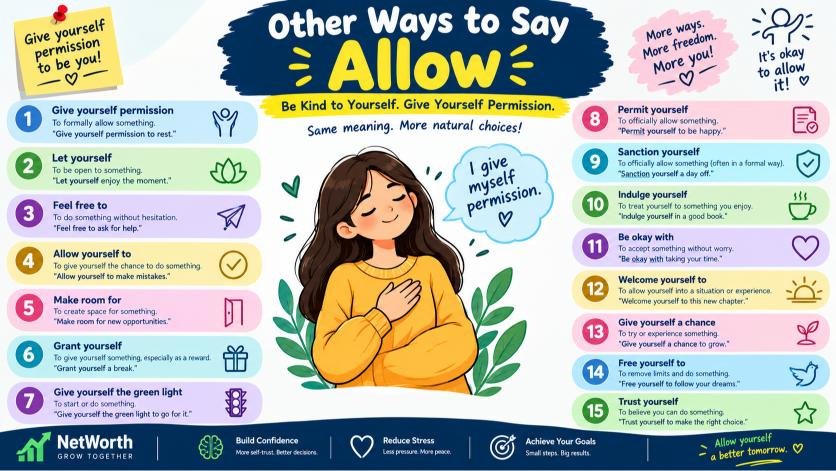
Are you looking for better ways to say “allow” without repeating the same word in every sentence? For you are writing an email, preparing an academic assignment, improving your vocabulary, or speaking in a professional setting, choosing the right alternative can make your English sound clearer and more natural. Words such as “permit,” “authorize,” “enable,” and “let” may appear similar to “allow,” but each has its own meaning, tone, and appropriate context. Using the right word can help you express permission, opportunity, or approval more precisely. Learning these alternatives is especially useful for English learners and professionals who want to communicate confidently in both formal and informal situations.
In this guide, you will discover 30 useful alternatives to “allow,” complete with meanings and example sentences to help you understand how each expression works in context. You will also learn which words are suitable for professional emails, academic writing, everyday conversations, and formal communication. Rather than treating every synonym as interchangeable, this guide highlights important differences in meaning and usage so you can choose the most appropriate expression for your needs. The examples focus on practical English usage, helping you expand your vocabulary and communicate with greater accuracy, clarity, and confidence
Quick Categories: Choose the Right Alternative
Formal alternatives to “allow”
- Permit: Give official or formal permission.
- Authorize: Grant someone the authority to do something.
- Grant permission: Explicitly approve a request.
- Give consent: Agree to something that requires your approval.
Pro Tip: Use authorize for official decisions and permit for rules, policies, or formal instructions.
Casual alternatives
- Let: Allow someone to do something.
- Give the go-ahead: Tell someone they can proceed.
- Be okay with: Accept something informally.
- Let someone: Give someone the freedom to act.
Pro Tip: Let sounds natural in everyday conversation, while give the go-ahead works well when a person is waiting for approval.
Professional alternatives
- Approve: Officially accept a request or proposal.
- Enable: Make an action or process possible.
- Grant access: Give someone permission to use a resource.
- Accommodate: Adjust to meet a request or need.
Pro Tip: Choose the word that describes the exact action. Approve means accepting a request, while enable means making something possible.
Informal expressions
- Go ahead: Proceed with an action.
- Give someone the green light: Approve a plan or activity.
- Make room for: Create space or opportunity.
- Let it happen: Avoid preventing an event or action.
Pro Tip: Informal expressions are useful in conversation, but use direct and specific wording in policies, contracts, and official emails.
“The best synonym is not simply a different word. It is the word that expresses your meaning most accurately.”
Common Mistakes When Using “Allow”
1. Using the wrong verb pattern. Allow is normally followed by an object and an infinitive with to. Example: Incorrect, “They allowed us enter.” Correct, “They allowed us to enter.”
2. Confusing allow with let. Let takes an object followed by the base verb without to. Example: Incorrect, “She let me to leave.” Correct, “She let me leave.”
3. Using authorize for every type of permission. It often suggests official authority. Example: “My friend authorized me to borrow her pen” sounds unnecessarily formal; “My friend let me borrow her pen” is more natural.
4. Confusing permission with ability. Enable often means making something possible rather than granting personal permission. Example: “The new software enables employees to collaborate remotely.”
5. Choosing an informal phrase for a formal document. Expressions such as give the green light may sound conversational. Example: In a policy, write “Management approved the request” rather than “Management gave the green light.”
What Does “Allow” Mean?
Allow is a verb meaning to give permission, refrain from preventing something, or make something possible.
It has several common grammatical patterns:
- Allow + someone + to + verb: “They allowed him to leave.”
- Allow + noun: “The rules allow exceptions.”
- Allow for + noun: “The budget allows for unexpected expenses.”
- Allow + something to happen: “The design allows air to circulate.”
The precise meaning depends on context. In “My manager allowed me to work remotely,” it means permission. In “The design allows more light into the room,” it means making something possible.
When to Use “Allow”
Choose alternatives according to your purpose and audience.
- Giving permission: Use permit, let, or give permission.
- Official approval: Use authorize, approve, or grant permission.
- Technology and systems: Use enable or provide access.
- Planning and scheduling: Use make provision for or leave room for.
- Personal decisions: Use let, agree to, or consent to when appropriate.
- Policies and regulations: Use permit, authorize, or be permitted to.
Spoken vs. written English
- Spoken: “You can go ahead,” “I’ll let you know,” and “That’s fine with me.”
- Written: “The policy permits employees to work remotely” and “Access has been authorized.”
Formal vs. informal English
- Formal: Permit, authorize, grant permission, give consent.
- Informal: Let, go ahead, be okay with, give the green light.
“Precision builds confidence: choose a synonym that matches the type of permission or possibility you mean.”
Is It Professional or Polite to Say “Allow”?
Yes. Allow is polite and professional in many situations. It is a neutral word, not inherently rude or overly casual. The important consideration is how the sentence is constructed and whether the speaker has the authority to grant permission.
Business-style example:
“The updated policy allows team members to request flexible working hours.”
- Polite? Yes.
- Professional? Yes, in most cases.
Compare “I’ll allow you to speak” with “Please feel free to share your perspective.” Both can communicate permission, but the second may sound more collaborative in a workplace discussion.
Pros and Cons of Using “Allow”
Pros
- Simple and natural: Easy to understand and use correctly.
- Friendly tone: Can communicate permission without sounding overly forceful.
- Common usage: Suitable for everyday and professional English.
- Easy to understand: Works in instructions, conversations, and policies.
Cons
- Too general for some contexts: May not specify whether permission, approval, or technical capability is meant.
- Potentially overused: Repeating allow can make writing less varied.
- Limited precision: It may not communicate formal authority as clearly as authorize.
- Not always the best formal wording: Some legal or technical contexts require a more specific term.
Other Ways to Say “Allow” With Examples
These alternatives will help you sound more fluent, confident, and natural in different situations.
Use them according to tone, context, and audience to express permission, possibility, agreement, or approval. The best choice depends on what you want to communicate.
1. Phrase: Permit
Meaning: To give someone permission to do something.
Explanation: Permit is more formal than let and commonly appears in rules and policies.
Example Sentence: “Visitors are permitted to use the library until 8 p.m.”
Best Use: Formal policies
Worst Use: Casual chatting
Tone: Formal, neutral, precise
Context Variability:
- Casual: “They let us stay.”
- Professional: “The policy permits remote work.”
- Spoken: “Are pets permitted here?”
2. Phrase: Let
Meaning: To allow someone to do something.
Explanation: Let is a common, natural alternative for everyday conversation.
Example Sentence: “My supervisor let me leave early.”
Best Use: Everyday conversation
Worst Use: Legal documents
Tone: Casual, direct, natural
Context Variability:
- Casual: “Let me try.”
- Professional: “Please let me know your decision.”
- Spoken: “Will they let us in?”
3. Phrase: Authorize
Meaning: To officially give permission or authority.
Explanation: Authorize is suitable when someone with appropriate authority approves an action.
Example Sentence: “The director authorized the purchase.”
Best Use: Official approval
Worst Use: Friendly chats
Tone: Formal, authoritative, precise
Context Variability:
- Casual: “The manager said it was okay.”
- Professional: “The director authorized the expenditure.”
- Spoken: “Who authorized this change?”
4. Phrase: Approve
Meaning: To officially accept or agree to a request or plan.
Explanation: Approve emphasizes a positive decision rather than permission in general.
Example Sentence: “The finance team approved our budget proposal.”
Best Use: Business decisions
Worst Use: Unrequested actions
Tone: Professional, decisive, neutral
Context Variability:
- Casual: “They said yes to the plan.”
- Professional: “The committee approved the proposal.”
- Spoken: “Has your manager approved it?”
5. Phrase: Give permission
Meaning: To explicitly allow someone to do something.
Explanation: This phrase clearly communicates that a person has granted permission.
Example Sentence: “My parents gave me permission to travel.”
Best Use: Clear instructions
Worst Use: Repetitive writing
Tone: Neutral, clear, courteous
Context Variability:
- Casual: “They said I could go.”
- Professional: “Please obtain permission before sharing the file.”
- Spoken: “Did she give you permission?”
6. Phrase: Grant permission
Meaning: To formally provide permission.
Explanation: This expression often appears in administrative, legal, or official contexts.
Example Sentence: “The organization granted permission to publish the photographs.”
Best Use: Official requests
Worst Use: Casual conversation
Tone: Formal, respectful, administrative
Context Variability:
- Casual: “They said it was okay.”
- Professional: “The department granted permission.”
- Spoken: “Has permission been granted?”
7. Phrase: Give consent
Meaning: To agree to something voluntarily.
Explanation: Give consent emphasizes a person’s agreement, particularly when their choice matters.
Example Sentence: “Participants must give consent before joining the study.”
Best Use: Informed agreement
Worst Use: Routine permissions
Tone: Formal, careful, respectful
Context Variability:
- Casual: “Are you happy for me to share it?”
- Professional: “Written consent is required.”
- Spoken: “Did everyone give consent?”
8. Phrase: Enable
Meaning: To make an action or outcome possible.
Explanation: Enable usually focuses on capability or opportunity rather than personal permission.
Example Sentence: “The new platform enables employees to collaborate remotely.”
Best Use: Technical writing
Worst Use: Simple permission
Tone: Professional, practical, precise
Context Variability:
- Casual: “This app lets me edit photos.”
- Professional: “The software enables secure collaboration.”
- Spoken: “This feature enables faster processing.”
9. Phrase: Facilitate
Meaning: To make an action or process easier.
Explanation: Facilitate is useful when a person or system supports progress without necessarily granting permission.
Example Sentence: “The new process facilitates communication between departments.”
Best Use: Process improvement
Worst Use: Direct permission
Tone: Formal, collaborative, professional
Context Variability:
- Casual: “This makes things easier.”
- Professional: “The framework facilitates coordination.”
- Spoken: “How can we facilitate the discussion?”
10. Phrase: Give the go-ahead
Meaning: To signal that an action may proceed.
Explanation: This conversational phrase usually indicates approval after a decision or review.
Example Sentence: “The client gave us the go-ahead to begin the project.”
Best Use: Project approval
Worst Use: Legal contracts
Tone: Friendly, confident, informal
Context Variability:
- Casual: “Go ahead!”
- Professional: “We received approval to proceed.”
- Spoken: “Has the client given us the go-ahead?”
11. Phrase: Give the green light
Meaning: To approve an action or plan.
Explanation: This idiom is common in business conversations and everyday speech.
Example Sentence: “Management gave the green light to launch the campaign.”
Best Use: Project launches
Worst Use: Formal regulations
Tone: Conversational, positive, confident
Context Variability:
- Casual: “They said we could start.”
- Professional: “The leadership team approved the launch.”
- Spoken: “Did we get the green light?”
12. Phrase: Accept
Meaning: To agree to receive or take something offered or proposed.
Explanation: Accept is appropriate when the focus is agreeing to a request, offer, or condition.
Example Sentence: “The landlord accepted our request to keep a pet.”
Best Use: Requests, offers
Worst Use: Technical capability
Tone: Neutral, clear, cooperative
Context Variability:
- Casual: “She said yes to it.”
- Professional: “We accept the revised terms.”
- Spoken: “Did they accept your request?”
13. Phrase: Agree to
Meaning: To say yes to a proposal, request, or arrangement.
Explanation: This phrase highlights agreement rather than the authority to grant permission.
Example Sentence: “The team agreed to extend the deadline.”
Best Use: Mutual decisions
Worst Use: One-sided authority
Tone: Cooperative, neutral, respectful
Context Variability:
- Casual: “He said he would do it.”
- Professional: “Both parties agreed to the revised schedule.”
- Spoken: “Would you agree to these terms?”
14. Phrase: Accommodate
Meaning: To adjust to meet someone’s needs or request.
Explanation: Accommodate often involves making a practical adjustment rather than simply giving permission.
Example Sentence: “We can accommodate your request for an earlier meeting.”
Best Use: Customer service
Worst Use: Legal authorization
Tone: Courteous, flexible, professional
Context Variability:
- Casual: “We can work around your schedule.”
- Professional: “We will accommodate reasonable requests.”
- Spoken: “Can we accommodate everyone?”
15. Phrase: Make provision for
Meaning: To prepare for or include the possibility of something.
Explanation: This formal phrase is useful when plans or policies account for a specific need or circumstance.
Example Sentence: “The budget makes provision for unexpected expenses.”
Best Use: Formal planning
Worst Use: Casual chatting
Tone: Formal, methodical, practical
Context Variability:
- Casual: “We saved some extra money.”
- Professional: “The plan makes provision for delays.”
- Spoken: “Have we made provision for extra staff?”
16. Phrase: Leave room for
Meaning: To preserve space, flexibility, or opportunity for something.
Explanation: This phrase is often figurative and does not necessarily mean granting permission.
Example Sentence: “The schedule leaves room for additional feedback.”
Best Use: Flexible planning
Worst Use: Official authorization
Tone: Flexible, thoughtful, neutral
Context Variability:
- Casual: “Let’s keep some time free.”
- Professional: “The timeline leaves room for revisions.”
- Spoken: “Can we leave room for questions?”
17. Phrase: Make possible
Meaning: To create the conditions needed for something to happen.
Explanation: This expression emphasizes the result or opportunity rather than formal permission.
Example Sentence: “Reliable internet access makes remote learning possible.”
Best Use: Explaining outcomes
Worst Use: Simple instructions
Tone: Clear, explanatory, neutral
Context Variability:
- Casual: “This lets us do more.”
- Professional: “The investment makes expansion possible.”
- Spoken: “What makes this possible?”
18. Phrase: Give access to
Meaning: To provide someone with the ability or permission to use something.
Explanation: This phrase is especially useful for files, systems, buildings, and restricted information.
Example Sentence: “The administrator gave the new employee access to the shared folder.”
Best Use: Digital resources
Worst Use: General agreement
Tone: Practical, professional, precise
Context Variability:
- Casual: “I shared the folder with you.”
- Professional: “Access has been granted to authorized personnel.”
- Spoken: “Can you give me access to the system?”
19. Phrase: Provide access to
Meaning: To make a resource available for someone to use.
Explanation: This slightly more formal phrase is common in technical and organizational writing.
Example Sentence: “The library provides access to thousands of digital resources.”
Best Use: Services, systems
Worst Use: Personal favors
Tone: Formal, informative, professional
Context Variability:
- Casual: “The app lets you read the files.”
- Professional: “The portal provides access to employee records.”
- Spoken: “Does this account provide access?”
20. Phrase: Authorize the use of
Meaning: To officially permit the use of something.
Explanation: This expression is useful for property, equipment, software, and other controlled resources.
Example Sentence: “The manager authorized the use of the conference room.”
Best Use: Resource control
Worst Use: Casual invitations
Tone: Formal, specific, authoritative
Context Variability:
- Casual: “She said we could use the room.”
- Professional: “The manager authorized the use of the equipment.”
- Spoken: “Who authorized the use of this device?”
21. Phrase: Sanction
Meaning: To formally approve or authorize an action.
Explanation: As a verb, sanction can mean approve, but the word also commonly means penalize, so context is essential.
Example Sentence: “The board sanctioned the proposed changes.”
Best Use: Official decisions
Worst Use: Everyday conversation
Tone: Formal, authoritative, institutional
Context Variability:
- Casual: “The board approved it.”
- Professional: “The committee sanctioned the expenditure.”
- Spoken: “Was the plan officially sanctioned?”
22. Phrase: Endorse
Meaning: To express support or approval for something.
Explanation: Endorse usually communicates backing or recommendation, not simply permission to act.
Example Sentence: “The department head endorsed the new training initiative.”
Best Use: Public support
Worst Use: Access requests
Tone: Professional, supportive, confident
Context Variability:
- Casual: “She supports the idea.”
- Professional: “The director endorsed the proposal.”
- Spoken: “Would you endorse this approach?”
23. Phrase: Give clearance
Meaning: To confirm that an action may proceed after the required checks.
Explanation: This expression often applies to security, safety, compliance, or official procedures.
Example Sentence: “The safety officer gave clearance to reopen the building.”
Best Use: Safety procedures
Worst Use: Everyday favors
Tone: Formal, procedural, authoritative
Context Variability:
- Casual: “They said it was safe to reopen.”
- Professional: “The site received safety clearance.”
- Spoken: “Have we received clearance?”
24. Phrase: Exempt
Meaning: To free someone or something from a rule or requirement.
Explanation: Exempt does not mean general permission; it means a particular rule or obligation does not apply.
Example Sentence: “The policy exempts small businesses from this requirement.”
Best Use: Rules, requirements
Worst Use: General invitations
Tone: Formal, precise, regulatory
Context Variability:
- Casual: “They don’t have to follow that rule.”
- Professional: “Eligible applicants are exempt from the fee.”
- Spoken: “Who is exempt from this requirement?”
25. Phrase: Tolerate
Meaning: To accept or endure something without trying to prevent it.
Explanation: Tolerate often implies that something is permitted despite being undesirable or difficult.
Example Sentence: “The organization will not tolerate harassment.”
Best Use: Conduct policies
Worst Use: Warm approval
Tone: Firm, neutral, sometimes disapproving
Context Variability:
- Casual: “I can put up with the noise.”
- Professional: “The policy does not tolerate discrimination.”
- Spoken: “How much disruption can we tolerate?”
26. Phrase: Accept the possibility of
Meaning: To recognize that something may happen.
Explanation: This phrase describes acknowledging a possibility rather than granting someone permission.
Example Sentence: “We must accept the possibility of a short delay.”
Best Use: Risk discussions
Worst Use: Permission requests
Tone: Reflective, cautious, analytical
Context Variability:
- Casual: “We might have to expect a delay.”
- Professional: “The plan accepts the possibility of schedule changes.”
- Spoken: “Can we accept the possibility that it may fail?”
27. Phrase: Make allowances for
Meaning: To consider a circumstance when making a decision or plan.
Explanation: This phrase means adjusting expectations to account for something, not necessarily giving permission.
Example Sentence: “The teacher made allowances for students who needed extra time.”
Best Use: Fair adjustments
Worst Use: Strict authorization
Tone: Considerate, measured, formal
Context Variability:
- Casual: “She gave them a little extra time.”
- Professional: “The policy makes allowances for exceptional circumstances.”
- Spoken: “Can we make allowances for the delay?”
28. Phrase: Open the door to
Meaning: To create an opportunity or possibility.
Explanation: This figurative phrase is useful when an action makes future developments possible.
Example Sentence: “The partnership opens the door to new markets.”
Best Use: New opportunities
Worst Use: Literal instructions
Tone: Optimistic, figurative, professional
Context Variability:
- Casual: “This could lead to new opportunities.”
- Professional: “The agreement opens the door to further collaboration.”
- Spoken: “Could this open the door to expansion?”
29. Phrase: Give someone free rein
Meaning: To allow someone considerable freedom to act or make decisions.
Explanation: This idiom suggests broad discretion rather than permission for just one specific action.
Example Sentence: “The director gave the design team free rein to develop the campaign.”
Best Use: Creative projects
Worst Use: Strict procedures
Tone: Trusting, informal, empowering
Context Variability:
- Casual: “She let us do it our way.”
- Professional: “The team was given considerable creative freedom.”
- Spoken: “Will you give me free rein?”
30. Phrase: Not stand in the way of
Meaning: To avoid preventing someone from doing something.
Explanation: This phrase emphasizes noninterference rather than direct approval.
Example Sentence: “I will not stand in the way of your career development.”
Best Use: Personal freedom
Worst Use: Formal instructions
Tone: Supportive, indirect, considerate
Context Variability:
- Casual: “I won’t stop you.”
- Professional: “We will not obstruct the team’s progress.”
- Spoken: “I don’t want to stand in your way.”
“Use permit for rules, authorize for official power, let for everyday speech, and enable for making something possible.”
Mini Quiz: Test Your Understanding
1. Which alternative is most suitable for official permission to purchase equipment?
Let
Authorize
Be okay with
2. Which sentence is grammatically correct?
They let us to leave.
They allowed us leave.
They allowed us to leave.
3. Which phrase means making a process easier?
Facilitate
Exempt
Tolerate
4. Your manager approves a project informally. Which phrase fits a team conversation?
Give the green light
Grant an exemption
Make provision for
0 of 4 answered
Try again
Comparison Table: Top 10 Alternatives to “Allow”
| Phrase | Tone | Best Use |
| Permit | Formal, neutral | Rules and policies |
| Let | Casual, natural | Everyday conversation |
| Authorize | Official, precise | Official decisions |
| Approve | Professional, neutral | Requests and proposals |
| Give permission | Clear, direct | Permission requests |
| Grant permission | Formal, administrative | Official approvals |
| Enable | Technical, practical | Systems and capabilities |
| Facilitate | Professional, collaborative | Processes and teamwork |
| Give the go-ahead | Informal, confident | Starting projects |
| Give the green light | Conversational, positive | Approving plans |
FAQs
1. What are the best synonyms for “allow”?
The most useful alternatives are permit, let, authorize, approve, and enable. Choose based on whether you mean giving permission, granting official authority, or making something possible.
2. What is a more formal word for “allow”?
Permit and authorize are strong formal alternatives. Use permit for rules and regulations, and authorize when someone with authority officially approves an action.
3. What is a casual way to say “allow”?
Let is the most natural casual alternative. For example, “My parents let me stay out late” sounds more conversational than “My parents permitted me to stay out late.”
4. What is the difference between “allow,” “permit,” and “authorize”?
Allow is a general term for permission or possibility. Permit is often more formal, while authorize specifically suggests granting official authority.
5. How can I use alternatives to “allow” in professional English?
Use approve for proposals, authorize for official decisions, grant access for resources, and enable for capabilities. These choices make professional writing more specific and precise.
See Also
- Other Ways to Say: Explore “Other Ways to Say Help” to expand your vocabulary for support, assistance, and cooperation.
- Professional English Guide: Learn how to write clear business emails and choose appropriate professional expressions for workplace communication.
Conclusion
Learning other ways to say allow helps you communicate permission, approval, flexibility, and possibility more accurately. Words such as permit, authorize, approve, and enable may appear similar, but each serves a different purpose. Understanding those differences improves your writing, makes workplace communication clearer, and helps you sound more natural in conversation.
Practise using one new alternative each day. Write a sentence, compare it with a real example, and consider whether the context is formal, casual, or professional. With regular practice, you will develop a more precise vocabulary and choose the right word with greater confidence.