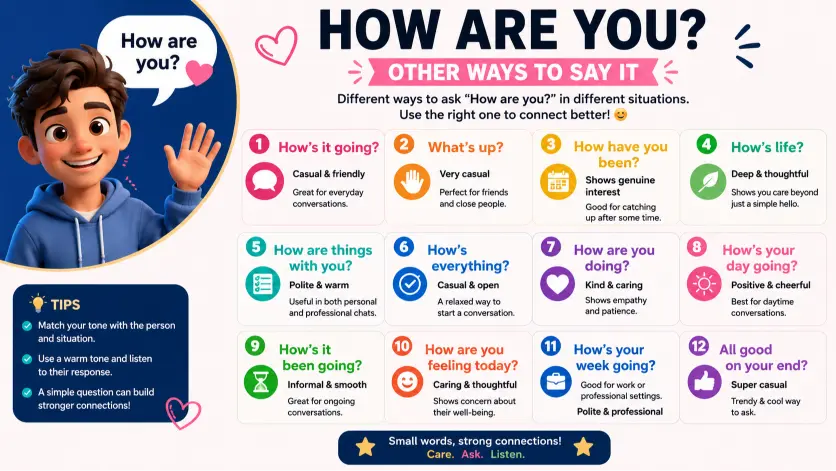
Ever feel like saying “How are you?” sounds a little too repetitive? You’re not alone. In everyday conversations, emails, workplace chats, and social interactions, choosing a fresh alternative can make your communication feel more natural and engaging. From casual questions like “How’s everything going?” to professional options such as “How have you been?” there are plenty of ways to check in with someone while matching the situation and relationship.
Knowing other ways to say “How are you?” can help English learners communicate with greater confidence, clarity, and social awareness. The right expression depends on context, tone, and how well you know the person. In this guide, you’ll discover practical alternatives with clear examples and usage guidance, making it easier to choose the right phrase for conversations, professional settings, texts, and friendly interactions. These expressions are designed around real-world English usage so you can communicate naturally without sounding forced or overly formal.
Quick Categories
Formal alternatives to “How are you?”
- How have you been?
- How are you doing today?
- How are things with you?
Pro Tip: Use these when speaking with people you do not know well or when you want to sound respectful without being overly formal.
Casual alternatives
- How’s everything going?
- What’s new with you?
- How’s life?
Pro Tip: These expressions work naturally with friends, classmates, neighbors, and familiar colleagues.
Professional alternatives
- How have things been going?
- How is everything progressing?
- How are things on your end?
Pro Tip: In professional settings, choose expressions that show interest without sounding overly personal.
Informal expressions
- What have you been up to?
- How’s it going?
- What’s happening?
Pro Tip: Reserve these informal expressions for relaxed conversations and people you already know.
“The best greeting is not always the most formal one. It is the one that fits your relationship and context.”
Common Mistakes
1. Using very casual expressions in formal situations
Mistake: “What’s happening?” when meeting a senior executive.
Better: “How have things been going?”
2. Asking a question without expecting an answer
Some expressions sound like simple greetings, but the listener may expect genuine interest.
Example: “How have you been?”
Be prepared to listen to the response.
3. Confusing “How are you?” with “What are you doing?”
“How are you?” asks about someone’s condition or well being.
Example: “How are you?” = asking about someone’s well being.
4. Using overly formal language with close friends
Mistake: “How are you feeling at this moment?”
Better: “How’s it going?”
5. Repeating the same greeting in every conversation
Constantly using one expression can make your English sound repetitive.
Example: Instead of always saying “How are you?”, try “How have you been?” when reconnecting with someone.
What Does “How Are You?” Mean?
“How are you?” is a standard English greeting used to ask about someone’s health, mood, feelings, or general well being.
Grammatically, how asks about a condition or state, while are is the present form of the verb to be used with you.
Example: “Hi, Sarah. How are you?”
The expression can be a genuine question or simply a polite social greeting, depending on the situation and relationship.
When to Use “How Are You?”
You can use “How are you?” in many everyday situations:
- When greeting someone for the first time that day
- When meeting a friend
- When starting a workplace conversation
- When speaking with a customer
- When reconnecting with someone
- During phone conversations
- In casual messages
- In some professional emails
Spoken vs. Written
Spoken: Very common and natural.
Written: Appropriate in casual messages and some professional communication, although alternatives can create a more specific tone.
Formal vs. Informal
The phrase itself is neutral and polite. Its level of formality depends heavily on the surrounding conversation and relationship.
Is It Professional or Polite to Say “How Are You?”
Polite? ✔️ Yes
Professional? ❌ No, in most cases
“How are you?” is certainly polite, but it is not especially professional or business specific. In professional communication, expressions such as “How have things been going?” or “How are things on your end?” may sound more purposeful.
Business example:
“Good morning, Mr. Ahmed. How have things been going with the new project?”
“Politeness makes a greeting pleasant; context makes it professional.”
Pros and Cons of Using “How Are You?”
Pros
- Simple and natural
- Friendly tone
- Common usage
- Easy to understand
Cons
- Too informal for some work situations
- Can become overused
- Has limited emotional range
- Not suitable for some formal writing
Other Ways to Say “How Are You?” With Examples
These alternatives will help you sound more fluent, confident, and natural in different situations.
Use them according to tone, context, and audience to express interest, warmth, enthusiasm, or approval.
1. Phrase: How have you been?
- Meaning: Asks about someone’s well being since you last saw them.
- Explanation: This is especially natural when reconnecting after some time apart.
- Example Sentence: “It’s great to see you again. How have you been?”
- Best Use: Reconnecting
- Worst Use: First introductions
- Tone: Warm, friendly, natural
- Context Variability: Casual, professional, spoken
2. Phrase: How are you doing?
- Meaning: Asks about someone’s current condition or well being.
- Explanation: It is one of the most natural alternatives in everyday English.
- Example Sentence: “Hi, Maria. How are you doing?”
- Best Use: Everyday greetings
- Worst Use: Formal letters
- Tone: Friendly, neutral, conversational
- Context Variability: Casual, professional, spoken
3. Phrase: How’s it going?
- Meaning: Asks how someone’s life or situation is progressing.
- Explanation: This is a relaxed expression commonly used in conversation.
- Example Sentence: “Hey, James. How’s it going?”
- Best Use: Friendly conversations
- Worst Use: Formal meetings
- Tone: Casual, relaxed, friendly
- Context Variability: Casual, informal, spoken
4. Phrase: How are things?
- Meaning: Asks generally about someone’s situation.
- Explanation: It is useful when you want a broad, natural greeting.
- Example Sentence: “It’s been a while. How are things?”
- Best Use: General check-ins
- Worst Use: Formal documents
- Tone: Neutral, friendly, natural
- Context Variability: Casual, professional, spoken
5. Phrase: How’s everything going?
- Meaning: Asks whether things are going well overall.
- Explanation: This expression communicates broader interest than a basic greeting.
- Example Sentence: “How’s everything going with your new job?”
- Best Use: Personal updates
- Worst Use: Formal reports
- Tone: Warm, conversational, interested
- Context Variability: Casual, professional, spoken
6. Phrase: How’s everything?
- Meaning: Asks about someone’s overall situation.
- Explanation: It is short and friendly while remaining easy to understand.
- Example Sentence: “Hi! How’s everything?”
- Best Use: Quick greetings
- Worst Use: Formal correspondence
- Tone: Friendly, simple, relaxed
- Context Variability: Casual, informal, spoken
7. Phrase: How have things been?
- Meaning: Asks how someone’s situation has been recently.
- Explanation: This works particularly well when you have not spoken recently.
- Example Sentence: “We haven’t talked in months. How have things been?”
- Best Use: Reconnecting
- Worst Use: Brief introductions
- Tone: Warm, thoughtful, natural
- Context Variability: Casual, professional, spoken
8. Phrase: How’s life?
- Meaning: Asks generally about someone’s life.
- Explanation: It is informal and usually used with people you know.
- Example Sentence: “It’s been ages. How’s life?”
- Best Use: Friends
- Worst Use: Client meetings
- Tone: Casual, friendly, relaxed
- Context Variability: Casual, informal, spoken
9. Phrase: What’s new with you?
- Meaning: Asks whether anything interesting or different has happened recently.
- Explanation: It encourages the other person to share an update.
- Example Sentence: “It’s been a few weeks. What’s new with you?”
- Best Use: Catching up
- Worst Use: Formal interviews
- Tone: Friendly, curious, conversational
- Context Variability: Casual, informal, spoken
10. Phrase: What have you been up to?
- Meaning: Asks what someone has been doing recently.
- Explanation: It is useful for starting a longer casual conversation.
- Example Sentence: “What have you been up to lately?”
- Best Use: Catching up
- Worst Use: Formal emails
- Tone: Informal, curious, friendly
- Context Variability: Casual, informal, spoken
“When reconnecting with someone, ‘How have you been?’ often feels more personal than a routine ‘How are you?’”
11. Phrase: How are things with you?
- Meaning: Asks about someone’s general circumstances.
- Explanation: This expression sounds considerate without being overly formal.
- Example Sentence: “I’m doing well. How are things with you?”
- Best Use: Personal check-ins
- Worst Use: Formal reports
- Tone: Warm, polite, conversational
- Context Variability: Casual, professional, spoken
12. Phrase: How is everything going on your end?
- Meaning: Asks about someone’s situation or responsibilities.
- Explanation: It is especially useful when discussing shared work or projects.
- Example Sentence: “How is everything going on your end with the campaign?”
- Best Use: Work updates
- Worst Use: Personal greetings
- Tone: Professional, friendly, practical
- Context Variability: Professional, casual, spoken
13. Phrase: How have things been going?
- Meaning: Asks about recent progress or circumstances.
- Explanation: It works well when you want a more thoughtful professional reaction phrase.
- Example Sentence: “How have things been going since our last meeting?”
- Best Use: Work check-ins
- Worst Use: Casual texting
- Tone: Professional, warm, respectful
- Context Variability: Professional, spoken, written
14. Phrase: How is everything progressing?
- Meaning: Asks about progress toward a goal.
- Explanation: This is more appropriate for projects and professional situations.
- Example Sentence: “How is everything progressing with the implementation?”
- Best Use: Project updates
- Worst Use: Friend greetings
- Tone: Formal, professional, focused
- Context Variability: Professional, spoken, written
15. Phrase: How are things on your end?
- Meaning: Asks about someone’s current situation.
- Explanation: This is particularly useful when coordinating work remotely.
- Example Sentence: “How are things on your end with the client?”
- Best Use: Workplace communication
- Worst Use: Formal applications
- Tone: Professional, neutral, collaborative
- Context Variability: Professional, spoken, written
16. Phrase: How’s your day going?
- Meaning: Asks how someone’s current day is progressing.
- Explanation: It is natural when speaking with someone during the day.
- Example Sentence: “Good afternoon. How’s your day going?”
- Best Use: Daily conversations
- Worst Use: Formal documents
- Tone: Friendly, warm, conversational
- Context Variability: Casual, professional, spoken
17. Phrase: How’s your week going?
- Meaning: Asks about someone’s experience during the current week.
- Explanation: It is a natural conversation starter at work or socially.
- Example Sentence: “How’s your week going so far?”
- Best Use: Weekly check-ins
- Worst Use: Formal letters
- Tone: Friendly, casual, natural
- Context Variability: Casual, professional, spoken
18. Phrase: How are you feeling?
- Meaning: Asks specifically about someone’s physical or emotional condition.
- Explanation: Use it when you have a genuine reason to ask about someone’s feelings or health.
- Example Sentence: “You seemed tired yesterday. How are you feeling today?”
- Best Use: Genuine concern
- Worst Use: Routine business
- Tone: Caring, personal, concerned
- Context Variability: Casual, personal, spoken
19. Phrase: How’s your day been?
- Meaning: Asks how someone’s day has gone so far.
- Explanation: It works particularly well later in the day.
- Example Sentence: “You’ve had a busy day. How’s your day been?”
- Best Use: Personal check-ins
- Worst Use: Formal writing
- Tone: Warm, conversational, caring
- Context Variability: Casual, informal, spoken
20. Phrase: How are you holding up?
- Meaning: Asks how someone is coping with a difficult situation.
- Explanation: This should be used when there is a reason to believe someone is experiencing difficulty.
- Example Sentence: “I know this has been stressful. How are you holding up?”
- Best Use: Difficult situations
- Worst Use: Routine greetings
- Tone: Supportive, caring, empathetic
- Context Variability: Casual, personal, spoken
21. Phrase: How’s everything been?
- Meaning: Asks about someone’s recent overall experience.
- Explanation: It is useful when catching up after a period of separation.
- Example Sentence: “We haven’t spoken lately. How’s everything been?”
- Best Use: Catching up
- Worst Use: Formal introductions
- Tone: Friendly, warm, natural
- Context Variability: Casual, informal, spoken
22. Phrase: How are things going for you?
- Meaning: Asks how someone’s life or circumstances are progressing.
- Explanation: It sounds slightly more personal than simply asking “How are things?”
- Example Sentence: “How are things going for you in your new role?”
- Best Use: Personal updates
- Worst Use: Formal reports
- Tone: Supportive, friendly, thoughtful
- Context Variability: Casual, professional, spoken
23. Phrase: How’s your morning going?
- Meaning: Asks how someone’s morning is progressing.
- Explanation: It is a natural greeting earlier in the day.
- Example Sentence: “Good morning! How’s your morning going?”
- Best Use: Morning greetings
- Worst Use: Evening meetings
- Tone: Friendly, warm, casual
- Context Variability: Casual, professional, spoken
24. Phrase: How’s your evening going?
- Meaning: Asks how someone’s evening is progressing.
- Explanation: Use it naturally during evening social interactions.
- Example Sentence: “Hi! How’s your evening going?”
- Best Use: Evening conversations
- Worst Use: Morning meetings
- Tone: Relaxed, friendly, conversational
- Context Variability: Casual, informal, spoken
25. Phrase: How have you been doing?
- Meaning: Asks about someone’s recent well being.
- Explanation: It is especially natural when reconnecting after some time.
- Example Sentence: “It’s wonderful to see you again. How have you been doing?”
- Best Use: Reconnecting
- Worst Use: Formal documents
- Tone: Warm, caring, natural
- Context Variability: Casual, professional, spoken
26. Phrase: How are things looking?
- Meaning: Asks about the expected condition or progress of a situation.
- Explanation: This is particularly useful when discussing plans, schedules, or projects.
- Example Sentence: “How are things looking for next week?”
- Best Use: Planning discussions
- Worst Use: Personal greetings
- Tone: Professional, practical, neutral
- Context Variability: Professional, spoken, written
27. Phrase: How is everything going with you?
- Meaning: Asks about someone’s overall circumstances.
- Explanation: It combines a friendly greeting with genuine interest.
- Example Sentence: “It’s been a while. How is everything going with you?”
- Best Use: Personal check-ins
- Worst Use: Formal reports
- Tone: Warm, friendly, interested
- Context Variability: Casual, professional, spoken
28. Phrase: How’s everything been going for you?
- Meaning: Asks about someone’s recent experiences.
- Explanation: This is useful for a more personal catch-up conversation.
- Example Sentence: “How’s everything been going for you since graduation?”
- Best Use: Personal catch-ups
- Worst Use: Formal meetings
- Tone: Friendly, thoughtful, conversational
- Context Variability: Casual, informal, spoken
29. Phrase: How have things been on your side?
- Meaning: Asks about someone’s situation or progress.
- Explanation: It works especially well when two people are working on related tasks.
- Example Sentence: “How have things been on your side since our last call?”
- Best Use: Work follow-ups
- Worst Use: Formal letters
- Tone: Professional, collaborative, neutral
- Context Variability: Professional, spoken, written
30. Phrase: How are you today?
- Meaning: Asks about someone’s current well being.
- Explanation: Adding “today” makes the question feel slightly more immediate and attentive.
- Example Sentence: “Good morning, everyone. How are you today?”
- Best Use: Daily greetings
- Worst Use: Formal reports
- Tone: Polite, friendly, neutral
- Context Variability: Casual, professional, spoken
“Choose your greeting based on the relationship, setting, and purpose of the conversation.”
Mini Quiz: Test Yourself
1. You meet a colleague after several months. Which sounds most natural?
A. How’s it going?
B. How have you been?
C. What’s happening?
Answer: B
2. Which expression is best for a project update?
A. How’s life?
B. What have you been up to?
C. How is everything progressing?
Answer: C
3. Your friend has experienced a difficult week. Which question shows appropriate concern?
A. How are you holding up?
B. How’s your morning going?
C. What’s new with you?
Answer: A
4. Which phrase is generally the safest neutral greeting?
A. How are you?
B. What’s happening?
C. How’s life?
Answer: A
Comparison Table: Top Alternatives
| Phrase | Tone | Best Use |
| How have you been? | Warm, friendly | Reconnecting |
| How are you doing? | Neutral, friendly | Everyday greetings |
| How’s it going? | Casual, relaxed | Friends and colleagues |
| How are things? | Neutral, natural | General check-ins |
| How’s everything going? | Warm, conversational | Personal updates |
| How have things been? | Thoughtful, friendly | Catching up |
| How are things on your end? | Professional, neutral | Workplace communication |
| How is everything progressing? | Formal, professional | Project discussions |
| How’s your day going? | Friendly, warm | Daily conversations |
| How are you holding up? | Caring, supportive | Difficult situations |
See Also
For more useful English alternatives, explore our guide on Other Ways to Say “Pardon” to learn polite ways to ask someone to repeat themselves.
You can also explore a Professional English guide for practical expressions that help you communicate clearly and confidently in workplace situations.
FAQs
1. What are the best alternatives to “How are you?”
Some of the most natural options are “How have you been?”, “How are you doing?”, “How are things?”, and “How’s everything going?”
2. How do professionals say “How are you?”
In professional settings, you can say “How have things been going?”, “How are things on your end?”, or “How is everything progressing?”
3. What is a casual way to say “How are you?”
“How’s it going?”, “How’s life?”, and “What have you been up to?” are natural informal expressions in English.
4. Is “How are you?” Grammatically correct?
Yes. “How are you?” is a grammatically correct and extremely common English greeting used to ask about someone’s general well being.
5. Should I use different alternatives in professional English?
Yes. Varying your expressions can make your communication sound more natural. Choose professional reaction phrases according to the relationship, purpose, and level of formality.
Conclusion
Learning different ways to ask “How are you?” gives English learners greater flexibility and confidence. Instead of relying on one familiar expression, you can choose a greeting that matches the situation, from friendly catch-ups to professional conversations. Understanding tone also helps you distinguish everyday greetings from informal expressions in English and workplace language.
The best way to improve is through regular practice. Try replacing the same greeting with a different alternative each day, paying attention to how native speakers use it in conversations, emails, and professional settings. With consistent practice, these expressions will become natural parts of your active vocabulary.









