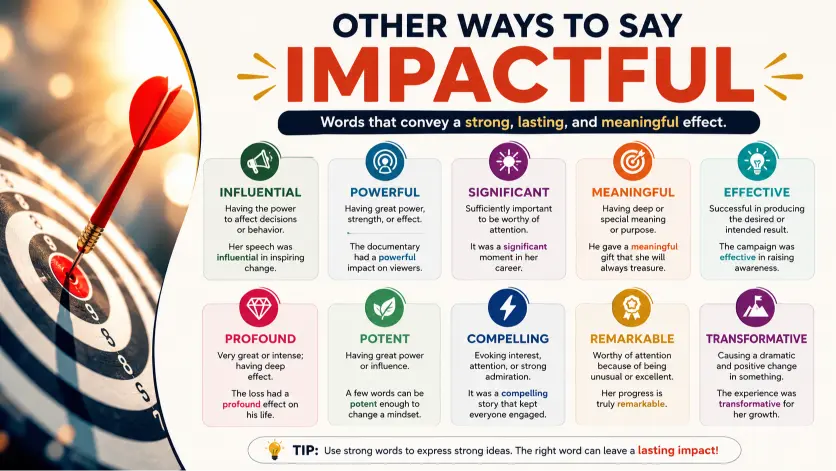
Words have the power to shape how your message is understood, and “impactful” is one of those versatile words that can sometimes feel overused. For you are writing a professional email, preparing an academic essay, creating a presentation, or improving your everyday English, choosing a more precise alternative can make your communication clearer and more memorable. Finding the right synonym also helps you express exactly what you mean, from something powerful and influential to something meaningful, effective, or significant.
In this guide, you will discover practical other ways to say impactful, along with examples and context to help you choose the best expression. Each alternative is explained in simple, learner-friendly English so you can understand when it fits formal, professional, academic, or casual communication. Drawing on established English usage and practical communication principles, this list is designed to help intermediate and advanced English learners expand their vocabulary while helping professionals write with greater clarity, confidence, and precision
Quick Categories
Formal alternatives to “impactful”
- Significant
- Influential
- Consequential
- Far-reaching
These words work particularly well in academic, analytical, and formal writing.
Pro Tip: Use “significant” for importance and “influential” when something changes opinions, behavior, or decisions.
Casual alternatives
- Powerful
- Moving
- Memorable
- Striking
These options are natural when discussing experiences, conversations, stories, or personal reactions.
Pro Tip: In casual conversation, “powerful” and “memorable” usually sound more natural than “impactful.”
Professional alternatives
- Effective
- Compelling
- Persuasive
- Influential
These are useful for presentations, reports, campaigns, leadership communication, and business discussions.
Pro Tip: Choose “effective” when something produces results and “persuasive” when it successfully changes someone’s opinion.
Informal expressions
- Really powerful
- Made a big difference
- Left a lasting impression
- Really stood out
These expressions are useful in conversations, emails with a friendly tone, and personal discussions.
Pro Tip: Informal expressions in English often sound more natural when you describe the actual effect instead of using a single adjective.
Precision creates stronger communication than repetition.
Common Mistakes When Using “Impactful”
1. Using “impactful” when you mean “important”
Mistake: The meeting was impactful because it was scheduled for Monday.
Better: The meeting was important because it concerned the company’s future.
“Impactful” suggests an effect or influence, not simply importance.
2. Using it repeatedly
Mistake: The impactful speech included impactful ideas and an impactful conclusion.
Better: The powerful speech included thought-provoking ideas and a memorable conclusion.
Using synonyms improves variety and precision.
3. Choosing a synonym that changes the meaning
Mistake: The report was influential.
If the report was well written but did not influence anyone, “influential” may be inaccurate.
Better: The report was effective and well researched.
4. Using highly formal vocabulary in casual conversation
Mistake: That movie was highly consequential.
Better: That movie was really powerful.
“Consequential” sounds formal and analytical.
5. Using “impactful” when a more specific word is available
Mistake: She gave an impactful presentation.
Better: She gave a persuasive presentation that convinced the investors to approve the proposal.
Specific vocabulary communicates more information.
What Does “Impactful” Mean?
Impactful means having a strong effect, influence, or impression on someone or something.
It is an adjective formed from the noun “impact” and is commonly used to describe communication, actions, experiences, ideas, decisions, or events.
Example:
Her presentation was impactful and changed the team’s approach to customer service.
Grammar
“Impactful” is an adjective.
Common patterns include:
- an impactful speech
- an impactful decision
- an impactful campaign
- an impactful experience
- an impactful message
Although “impactful” is widely used in modern English, some formal writers prefer more precise alternatives such as effective, influential, significant, or far-reaching.
When to Use “Impactful”
You can use “impactful” when describing something that:
- Creates a noticeable effect
- Changes someone’s thinking
- Influences behavior
- Produces meaningful results
- Leaves a strong impression
- Communicates an important message
- Creates emotional or social change
- Makes a presentation memorable
Spoken vs. Written
Spoken English:
“Her story was really impactful.”
Written English:
“Her research had a significant impact on public policy.”
Formal vs. Informal
Formal:
“The initiative had far-reaching consequences.”
Informal:
“That conversation really made a difference.”
Context determines whether a word sounds natural, polished, or unnecessarily formal.
Is It Professional or Polite to Say “Impactful”?
Polite? ✔️ Yes
Professional? ❌ No, in most cases
“Impactful” is not rude or impolite. However, in formal professional writing, a more precise word may communicate your meaning better.
For example, instead of:
“The training program was impactful.”
A business report could say:
“The training program significantly improved employee productivity.”
The second version explains the actual result and sounds more precise.
Pros and Cons of Using “Impactful”
Pros
- Simple and natural: Easy for most English speakers to understand.
- Friendly tone: Works well in general conversation.
- Common usage: Frequently appears in modern business and everyday English.
- Easy to understand: Clearly suggests that something created an effect.
Cons
- Too informal for some work contexts: Formal writing may benefit from greater precision.
- Overused: Repetition can make writing sound generic.
- Limited emotional range: It does not explain what kind of effect occurred.
- Not suitable for all formal writing: Academic or analytical writing may require a more specific term.
Other Ways to Say “Impactful” With Examples
These other ways to say impactful will help you sound more fluent, confident, and natural in different situations.
Use them according to tone, context, and audience to express excitement, admiration, or approval.
1. Phrase: Influential
- Meaning: Having the power to change opinions, behavior, or decisions.
- Explanation: Use “influential” when something or someone actively affects others.
- Example Sentence: Her research was influential in shaping the company’s new strategy.
- Best Use: Professional communication
- Worst Use: Simple importance
- Tone: Formal, authoritative, precise
- Context Variability: Professional, academic, written
2. Phrase: Powerful
- Meaning: Having a strong emotional, intellectual, or practical effect.
- Explanation: “Powerful” is one of the most flexible alternatives to “impactful.”
- Example Sentence: His speech delivered a powerful message about leadership.
- Best Use: Speeches and stories
- Worst Use: Technical analysis
- Tone: Strong, emotional, versatile
- Context Variability: Casual, professional, spoken
3. Phrase: Effective
- Meaning: Producing the intended result.
- Explanation: Use “effective” when something successfully accomplishes its purpose.
- Example Sentence: The campaign was highly effective at increasing brand awareness.
- Best Use: Business results
- Worst Use: Emotional reactions
- Tone: Professional, practical, objective
- Context Variability: Professional, academic, written
4. Phrase: Significant
- Meaning: Important enough to have a noticeable effect.
- Explanation: “Significant” emphasizes importance and measurable influence.
- Example Sentence: The policy created significant improvements in workplace safety.
- Best Use: Formal writing
- Worst Use: Casual reactions
- Tone: Formal, objective, analytical
- Context Variability: Professional, academic, written
5. Phrase: Meaningful
- Meaning: Having value, importance, or emotional significance.
- Explanation: Use “meaningful” when the effect matters personally or socially.
- Example Sentence: Her feedback led to a meaningful improvement in the team’s communication.
- Best Use: Personal impact
- Worst Use: Pure statistics
- Tone: Warm, thoughtful, positive
- Context Variability: Casual, professional, spoken
6. Phrase: Compelling
- Meaning: Extremely convincing or interesting.
- Explanation: “Compelling” works especially well for arguments, presentations, evidence, and stories.
- Example Sentence: He presented a compelling argument for investing in renewable energy.
- Best Use: Arguments and ideas
- Worst Use: Simple events
- Tone: Professional, persuasive, confident
- Context Variability: Professional, academic, written
7. Phrase: Memorable
- Meaning: Easy to remember because it made a strong impression.
- Explanation: Use it when something stays in someone’s memory.
- Example Sentence: The speaker gave a memorable presentation that everyone discussed afterward.
- Best Use: Experiences and events
- Worst Use: Financial results
- Tone: Positive, conversational, expressive
- Context Variability: Casual, professional, spoken
8. Phrase: Thought-provoking
- Meaning: Making someone think deeply about an issue.
- Explanation: This phrase is ideal for ideas, questions, books, films, and discussions.
- Example Sentence: The documentary offered a thought-provoking perspective on climate change.
- Best Use: Ideas and media
- Worst Use: Routine tasks
- Tone: Intellectual, reflective, sophisticated
- Context Variability: Professional, academic, written
9. Phrase: Persuasive
- Meaning: Successful at convincing someone to accept an idea.
- Explanation: Use “persuasive” when the main effect involves changing someone’s opinion.
- Example Sentence: She delivered a persuasive presentation to the investors.
- Best Use: Business presentations
- Worst Use: Emotional memories
- Tone: Professional, confident, strategic
- Context Variability: Professional, academic, spoken
10. Phrase: Striking
- Meaning: Immediately noticeable or impressive.
- Explanation: “Striking” highlights how strongly something catches attention.
- Example Sentence: The report contains several striking findings about customer behavior.
- Best Use: Noticeable results
- Worst Use: Routine information
- Tone: Elegant, vivid, descriptive
- Context Variability: Professional, casual, written
When you know the exact effect, choose the synonym that describes that effect.
11. Phrase: Consequential
- Meaning: Producing important results or consequences.
- Explanation: This formal adjective is useful when an action has serious results.
- Example Sentence: The decision was consequential for the company’s long-term growth.
- Best Use: Formal analysis
- Worst Use: Casual conversation
- Tone: Formal, serious, analytical
- Context Variability: Professional, academic, written
12. Phrase: Far-reaching
- Meaning: Affecting many people, areas, or situations.
- Explanation: Use it for effects that extend beyond the immediate situation.
- Example Sentence: The new legislation could have far-reaching effects on small businesses.
- Best Use: Large-scale effects
- Worst Use: Personal moments
- Tone: Formal, serious, expansive
- Context Variability: Professional, academic, written
13. Phrase: Transformative
- Meaning: Causing a major and lasting change.
- Explanation: “Transformative” is stronger than simply saying something had an effect.
- Example Sentence: The leadership program was a transformative experience for many employees.
- Best Use: Major change
- Worst Use: Minor effects
- Tone: Positive, powerful, professional
- Context Variability: Professional, personal, written
14. Phrase: Influential and Effective
- Meaning: Both capable of influencing people and producing results.
- Explanation: This combination is useful when describing successful ideas or leaders.
- Example Sentence: She became an influential and effective leader within the organization.
- Best Use: Leadership descriptions
- Worst Use: Simple events
- Tone: Professional, positive, authoritative
- Context Variability: Professional, written, spoken
15. Phrase: Eye-opening
- Meaning: Giving someone a new or unexpected understanding.
- Explanation: It is useful when an experience changes how someone sees an issue.
- Example Sentence: The workshop was an eye-opening experience for the new employees.
- Best Use: New insights
- Worst Use: Formal reports
- Tone: Conversational, reflective, engaging
- Context Variability: Casual, spoken, informal
16. Phrase: Moving
- Meaning: Creating strong emotional feelings.
- Explanation: Use “moving” for speeches, stories, performances, or personal experiences.
- Example Sentence: Her farewell speech was deeply moving.
- Best Use: Emotional moments
- Worst Use: Business metrics
- Tone: Emotional, warm, sincere
- Context Variability: Casual, spoken, written
17. Phrase: Impressive
- Meaning: Causing admiration because of quality, ability, or achievement.
- Explanation: “Impressive” focuses on admiration rather than measurable influence.
- Example Sentence: The team achieved impressive results in its first quarter.
- Best Use: Achievements
- Worst Use: Emotional experiences
- Tone: Positive, friendly, complimentary
- Context Variability: Casual, professional, spoken
18. Phrase: Remarkable
- Meaning: Unusually notable or worthy of attention.
- Explanation: Use it when something stands out because of its exceptional quality.
- Example Sentence: The project achieved remarkable growth within six months.
- Best Use: Exceptional results
- Worst Use: Ordinary situations
- Tone: Positive, polished, enthusiastic
- Context Variability: Professional, casual, written
19. Phrase: Influencing
- Meaning: Affecting how someone thinks, feels, or behaves.
- Explanation: This form focuses directly on the process of creating influence.
- Example Sentence: Social media is increasingly influential in shaping consumer behavior.
- Best Use: Social trends
- Worst Use: Simple descriptions
- Tone: Analytical, professional, modern
- Context Variability: Professional, academic, written
20. Phrase: Attention-grabbing
- Meaning: Quickly attracting someone’s attention.
- Explanation: Use it when the main effect is capturing interest.
- Example Sentence: The campaign uses an attention-grabbing headline.
- Best Use: Marketing content
- Worst Use: Academic analysis
- Tone: Energetic, modern, conversational
- Context Variability: Casual, professional, written
21. Phrase: Resonant
- Meaning: Creating a strong emotional or intellectual connection.
- Explanation: “Resonant” is useful when a message connects deeply with an audience.
- Example Sentence: The campaign delivered a resonant message about community.
- Best Use: Brand messaging
- Worst Use: Basic conversation
- Tone: Sophisticated, emotional, polished
- Context Variability: Professional, creative, written
22. Phrase: Impactful in Practice
- Meaning: Producing meaningful results when applied.
- Explanation: This phrase emphasizes real-world effectiveness.
- Example Sentence: The new strategy has been impactful in practice, especially for smaller teams.
- Best Use: Practical results
- Worst Use: Simple opinions
- Tone: Professional, analytical, practical
- Context Variability: Professional, spoken, written
23. Phrase: Highly Effective
- Meaning: Producing very strong or successful results.
- Explanation: This is a precise professional alternative when measurable outcomes matter.
- Example Sentence: The new training method has been highly effective.
- Best Use: Business outcomes
- Worst Use: Emotional stories
- Tone: Formal, objective, confident
- Context Variability: Professional, academic, written
24. Phrase: Lasting
- Meaning: Continuing for a long time.
- Explanation: Use “lasting” when something continues to affect people or situations.
- Example Sentence: The mentorship program had a lasting effect on her career.
- Best Use: Long-term effects
- Worst Use: Immediate reactions
- Tone: Positive, thoughtful, polished
- Context Variability: Professional, personal, written
25. Phrase: Influential in Shaping
- Meaning: Playing an important role in developing something.
- Explanation: This phrase clearly explains how influence contributed to an outcome.
- Example Sentence: Her research was influential in shaping modern teaching methods.
- Best Use: Academic influence
- Worst Use: Casual remarks
- Tone: Formal, academic, precise
- Context Variability: Academic, professional, written
26. Phrase: Made a Difference
- Meaning: Produced a positive or noticeable change.
- Explanation: This natural expression is excellent for everyday conversation.
- Example Sentence: Your advice really made a difference during my first week at work.
- Best Use: Everyday conversation
- Worst Use: Formal reports
- Tone: Friendly, natural, conversational
- Context Variability: Casual, spoken, informal
27. Phrase: Left a Lasting Impression
- Meaning: Continued to be remembered after an experience.
- Explanation: Use this phrase for people, speeches, events, and experiences.
- Example Sentence: Her presentation left a lasting impression on the audience.
- Best Use: Strong memories
- Worst Use: Technical results
- Tone: Warm, polished, expressive
- Context Variability: Casual, professional, spoken
28. Phrase: Stood Out
- Meaning: Was more noticeable or impressive than others.
- Explanation: “Stood out” is a natural conversational alternative.
- Example Sentence: Your presentation really stood out from the others.
- Best Use: Informal feedback
- Worst Use: Academic analysis
- Tone: Casual, positive, natural
- Context Variability: Casual, spoken, informal
29. Phrase: Highly Significant
- Meaning: Extremely important or consequential.
- Explanation: This phrase is useful when discussing serious findings, events, or decisions.
- Example Sentence: The study produced highly significant findings for the medical research team.
- Best Use: Formal analysis
- Worst Use: Casual conversation
- Tone: Formal, analytical, authoritative
- Context Variability: Academic, professional, written
30. Phrase: Truly Powerful
- Meaning: Creating a particularly strong effect or emotional response.
- Explanation: This expressive phrase works well when emphasizing a strong reaction.
- Example Sentence: Her story was truly powerful and encouraged others to share their experiences.
- Best Use: Emotional impact
- Worst Use: Statistical reports
- Tone: Emotional, emphatic, sincere
- Context Variability: Casual, spoken, creative
Strong English is not about using complicated words. It is about choosing the most accurate word for the situation.
Professional Reaction Phrases
If you need professional reaction phrases, consider these options:
- That was highly effective.
- The presentation was particularly compelling.
- The findings are highly significant.
- The message was clear and persuasive.
- The initiative produced meaningful results.
- The research offers valuable insights.
- The strategy had a measurable effect.
- The proposal could have far-reaching implications.
These phrases are especially useful in meetings, presentations, reports, performance reviews, and workplace discussions.
Informal Expressions in English
For everyday communication, you can replace “impactful” with more natural expressions such as:
- It really made a difference.
- That really stood out.
- It left a lasting impression.
- That was really powerful.
- It changed the way I think about it.
- That really got me thinking.
- It meant a lot to me.
- That was an eye-opening experience.
These expressions often sound more conversational than formal vocabulary.
See Also
- See also: Other Ways to Say “How Are You?” for natural alternatives in everyday conversations.
- See also: Professional English Guide: Better Words for Workplace Communication for more precise vocabulary in professional settings.
Mini Quiz: Test Your Understanding
1. Which phrase is best for a formal report about a major effect?
A. Really cool
B. Made a big difference
C. Far-reaching
D. Stood out
Answer: C. Far-reaching
2. Which option best describes a presentation that successfully convinces investors?
A. Persuasive
B. Moving
C. Memorable
D. Casual
Answer: A. Persuasive
3. You are talking with a friend about an emotional movie. Which sounds most natural?
A. The movie was consequential.
B. The movie had far-reaching implications.
C. The movie was really moving.
D. The movie was highly significant.
Answer: C. The movie was really moving.
4. Which phrase means that something continues to affect you?
A. Lasting
B. Routine
C. Temporary
D. Ordinary
Answer: A. Lasting
Comparison Table: Top Alternatives
| Phrase | Tone | Best Use |
| Influential | Formal | Ideas and leadership |
| Powerful | Versatile | Speeches and emotions |
| Effective | Professional | Results and strategies |
| Significant | Formal | Research and importance |
| Meaningful | Warm | Personal experiences |
| Compelling | Professional | Arguments and presentations |
| Memorable | Conversational | Events and experiences |
| Persuasive | Professional | Business communication |
| Thought-provoking | Intellectual | Ideas and discussions |
| Far-reaching | Formal | Large-scale effects |
FAQs
1. What are the best alternatives to “impactful”?
Some of the strongest alternatives are influential, powerful, effective, significant, meaningful, compelling, memorable, persuasive, and far-reaching. The best choice depends on the context.
2. What is a professional way to say “impactful”?
In professional English, effective, influential, significant, compelling, or far-reaching are often better choices because they communicate a more specific meaning.
3. Is “impactful” correct English?
Yes. “Impactful” is widely used in modern English as an adjective meaning capable of producing a strong effect or influence. However, some writers prefer more precise alternatives.
4. What is a formal word for “impactful”?
Depending on the intended meaning, significant, consequential, influential, far-reaching, or transformative can work well in formal writing.
5. How can I avoid repeating “impactful”?
Identify the exact effect you want to describe. Use persuasive for convincing communication, memorable for strong memories, effective for successful results, and influential for changes in opinions or behavior.
Conclusion
Learning other ways to say something impactful gives you greater control over your English. Instead of relying on one general adjective, you can choose words such as “effective,” “influential,” “meaningful,” “persuasive,” or “transformative” to communicate the exact effect you mean. This makes your writing more precise and your spoken English more natural.
Practice these alternatives in everyday conversations, workplace emails, presentations, and academic writing. Most importantly, pay attention to tone. A casual expression such as “made a difference” may be perfect in conversation, while “significant” or “far-reaching” may be better for formal writing. Strong English comes from knowing not only what a word means, but also when to use it.









