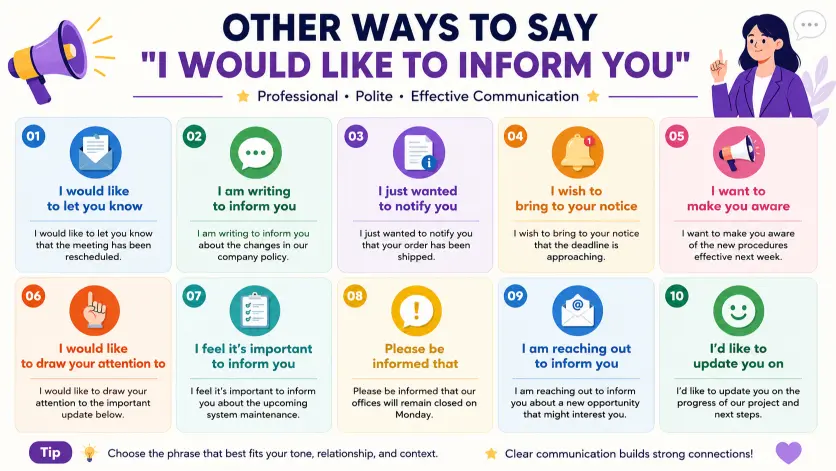
Need a more natural and professional way to share important information? The phrase “I would like to inform you” is grammatically correct, but using the same expression repeatedly can make emails, workplace messages, and formal communication sound repetitive. Fortunately, English offers many polished alternatives that can help you communicate the same idea with greater clarity, confidence, and purpose.
In this guide, you’ll discover practical alternatives to “I would like to inform you” for emails, business communication, announcements, and everyday professional situations. Each expression is selected with context, tone, and natural English usage in mind, so you can choose the right phrase instead of simply replacing words mechanically. Whether you need a formal expression for a client, a polite workplace phrase, or a concise option for an email, these alternatives will help you communicate information professionally and naturally.
Quick Categories
Formal alternatives to “I would like to inform you”
- Please be informed
- I am writing to inform you
- I wish to inform you
- I would like to notify you
These expressions work well in official correspondence, formal notices, administrative communication, and business writing.
Pro Tip: Use formal expressions when clarity and authority matter, but avoid making a simple message sound unnecessarily complicated.
Casual alternatives
- I want to let you know
- Just wanted to let you know
- I wanted to tell you
- I thought I should let you know
These phrases are more natural for conversations, friendly emails, chats, and familiar workplace communication.
Pro Tip: In casual communication, choose simple language that sounds conversational rather than overly official.
Professional alternatives
- I am reaching out to let you know
- I am writing to share an update
- I would like to bring to your attention
- I am pleased to let you know
These expressions are particularly useful for workplace emails, customer communication, project updates, and professional announcements.
Pro Tip: Match the phrase to the purpose. Use “I am pleased to let you know” for positive news and “I would like to bring to your attention” for something requiring consideration.
Informal expressions in English
- Just letting you know
- I wanted to give you a heads up
- Here is an update
- I thought you should know
These expressions are suitable for friends, colleagues you know well, informal messages, and everyday conversations.
Pro Tip: Avoid very informal expressions when writing official letters, applications, complaints, or messages to senior executives.
Professional English is about choosing the right level of formality, not using the longest words possible.
Common Mistakes
1. Using the phrase in every email
Repeating “I would like to inform you” can make professional writing sound repetitive.
Example: “I would like to inform you that the meeting is tomorrow. I would like to inform you that the location has changed.”
Better: “I am writing to confirm that the meeting is tomorrow. Please note that the location has changed.”
2. Using a formal expression in a casual conversation
The phrase can sound unnecessarily official when talking to friends or familiar colleagues.
Example: “I would like to inform you that I am going home now.”
Better: “I just wanted to let you know that I am heading home.”
3. Confusing “inform” with “ask”
“Inform” means to give someone information. It does not normally mean to request information.
Example: “I would like to inform you when the meeting starts.”
Better: “Could you let me know when the meeting starts?”
4. Using awkward grammar after “inform”
The verb “inform” is commonly followed by a person and information, or by “that” plus a clause.
Example: “I would like to inform about the schedule.”
Better: “I would like to inform you about the schedule.”
5. Making good news sound too cold
A highly formal expression can reduce warmth when you are announcing positive news.
Example: “Please be informed that you have been selected.”
Better: “I am pleased to let you know that you have been selected.”
What Does “I Would Like to Inform You” Mean?
“I would like to inform you” means “I want to give you some information” or “I want you to know about something.”
The phrase uses would like, a polite structure used to express a desire or intention. “Inform” means to give someone information.
For example:
“I would like to inform you that your application has been approved.”
The expression is grammatically correct and polite. However, its level of formality can make it sound more official than everyday alternatives such as “I wanted to let you know.”
When to Use “I Would Like to Inform You”
You can use the expression in several situations, particularly when the information deserves a polite or formal introduction.
Common contexts
- Formal business emails
- Official announcements
- Administrative notices
- Customer service communication
- Academic correspondence
- Workplace updates
- Policy announcements
- Formal invitations
- Important notifications
- Written professional communication
Spoken vs Written
Written: The expression is more natural in formal letters, notices, and business emails.
Spoken: It can be used in speech, but everyday speakers often prefer simpler alternatives such as “I wanted to let you know.”
Formal vs Informal
Formal: “I would like to inform you that the policy has changed.”
Neutral: “I wanted to let you know that the policy has changed.”
Informal: “Just wanted to let you know that things have changed.”
The meaning is similar, but the social tone is different.
Is It Professional or Polite to Say “I Would Like to Inform You”?
Yes, the phrase is polite and grammatically correct. However, professional does not always mean formal.
In modern workplace English, overly formal language can sometimes sound distant or bureaucratic. A more natural professional expression may communicate the same information more effectively.
Polite? ✔️ Yes
Professional? ❌ No, in most everyday workplace situations
A business style example is:
“I am writing to inform you that the project deadline has been extended until Friday.”
This sounds professional because it is direct, clear, and appropriate for written communication.
For a warmer workplace message, you could say:
“I wanted to let you know that the project deadline has been extended until Friday.”
Politeness creates respect, but natural wording creates connection.
Pros and Cons of Using “I Would Like to Inform You”
Pros
- Simple and natural: The meaning is easy for most English speakers to understand.
- Friendly tone: “Would like” softens the statement.
- Common usage: It is widely recognized in formal communication.
- Easy to understand: The purpose of the sentence is immediately clear.
Cons
- Too informal for work: In some highly official contexts, a more precise notification phrase may be preferable.
- Overused: Repeating it across multiple messages can sound formulaic.
- Limited emotional range: It does not naturally communicate excitement, appreciation, concern, or urgency.
- Not suitable for formal writing: Some official situations require more specific language, depending on the purpose of the communication.
Other Ways to Say “I Would Like to Inform You” With Examples
These alternatives will help you sound more fluent, confident, and natural in different situations.
Use them according to tone, context, and audience to communicate information clearly and, when appropriate, express excitement, admiration, or approval.
1. Phrase: I Want to Let You Know
Meaning: This means you want someone to receive or understand some information.
Explanation: It is a simple, natural alternative that works well in everyday communication.
Example Sentence: I want to let you know that your application has been received.
Best Use: Everyday communication
Worst Use: Legal notices
Tone: Natural, friendly, clear
Context Variability: Casual: “I want to let you know I am running late.” Professional: “I want to let you know that the report is ready.” Spoken: “I want to let you know what happened.”
2. Phrase: I Would Like to Let You Know
Meaning: This politely introduces information you want someone to know.
Explanation: It is slightly softer and more conversational than “I would like to inform you.”
Example Sentence: I would like to let you know that your appointment has been confirmed.
Best Use: Polite updates
Worst Use: Urgent warnings
Tone: Polite, neutral, professional
Context Variability: Casual: “I would like to let you know I appreciate your help.” Professional: “I would like to let you know that the schedule has changed.” Spoken: “I would like to let you know about the changes.”
3. Phrase: Please Be Informed
Meaning: This asks the reader to take note of specific information.
Explanation: It is highly formal and commonly appears in official notices.
Example Sentence: Please be informed that the office will remain closed on Monday.
Best Use: Official notices
Worst Use: Friendly chats
Tone: Formal, direct, official
Context Variability: Casual: Usually inappropriate. Professional: “Please be informed that the deadline has changed.” Spoken: Suitable for formal announcements.
4. Phrase: I Am Writing to Inform You
Meaning: This states that the purpose of your written message is to provide information.
Explanation: It is a standard opening for professional correspondence.
Example Sentence: I am writing to inform you that your request has been approved.
Best Use: Business emails
Worst Use: Casual messages
Tone: Formal, professional, direct
Context Variability: Casual: Too formal. Professional: “I am writing to inform you of the revised schedule.” Spoken: Rarely needed.
5. Phrase: I Wish to Inform You
Meaning: This means you wish to provide someone with information.
Explanation: It is formal and works best in official or ceremonial communication.
Example Sentence: I wish to inform you that the committee has reached a decision.
Best Use: Formal correspondence
Worst Use: Casual conversations
Tone: Formal, respectful, official
Context Variability: Casual: Too formal. Professional: Suitable for official correspondence. Spoken: Appropriate during formal announcements.
6. Phrase: I Would Like to Notify You
Meaning: This means you want to officially tell someone about something.
Explanation: “Notify” emphasizes giving formal or important information.
Example Sentence: I would like to notify you that your membership will expire next month.
Best Use: Official notifications
Worst Use: Friendly updates
Tone: Formal, precise, administrative
Context Variability: Casual: Unnatural. Professional: “I would like to notify you of the policy change.” Spoken: Suitable for formal notifications.
7. Phrase: I Am Reaching Out to Let You Know
Meaning: This means you are contacting someone to share information.
Explanation: It is a common modern professional expression, especially in email communication.
Example Sentence: I am reaching out to let you know that your interview has been rescheduled.
Best Use: Workplace emails
Worst Use: Legal documents
Tone: Professional, warm, modern
Context Variability: Casual: “I am reaching out to let you know I arrived safely.” Professional: “I am reaching out to let you know about the updated proposal.” Spoken: Natural in workplace conversations.
8. Phrase: I Am Pleased to Let You Know
Meaning: This introduces positive information.
Explanation: It adds warmth and positive emotion to an announcement.
Example Sentence: I am pleased to let you know that you have been selected for the position.
Best Use: Good news
Worst Use: Negative news
Tone: Warm, positive, professional
Context Variability: Casual: “I am pleased to let you know your gift arrived.” Professional: “I am pleased to let you know that your proposal was accepted.” Spoken: “I am pleased to let you know you were selected.”
9. Phrase: I Am Writing to Share an Update
Meaning: This introduces new or changed information.
Explanation: It sounds natural in workplace communication and avoids unnecessary formality.
Example Sentence: I am writing to share an update regarding the project timeline.
Best Use: Project updates
Worst Use: Personal chats
Tone: Professional, clear, neutral
Context Variability: Casual: Usually unnecessary. Professional: Excellent for email updates. Spoken: “I wanted to share an update.”
10. Phrase: I Wanted to Let You Know
Meaning: This means you intended to give someone information.
Explanation: It is one of the most natural choices for everyday and workplace communication.
Example Sentence: I wanted to let you know that the meeting has been moved to Thursday.
Best Use: Everyday updates
Worst Use: Formal notices
Tone: Natural, polite, approachable
Context Variability: Casual: Very natural. Professional: Suitable for colleagues and clients. Spoken: Extremely natural.
11. Phrase: Just Wanted to Let You Know
Meaning: This casually introduces information.
Explanation: “Just” makes the statement sound lighter and less formal.
Example Sentence: Just wanted to let you know that I sent the documents.
Best Use: Quick messages
Worst Use: Official letters
Tone: Casual, friendly, relaxed
Context Variability: Casual: Excellent. Professional: Suitable for familiar colleagues. Spoken: Very common.
12. Phrase: I Thought I Should Let You Know
Meaning: This means you believe someone should have certain information.
Explanation: It is useful when the information may affect the other person.
Example Sentence: I thought I should let you know that the client requested a change.
Best Use: Important updates
Worst Use: Formal notices
Tone: Considerate, neutral, conversational
Context Variability: Casual: Natural. Professional: Suitable for colleagues. Spoken: Very natural.
13. Phrase: I Thought You Should Know
Meaning: This tells someone that the information may be relevant to them.
Explanation: It is direct but still considerate.
Example Sentence: I thought you should know that the deadline has been moved forward.
Best Use: Relevant information
Worst Use: Formal announcements
Tone: Friendly, considerate, direct
Context Variability: Casual: Very natural. Professional: Good for internal communication. Spoken: Very common.
14. Phrase: I Am Reaching Out Regarding
Meaning: This means you are contacting someone about a particular matter.
Explanation: It is useful when the information concerns a specific topic.
Example Sentence: I am reaching out regarding the changes to your account.
Best Use: Business correspondence
Worst Use: Friendly chats
Tone: Professional, concise, courteous
Context Variability: Casual: Somewhat formal. Professional: Excellent. Spoken: More common in business contexts.
15. Phrase: I Would Like to Bring to Your Attention
Meaning: This means you want someone to notice or consider something important.
Explanation: It is especially useful for concerns, issues, or matters requiring attention.
Example Sentence: I would like to bring to your attention a discrepancy in the latest report.
Best Use: Important issues
Worst Use: Simple updates
Tone: Formal, serious, respectful
Context Variability: Casual: Too formal. Professional: Highly suitable. Spoken: Appropriate for formal discussions.
16. Phrase: I Am Contacting You to Inform You
Meaning: This explains that your reason for contacting someone is to provide information.
Explanation: It is clear and professional, especially when the reason for contact needs to be explicit.
Example Sentence: I am contacting you to inform you of a change to your appointment.
Best Use: Formal contact
Worst Use: Friendly messages
Tone: Formal, clear, direct
Context Variability: Casual: Too formal. Professional: Appropriate. Spoken: Suitable for official conversations.
17. Phrase: I Am Writing to Advise You
Meaning: This means you are formally giving someone information or guidance.
Explanation: “Advise” can sound authoritative and is common in business correspondence.
Example Sentence: I am writing to advise you that the payment deadline has been extended.
Best Use: Business notices
Worst Use: Casual conversations
Tone: Formal, professional, authoritative
Context Variability: Casual: Unnatural. Professional: Very useful. Spoken: Suitable in formal contexts.
18. Phrase: I Would Like to Advise You
Meaning: This means you want to give someone information, guidance, or notice.
Explanation: It is formal and particularly common in customer service and administrative communication.
Example Sentence: I would like to advise you that your request is currently being reviewed.
Best Use: Customer communication
Worst Use: Friendly updates
Tone: Formal, courteous, administrative
Context Variability: Casual: Too formal. Professional: Suitable. Spoken: Works in official situations.
19. Phrase: I Am Happy to Let You Know
Meaning: This introduces positive information with a friendly tone.
Explanation: It is warmer than a neutral notification and works well for good news.
Example Sentence: I am happy to let you know that your application has been successful.
Best Use: Positive news
Worst Use: Serious warnings
Tone: Warm, positive, friendly
Context Variability: Casual: Very natural. Professional: Good for positive announcements. Spoken: Natural and friendly.
20. Phrase: I Am Delighted to Inform You
Meaning: This expresses strong happiness while giving information.
Explanation: It is appropriate when announcing particularly positive news.
Example Sentence: I am delighted to inform you that you have been awarded the scholarship.
Best Use: Major good news
Worst Use: Negative updates
Tone: Formal, enthusiastic, positive
Context Variability: Casual: Sounds formal. Professional: Excellent for achievements. Spoken: Suitable for formal announcements.
21. Phrase: I Am Excited to Share
Meaning: This introduces information that makes you enthusiastic or happy.
Explanation: It is ideal for announcements involving achievements, launches, opportunities, or exciting developments.
Example Sentence: I am excited to share that our new program will launch next month.
Best Use: Exciting news
Worst Use: Serious warnings
Tone: Enthusiastic, positive, engaging
Context Variability: Casual: Very natural. Professional: Excellent for announcements. Spoken: Natural for positive news.
22. Phrase: I Am Writing to Share
Meaning: This means your written message exists to communicate information.
Explanation: It is a flexible alternative for professional emails and announcements.
Example Sentence: I am writing to share the latest results with the team.
Best Use: Business updates
Worst Use: Casual chats
Tone: Professional, neutral, clear
Context Variability: Casual: Slightly formal. Professional: Excellent. Spoken: Better replaced with “I wanted to share.”
23. Phrase: I Want to Bring to Your Attention
Meaning: This means you want someone to notice something important.
Explanation: It is direct and useful when an issue needs consideration.
Example Sentence: I want to bring to your attention a problem with the current schedule.
Best Use: Workplace concerns
Worst Use: Friendly news
Tone: Direct, professional, serious
Context Variability: Casual: Can sound serious. Professional: Very useful. Spoken: Natural in workplace discussions.
24. Phrase: I Am Letting You Know
Meaning: This means you are giving someone information directly.
Explanation: It is straightforward and can work in both spoken and written communication.
Example Sentence: I am letting you know that the documents are ready for review.
Best Use: Direct updates
Worst Use: Ceremonial announcements
Tone: Direct, neutral, clear
Context Variability: Casual: Natural. Professional: Suitable for internal communication. Spoken: Very natural.
25. Phrase: I Wanted to Update You
Meaning: This means you want to give someone new information about an ongoing situation.
Explanation: It is particularly useful for projects, applications, orders, and workplace tasks.
Example Sentence: I wanted to update you on the progress of the project.
Best Use: Progress updates
Worst Use: Formal notices
Tone: Professional, friendly, informative
Context Variability: Casual: Natural. Professional: Excellent. Spoken: Very natural.
26. Phrase: Here Is an Update
Meaning: This introduces new information about a situation.
Explanation: It is concise and works well when the reader already understands the subject.
Example Sentence: Here is an update on the delivery schedule.
Best Use: Quick updates
Worst Use: Formal letters
Tone: Concise, neutral, practical
Context Variability: Casual: Very natural. Professional: Excellent for internal emails. Spoken: Natural.
27. Phrase: I Am Reaching Out to Share
Meaning: This means you are contacting someone to communicate information.
Explanation: It has a modern professional tone and is useful for email communication.
Example Sentence: I am reaching out to share some important information about the upcoming event.
Best Use: Professional emails
Worst Use: Official legal notices
Tone: Professional, warm, modern
Context Variability: Casual: Slightly formal. Professional: Very suitable. Spoken: Less common than “I wanted to share.”
28. Phrase: Please Note That
Meaning: This asks the reader to pay attention to specific information.
Explanation: It is concise and useful when communicating a change, condition, or important detail.
Example Sentence: Please note that the office will close at 3 p.m. on Friday.
Best Use: Important details
Worst Use: Friendly announcements
Tone: Formal, direct, concise
Context Variability: Casual: Can sound official. Professional: Excellent. Spoken: Suitable for instructions and announcements.
29. Phrase: I Am Writing to Make You Aware
Meaning: This means you are intentionally bringing information to someone’s attention.
Explanation: It is formal and useful when the reader may not know about an issue or situation.
Example Sentence: I am writing to make you aware of a change in our company policy.
Best Use: Policy updates
Worst Use: Casual messages
Tone: Formal, informative, serious
Context Variability: Casual: Too formal. Professional: Suitable. Spoken: Better replaced with “I wanted to let you know.”
30. Phrase: I Would Like to Share Some Information
Meaning: This politely introduces information you want to communicate.
Explanation: It is flexible and slightly warmer than “I would like to inform you.”
Example Sentence: I would like to share some information about the upcoming training session.
Best Use: Professional communication
Worst Use: Urgent alerts
Tone: Polite, professional, neutral
Context Variability: Casual: Acceptable but formal. Professional: Excellent. Spoken: Natural in presentations and meetings.
Use “inform” for official clarity, “let you know” for natural communication, and “share” when you want a warmer professional tone.
Mini Quiz / Self Check
1. You are writing a formal company notice about a holiday closure. Which phrase is most appropriate?
A. Just wanted to let you know
B. Please be informed
C. Hey, here is an update
D. I thought you should know
Answer: B. Please be informed
2. You are messaging a colleague you know well about a meeting change. Which sounds most natural?
A. I wish to inform you
B. I would like to notify you
C. I wanted to let you know
D. I am writing to advise you
Answer: C. I wanted to let you know
3. You are announcing that an employee received a promotion. Which phrase adds positive emotion?
A. I am delighted to inform you
B. Please be informed
C. I am contacting you to inform you
D. Please note that
Answer: A. I am delighted to inform you
4. You need to draw your manager’s attention to an important problem. Which expression works best?
A. I am happy to let you know
B. I would like to bring to your attention
C. Just wanted to let you know
D. Here is an update
Answer: B. I would like to bring to your attention
Comparison Table: Top Alternatives
| Phrase | Tone | Best Use |
| I want to let you know | Friendly, natural | Everyday communication |
| I wanted to let you know | Polite, conversational | Workplace updates |
| Please be informed | Formal, official | Official notices |
| I am writing to inform you | Formal, professional | Business emails |
| I would like to notify you | Formal, precise | Official notifications |
| I am pleased to let you know | Positive, professional | Good news |
| I am reaching out to let you know | Modern, professional | Business emails |
| I would like to bring to your attention | Formal, serious | Important issues |
| I am happy to let you know | Warm, positive | Positive updates |
| Please note that | Direct, concise | Important details |
See Also
For more useful English alternatives, explore another Other Ways to Say guide to expand your vocabulary and learn how different expressions change according to context.
You can also explore a Professional English guide for practical expressions used in workplace emails, meetings, presentations, and business conversations.
FAQs
What is a professional alternative to “I would like to inform you”?
“I am writing to inform you,” “I would like to notify you,” and “I am reaching out to let you know” are useful professional alternatives.
Is “I would like to inform you” grammatically correct?
Yes. It is grammatically correct and polite. However, it can sound formal or repetitive in modern workplace communication.
What is a more natural way to say “I would like to inform you”?
“I wanted to let you know” is often more natural, especially in everyday conversations and friendly professional emails.
What is a formal alternative to “I would like to inform you”?
“Please be informed,” “I wish to inform you,” and “I am writing to inform you” are formal alternatives suitable for official communication.
What can I say instead of “I would like to inform you” in an email?
Depending on your purpose, you can write “I wanted to let you know,” “I am writing to share an update,” “Please note that,” or “I am pleased to let you know.”
Conclusion
Learning other ways to say I would like to inform you gives you more control over tone, clarity, and professionalism. The best expression depends on your audience and purpose. Formal phrases such as “Please be informed” are useful for official notices, while “I wanted to let you know” sounds more natural in everyday workplace communication. Positive expressions such as “I am pleased to let you know” also allow you to communicate good news with warmth.
For stronger English communication, practice replacing the same phrase with different expressions depending on the situation. Pay attention to whether you are speaking or writing, communicating with a friend or professional contact, and sharing neutral, positive, or sensitive information. The goal is not to memorize every alternative, but to develop the confidence to select the right phrase naturally.









