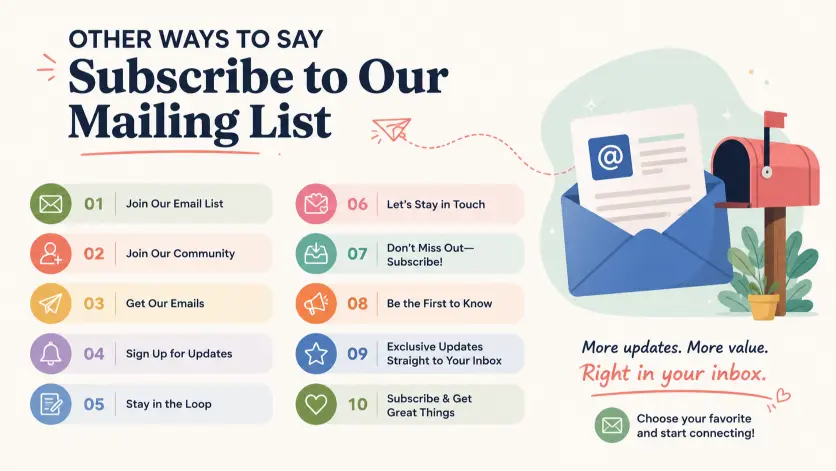
A simple call to action can make a big difference in how readers respond to your website, newsletter, or marketing message. While “subscribe to our mailing list” is clear and familiar, repeating the same phrase can sometimes feel generic or overly promotional. Using alternative expressions can make your content sound more natural, engaging, and appropriate for different audiences. From friendly website copy to polished business communication, the right wording can encourage readers to stay connected without making the invitation feel forced.
In this guide, you’ll discover practical and natural other ways to say “subscribe to our mailing list”, with examples for websites, emails, newsletters, and professional communication. The alternatives are organized by tone and purpose, helping English learners, marketers, writers, and business professionals choose wording that fits their context. Each expression focuses on clarity, natural English usage, and audience-friendly communication, so you can confidently replace repetitive calls to action with phrases that sound modern, trustworthy, and engaging
Quick Categories
Formal alternatives to “subscribe to our mailing list”
- Register to receive our communications
- Sign up to receive our updates
- Subscribe to receive official updates
- Register for email updates
These expressions work well when communicating with customers, organizations, members, or professional audiences.
Pro Tip: Use formal wording when your audience expects authority, clarity, and a polished communication style.
Casual alternatives
- Join our mailing list
- Get our latest updates
- Stay in the loop
- Keep up with our news
These phrases sound approachable and work well for blogs, lifestyle websites, communities, and creative brands.
Pro Tip: Choose shorter, friendlier wording when your audience already knows your brand.
Professional alternatives
- Subscribe to our newsletter
- Receive our latest insights
- Get industry updates by email
- Stay informed with our updates
These are particularly useful for companies, consultants, educational organizations, and professional publications.
Pro Tip: Professional subscription language should communicate value instead of simply asking for an action.
Informal expressions
- Want our latest news? Sign up
- Get updates straight to your inbox
- Join the list
- Keep in touch with us
These expressions are conversational and suitable for less formal websites and community focused content.
Pro Tip: Informal expressions work best when the brand voice is friendly and conversational.
“A simple invitation can become more persuasive when it tells readers what they will receive.”
Common Mistakes
1. Using overly formal language with a casual audience
Mistake: Register to receive our official electronic communications.
Better: Join our mailing list to get the latest updates.
The first version sounds unnecessarily formal for a friendly website.
2. Repeating the same subscription phrase
Mistake: Subscribe to our mailing list appears repeatedly across every page.
Better: Rotate natural alternatives such as Join our newsletter or Get our latest updates.
Variety can improve readability and make calls to action feel less repetitive.
3. Forgetting to explain the benefit
Mistake: Join our mailing list.
Better: Join our mailing list to receive weekly tips and exclusive updates.
Readers are more likely to respond when they understand what they will receive.
4. Using informal language in a formal business setting
Mistake: Hop on our email list and see what is happening.
Better: Sign up to receive our latest company updates.
Professional audiences generally respond better to precise and polished wording.
5. Making the call to action unclear
Mistake: Stay connected.
This can mean several things and may not clearly communicate that the reader is signing up for emails.
Better: Sign up for email updates.
“Clarity should come before creativity in professional communication.”
What Does “Subscribe to Our Mailing List” Mean?
Subscribe to our mailing list means asking someone to provide their email address so they can receive future communications from an individual, organization, business, website, or publication.
The phrase contains the verb subscribe, which means to agree to receive something regularly. Our mailing list refers to a collection of email addresses belonging to people who have chosen to receive messages.
For example:
Subscribe to our mailing list to receive weekly business tips.
Grammatically, subscribe to is the standard verb pattern. We say subscribe to a newsletter, subscribe to a service, or subscribe to a mailing list.
The phrase is grammatically correct and widely understood, but alternatives can sometimes sound more direct, modern, or audience friendly.
When to Use “Subscribe to Our Mailing List”
You can use this phrase in many written contexts, including:
- Website signup forms
- Newsletter landing pages
- Blog pages
- Online stores
- Company websites
- Event registration pages
- Educational websites
- Membership platforms
- Customer communication pages
- Marketing campaigns
Spoken vs Written
The phrase is more common in written English than everyday conversation.
On a website:
Subscribe to our mailing list for monthly updates.
In conversation, a speaker might say:
You can sign up for our newsletter if you want the latest updates.
Formal vs Informal
The phrase itself is relatively neutral. It is neither highly formal nor strongly informal.
For formal communication, Register to receive our communications may sound more polished.
For casual communication, Join our list or Get our latest updates may sound more natural.
Is “Subscribe to Our Mailing List” Professional or Polite to Say?
The phrase is polite and understandable, but it can sometimes sound more like a standard marketing instruction than a personalized professional invitation.
Polite? Yes
Professional? No, in most cases
It can still be perfectly appropriate on a business website, especially when the purpose is to provide a clear subscription button.
For a more polished business context, consider:
Sign up to receive our latest industry insights and company updates.
This version focuses on the benefit and sounds more purposeful.
Pros and Cons of Using “Subscribe to Our Mailing List”
Pros
- Simple and natural: Most readers immediately understand the request.
- Friendly tone: It is inviting without being overly formal.
- Common usage: Readers frequently see it on websites and newsletters.
- Easy to understand: The action is clearly communicated.
Cons
- Too informal for some work contexts: Certain corporate communications may benefit from more polished wording.
- Overused: Many websites use exactly the same phrase.
- Limited emotional range: It does not communicate excitement or exclusivity.
- Not suitable for formal writing: More precise language may be preferable in certain professional documents.
“The strongest subscription message tells readers both what to do and why it is worth doing.”
Other Ways to Say “Subscribe to Our Mailing List” With Examples
These alternatives will help you sound more fluent, confident, and natural in different situations.
Use them according to tone, context, and audience to express excitement, admiration, or approval when appropriate.
1. Phrase: Join Our Mailing List
Meaning: Become a member of a group that receives regular email updates.
Explanation: This is one of the most natural and widely applicable alternatives.
Example Sentence: Join our mailing list to receive the latest news, resources, and announcements.
Best Use: Websites and newsletters
Worst Use: Highly formal documents
Tone: Friendly, neutral, welcoming
Context Variability: Casual: Join our list for updates. Professional: Join our mailing list for company news. Spoken: You can join our mailing list if you like.
2. Phrase: Sign Up for Our Newsletter
Meaning: Register to receive a newsletter by email.
Explanation: This phrase is especially useful when your emails contain recurring newsletter content.
Example Sentence: Sign up for our newsletter to receive practical English learning tips every week.
Best Use: Blogs and businesses
Worst Use: Legal documents
Tone: Clear, friendly, professional
Context Variability: Casual: Sign up for our newsletter. Professional: Sign up for our weekly industry newsletter. Spoken: You can sign up for our newsletter.
3. Phrase: Subscribe to Our Newsletter
Meaning: Choose to receive a newsletter regularly.
Explanation: This is a direct alternative when the mailing list primarily distributes newsletters.
Example Sentence: Subscribe to our newsletter for expert advice and monthly insights.
Best Use: Newsletter pages
Worst Use: Personal conversations
Tone: Neutral, polished, direct
Context Variability: Casual: Subscribe to our newsletter. Professional: Subscribe to receive our monthly research newsletter. Spoken: You can subscribe to our newsletter online.
4. Phrase: Sign Up to Receive Our Updates
Meaning: Register to receive future information.
Explanation: This phrase emphasizes the updates rather than the mailing list itself.
Example Sentence: Sign up to receive our updates about upcoming events and new resources.
Best Use: Business websites
Worst Use: Casual chats
Tone: Professional, clear, inviting
Context Variability: Casual: Sign up for our updates. Professional: Sign up to receive company updates. Spoken: You can sign up to receive our updates.
5. Phrase: Get Our Latest Updates
Meaning: Receive new information from a company or organization.
Explanation: This short expression focuses on the benefit of subscribing.
Example Sentence: Get our latest updates, helpful resources, and announcements directly in your inbox.
Best Use: Landing pages
Worst Use: Formal letters
Tone: Friendly, modern, concise
Context Variability: Casual: Get our latest updates. Professional: Get our latest industry updates. Spoken: You can get our latest updates by email.
6. Phrase: Receive Our Latest News
Meaning: Get new information about a business, organization, or subject.
Explanation: This wording works well when the emails primarily contain news.
Example Sentence: Sign up today to receive our latest news and announcements.
Best Use: News websites
Worst Use: Informal chats
Tone: Neutral, informative, polished
Context Variability: Casual: Receive our latest news. Professional: Receive the latest company news. Spoken: You can receive our latest news by email.
7. Phrase: Get Updates Straight to Your Inbox
Meaning: Receive updates directly through email.
Explanation: This phrase highlights convenience and feels more conversational.
Example Sentence: Get updates straight to your inbox by joining our email list.
Best Use: Marketing pages
Worst Use: Formal reports
Tone: Conversational, friendly, modern
Context Variability: Casual: Get updates straight to your inbox. Professional: Receive updates directly in your inbox. Spoken: We can send updates straight to your inbox.
8. Phrase: Stay Informed With Our Updates
Meaning: Keep yourself informed by receiving regular information.
Explanation: This is useful when your emails provide valuable professional or educational information.
Example Sentence: Stay informed with our updates on industry trends and new developments.
Best Use: Professional websites
Worst Use: Very casual posts
Tone: Professional, informative, confident
Context Variability: Casual: Stay informed with our updates. Professional: Stay informed with our latest industry insights. Spoken: You can stay informed through our email updates.
9. Phrase: Stay in the Loop
Meaning: Continue receiving important or interesting information.
Explanation: This is a common conversational expression that works well in friendly marketing.
Example Sentence: Stay in the loop by signing up for our latest email updates.
Best Use: Community websites
Worst Use: Formal correspondence
Tone: Casual, friendly, conversational
Context Variability: Casual: Stay in the loop with our news. Professional: Stay in the loop on important announcements. Spoken: Sign up if you want to stay in the loop.
10. Phrase: Keep Up With Our News
Meaning: Continue learning about new developments.
Explanation: This phrase encourages readers to stay connected with ongoing information.
Example Sentence: Join our newsletter to keep up with our latest news.
Best Use: Blogs and brands
Worst Use: Legal writing
Tone: Friendly, natural, approachable
Context Variability: Casual: Keep up with our news. Professional: Keep up with company developments. Spoken: You can keep up with our news by email.
11. Phrase: Receive Email Updates From Us
Meaning: Get future updates through email.
Explanation: This is a straightforward and professional alternative.
Example Sentence: Sign up to receive email updates from us about new courses and events.
Best Use: Business websites
Worst Use: Informal conversations
Tone: Neutral, professional, direct
Context Variability: Casual: Get email updates from us. Professional: Receive email updates from our team. Spoken: You can receive updates from us by email.
12. Phrase: Register for Email Updates
Meaning: Sign up to receive future information by email.
Explanation: This sounds more formal and is useful for organizations and professional services.
Example Sentence: Register for email updates about upcoming conferences and publications.
Best Use: Organizations and events
Worst Use: Casual blogs
Tone: Formal, precise, professional
Context Variability: Casual: Sign up for updates. Professional: Register for email updates. Spoken: You can register to receive email updates.
13. Phrase: Sign Up for Email Notifications
Meaning: Register to receive notifications through email.
Explanation: This phrase is useful when messages are short alerts rather than traditional newsletters.
Example Sentence: Sign up for email notifications about new courses and important announcements.
Best Use: Service websites
Worst Use: Personal letters
Tone: Neutral, functional, professional
Context Variability: Casual: Sign up for notifications. Professional: Sign up for email notifications. Spoken: You can sign up for email notifications.
14. Phrase: Get the Latest From Us
Meaning: Receive the newest content, news, or updates from a business or organization.
Explanation: This is concise and works well as a modern marketing call to action.
Example Sentence: Get the latest from us by signing up for our weekly newsletter.
Best Use: Brand websites
Worst Use: Formal reports
Tone: Friendly, modern, concise
Context Variability: Casual: Get the latest from us. Professional: Receive the latest updates from our team. Spoken: Sign up to get the latest from us.
15. Phrase: Keep in Touch With Us
Meaning: Maintain communication with a person, business, or organization.
Explanation: This expression is warmer than a direct subscription request.
Example Sentence: Keep in touch with us by joining our email community.
Best Use: Communities and brands
Worst Use: Legal notices
Tone: Warm, friendly, personal
Context Variability: Casual: Keep in touch with us. Professional: Stay connected with our organization. Spoken: You can keep in touch with us through email.
16. Phrase: Receive Our Regular Communications
Meaning: Get recurring messages from an organization.
Explanation: This is a formal option suitable for institutional communication.
Example Sentence: Register to receive our regular communications and important announcements.
Best Use: Corporate communication
Worst Use: Casual marketing
Tone: Formal, polished, institutional
Context Variability: Casual: Get regular updates. Professional: Receive our regular communications. Spoken: You can register to receive our communications.
17. Phrase: Sign Up for Our Email List
Meaning: Register to receive emails from a business or organization.
Explanation: This is direct, familiar, and easy for most audiences to understand.
Example Sentence: Sign up for our email list to receive weekly recommendations.
Best Use: Websites and blogs
Worst Use: Academic papers
Tone: Neutral, friendly, direct
Context Variability: Casual: Sign up for our email list. Professional: Sign up for our company email list. Spoken: You can sign up for our email list.
18. Phrase: Join Our Email Community
Meaning: Become part of a group connected through email communication.
Explanation: This option creates a stronger sense of belonging than a basic subscription request.
Example Sentence: Join our email community for exclusive resources and helpful insights.
Best Use: Communities and brands
Worst Use: Formal notices
Tone: Warm, welcoming, engaging
Context Variability: Casual: Join our email community. Professional: Join our professional email community. Spoken: You can join our email community.
19. Phrase: Get Exclusive Updates
Meaning: Receive information that may not be available to everyone.
Explanation: This phrase emphasizes the value or exclusivity of subscribing.
Example Sentence: Sign up today to get exclusive updates, offers, and resources.
Best Use: Marketing campaigns
Worst Use: Formal reports
Tone: Persuasive, friendly, promotional
Context Variability: Casual: Get exclusive updates. Professional: Receive exclusive industry insights. Spoken: You can sign up for exclusive updates.
20. Phrase: Receive New Content by Email
Meaning: Get newly published content through email.
Explanation: This works especially well for blogs, educational websites, and publishers.
Example Sentence: Sign up to receive new content by email every week.
Best Use: Content websites
Worst Use: Personal conversation
Tone: Clear, informative, professional
Context Variability: Casual: Get new content by email. Professional: Receive newly published content by email. Spoken: You can receive our new content by email.
21. Phrase: Get Our Newsletter in Your Inbox
Meaning: Receive a newsletter directly through email.
Explanation: This phrase combines a friendly tone with a clear description of the benefit.
Example Sentence: Get our newsletter in your inbox every Friday.
Best Use: Blogs and brands
Worst Use: Formal documents
Tone: Friendly, conversational, inviting
Context Variability: Casual: Get our newsletter in your inbox. Professional: Receive our newsletter by email. Spoken: We can send our newsletter to your inbox.
22. Phrase: Sign Up for Our Latest News
Meaning: Register to receive new news and announcements.
Explanation: This wording puts the value of the content before the technical action.
Example Sentence: Sign up for our latest news and product announcements.
Best Use: Business websites
Worst Use: Academic writing
Tone: Clear, modern, professional
Context Variability: Casual: Sign up for our latest news. Professional: Sign up to receive the latest company news. Spoken: You can sign up for our latest news.
23. Phrase: Stay Connected With Our Updates
Meaning: Continue receiving information from an organization.
Explanation: This creates a sense of ongoing connection with the audience.
Example Sentence: Stay connected with our updates by joining our newsletter.
Best Use: Community websites
Worst Use: Legal communication
Tone: Warm, professional, welcoming
Context Variability: Casual: Stay connected with our updates. Professional: Stay connected with our latest announcements. Spoken: You can stay connected through our updates.
24. Phrase: Receive Our Latest Insights
Meaning: Get new ideas, knowledge, or expert information.
Explanation: This is especially effective for professional, educational, and business audiences.
Example Sentence: Sign up to receive our latest insights on digital marketing and communication.
Best Use: Professional content
Worst Use: Casual blogs
Tone: Expert, polished, professional
Context Variability: Casual: Get our latest insights. Professional: Receive our latest industry insights. Spoken: You can receive our latest insights by email.
25. Phrase: Get Weekly Updates From Our Team
Meaning: Receive regular weekly information from an organization.
Explanation: This option creates a personal connection by identifying the people behind the communication.
Example Sentence: Sign up to get weekly updates from our team.
Best Use: Company websites
Worst Use: Formal notices
Tone: Friendly, personal, professional
Context Variability: Casual: Get weekly updates from our team. Professional: Receive weekly updates from our team. Spoken: We send weekly updates to subscribers.
26. Phrase: Stay Updated With Our Newsletter
Meaning: Continue learning about recent information through a newsletter.
Explanation: This is a natural option for publications and educational websites.
Example Sentence: Stay updated with our newsletter and never miss a new resource.
Best Use: Educational websites
Worst Use: Formal contracts
Tone: Helpful, professional, approachable
Context Variability: Casual: Stay updated with our newsletter. Professional: Stay updated through our monthly newsletter. Spoken: You can stay updated through our newsletter.
27. Phrase: Subscribe for Future Updates
Meaning: Choose to receive information in the future.
Explanation: This concise alternative emphasizes continued communication.
Example Sentence: Subscribe for future updates about our courses and events.
Best Use: Event pages
Worst Use: Personal messages
Tone: Direct, neutral, professional
Context Variability: Casual: Subscribe for future updates. Professional: Subscribe to receive future announcements. Spoken: You can subscribe for future updates.
28. Phrase: Sign Up to Stay Informed
Meaning: Register so you can continue receiving useful information.
Explanation: This phrase focuses on the reader’s benefit rather than the mailing list.
Example Sentence: Sign up to stay informed about new research, events, and resources.
Best Use: Professional websites
Worst Use: Casual social posts
Tone: Professional, informative, confident
Context Variability: Casual: Sign up to stay informed. Professional: Sign up to stay informed about industry developments. Spoken: You can sign up to stay informed.
29. Phrase: Receive Our Email Newsletter
Meaning: Get a recurring newsletter through email.
Explanation: This is a clear and slightly formal alternative for newsletter focused websites.
Example Sentence: Register to receive our email newsletter each month.
Best Use: Business websites
Worst Use: Casual conversation
Tone: Formal, clear, neutral
Context Variability: Casual: Get our email newsletter. Professional: Receive our monthly email newsletter. Spoken: You can receive our email newsletter.
30. Phrase: Join Us for Regular Email Updates
Meaning: Become part of the audience receiving recurring email information.
Explanation: This creates a welcoming invitation while clearly communicating the purpose.
Example Sentence: Join us for regular email updates, practical resources, and company news.
Best Use: Organizations and brands
Worst Use: Formal contracts
Tone: Welcoming, professional, engaging
Context Variability: Casual: Join us for regular updates. Professional: Join our email update list. Spoken: You can join us for regular email updates.
“Professional English becomes more natural when you match your wording to your audience.”
How to Choose the Right Alternative
Not every alternative works equally well in every situation. The best choice depends on what you want readers to feel and what type of content they will receive.
For a formal organization
Choose:
Register for email updates
Receive our regular communications
Register to receive our communications
These options sound structured and professional.
For a business website
Choose:
Sign up for our newsletter
Receive our latest insights
Stay informed with our updates
These phrases communicate value while maintaining a professional tone.
For a friendly blog
Choose:
Join our mailing list
Get our latest updates
Stay in the loop
These options feel more conversational.
For an educational website
Choose:
Receive our latest insights
Receive new content by email
Sign up to stay informed
These alternatives emphasize knowledge and usefulness.
For marketing campaigns
Choose:
Get exclusive updates
Get the latest from us
Get updates straight to your inbox
These phrases can create a stronger call to action.
Professional Reaction Phrases and Subscription Language
Subscription language is closely connected with other areas of professional English. For example, when someone receives an invitation, announcement, or newsletter, they may need suitable professional reaction phrases.
Instead of simply saying:
Thanks.
A professional response could be:
Thank you for the update. I appreciate you keeping me informed.
Or:
Thank you for sharing this information. I look forward to receiving future updates.
These expressions demonstrate how context changes the language you choose.
Informal Expressions in English
English learners often encounter informal expressions in emails, blogs, websites, and everyday conversations.
Examples include:
- Stay in the loop
- Keep in touch
- Join the list
- Get the latest
- Keep up with our news
- Get updates straight to your inbox
These expressions are understandable and natural, but they should not automatically be used in every professional situation.
“Fluency means knowing not only what a phrase means, but also when it sounds appropriate.”
See Also
See also: Explore our guide to Other Ways to Say “Thank You” for more natural expressions for professional and everyday communication.
See also: Read our Professional English Guide to improve vocabulary, workplace communication, email language, and formal expressions.
Mini Quiz and Self Check
1. You are writing a corporate newsletter signup page. Which option sounds most professional?
A. Hop onto our list.
B. Sign up to receive our latest industry insights.
C. Come get our emails.
Correct answer: B
2. Which phrase is most conversational?
A. Receive our regular communications.
B. Register for email updates.
C. Stay in the loop.
Correct answer: C
3. You run an educational blog and want to emphasize new content. Which option is strongest?
A. Receive new content by email.
B. Register for official communications.
C. Join the corporate mailing system.
Correct answer: A
4. Which phrase focuses most strongly on exclusivity?
A. Get exclusive updates.
B. Receive email updates from us.
C. Register for email notifications.
Correct answer: A
Comparison Table: Top Alternatives
| Phrase | Tone | Best Use |
| Join Our Mailing List | Friendly | Websites |
| Sign Up for Our Newsletter | Professional | Newsletters |
| Subscribe to Our Newsletter | Neutral | Publications |
| Get Our Latest Updates | Friendly | Blogs |
| Receive Our Latest News | Informative | News websites |
| Stay in the Loop | Casual | Communities |
| Register for Email Updates | Formal | Organizations |
| Receive Our Latest Insights | Professional | Business content |
| Get Updates Straight to Your Inbox | Conversational | Marketing |
| Sign Up to Stay Informed | Professional | Educational content |
FAQs
What are the best alternatives to “subscribe to our mailing list”?
Some of the strongest alternatives are Join our mailing list, Sign up for our newsletter, Receive our latest updates, Stay informed with our updates, and Get updates straight to your inbox.
Is “subscribe to our mailing list” professional?
Yes, it is clear and acceptable on most websites, but it can sound generic. In professional communication, benefit focused phrases such as Receive our latest insights may sound more polished.
What is a more casual way to say “subscribe to our mailing list”?
Join our list, Stay in the loop, Get our latest updates, and Keep in touch with us are more casual and conversational choices.
What is a formal way to ask someone to join an email list?
You can say Register for email updates, Register to receive our communications, or Sign up to receive official updates.
How can I make a newsletter signup phrase more engaging?
Focus on the benefit for the reader. Instead of only saying Subscribe to our mailing list, try Sign up to receive weekly tips, Get exclusive updates, or Receive our latest insights.
Conclusion
Learning other ways to say subscribe to our mailing list gives English learners and professionals more control over tone, clarity, and audience. A phrase such as Join our mailing list feels welcoming, while Register for email updates sounds more formal. Similarly, Receiving our latest insights can work especially well for business and educational audiences.
The key is to practice choosing language based on context rather than memorizing one expression. Try using a different alternative each day in a sentence, email, website call to action, or professional message. With regular practice, you will become more confident at selecting natural English expressions that sound clear, polite, and appropriate for every situation









