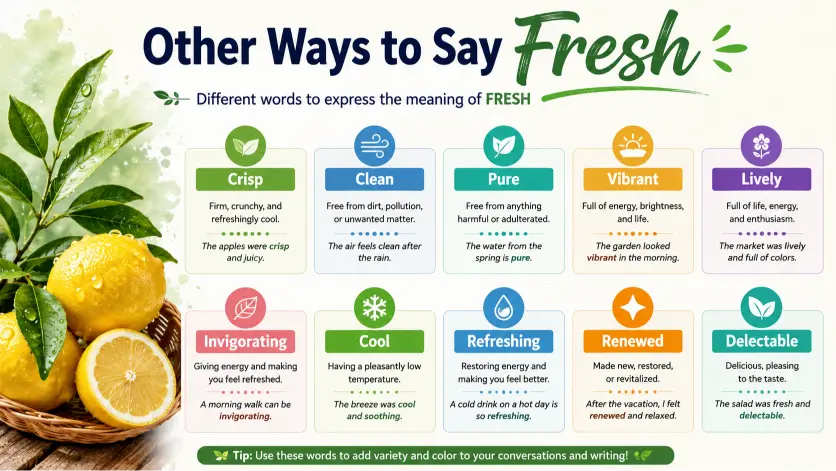
resh is a simple and useful word, but using the same expression repeatedly can make your English sound predictable. Learning other ways to say fresh can help you communicate more naturally, describe food and drinks more precisely, talk about new ideas, and choose vocabulary that fits casual, academic, or professional situations. From everyday alternatives like “new” and “crisp” to more specific expressions such as “recent,” “revitalized,” or “pure,” the right synonym depends on the meaning you want to express.
In this guide, you’ll discover practical and natural alternatives to fresh, organized for different contexts and levels of English. Each option focuses on clarity, appropriate usage, and real-world communication, making the list useful for students, English learners, writers, and professionals. For you’re describing recently made food, clean air, a new perspective, or something original, these alternatives can help you sound more precise and confident
Quick Categories
Formal alternatives to “fresh”
- Recent
- Newly prepared
- Original
- Innovative
Pro Tip: Use precise words such as “recent,” “original,” or “innovative” when writing reports, presentations, and formal correspondence.
Casual alternatives
- New
- Crisp
- Clean
- Bright
Pro Tip: In everyday conversation, choose short and familiar alternatives that sound natural rather than overly sophisticated.
Professional alternatives
- Innovative
- Up-to-date
- Original
- Renewed
Pro Tip: In professional English, replace “fresh” with a word that identifies exactly what is new, improved, or relevant.
Informal expressions
- Brand-new
- Good as new
- Straight from the oven
- Just made
Pro Tip: Informal expressions work well in conversations but may sound too relaxed in reports or formal business writing.
“The best synonym depends on what ‘fresh’ means in your sentence.”
Common Mistakes When Using “Fresh”
1. Using “fresh” when you mean “new”
Incorrect: I bought a fresh laptop yesterday.
Better: I bought a new laptop yesterday.
“Fresh” usually does not describe an ordinary newly purchased object as naturally as “new” does.
2. Using “fresh” when you mean “recent”
Incorrect: I read a fresh report from the company.
Better: I read a recent report from the company.
“Recent” is more precise when referring to something that happened or appeared lately.
3. Using “fresh” for every type of food
Incorrect: The frozen meal is fresh.
Better: The frozen meal is newly prepared or recently made, depending on the intended meaning.
“Fresh” can suggest quality or lack of spoilage, so context matters.
4. Using “fresh” instead of “original”
Incorrect: She presented a fresh solution to the problem.
This sentence is possible, but if you specifically mean that the solution is creative or unusual, original may be clearer.
5. Using informal expressions in formal writing
Incorrect: We have a brand-new plan for the project.
Better: We have a new strategy for the project.
“Brand-new” is natural in conversation but may be unnecessarily informal in professional documents.
What Does “Fresh” Mean?
Fresh generally means recently produced, prepared, obtained, cleaned, or experienced. It can also describe something that feels new, original, energetic, or pleasantly different.
The exact meaning depends on context.
Example:
We need a fresh approach to this problem.
Here, “fresh” means new or different, rather than recently produced.
Grammatically, fresh is usually an adjective and commonly appears before a noun:
fresh food
fresh ideas
fresh air
fresh perspective
It can also appear after linking verbs:
The bread is fresh.
“Fresh is versatile, but specificity makes your English stronger.”
When to Use “Fresh”
You can use fresh in several common contexts:
- Food: fresh vegetables, fresh bread, fresh fruit
- Air: fresh air, fresh breeze
- Ideas: fresh ideas, fresh thinking
- Perspectives: a fresh perspective
- Appearance: looking fresh
- Energy: fresh energy
- Information: fresh information
- Experiences: a fresh start
- Creative work: a fresh approach
Spoken English
“Fresh” is extremely common in everyday speech.
Example:
Let’s get some fresh air.
Written English
“Fresh” is also appropriate in writing, but formal writing may benefit from a more specific synonym.
Example:
The organization needs a fresh approach to customer service.
Formal vs. Informal
The word itself is neutral, but some expressions containing “fresh” are more informal.
Neutral: fresh information
Professional: updated information
Informal: brand-new information
Is It Professional or Polite to Say “Fresh”?
Politeness? ✔️ Yes
Professional? ❌ No, in most cases
The word fresh is polite and grammatically correct, but whether it sounds professional depends on what you are describing. In business communication, more precise terms such as recent, updated, innovative, original, or newly prepared can communicate the intended meaning more clearly.
Business-style example:
We would appreciate your fresh perspective on the proposed strategy.
Here, “fresh perspective” is both natural and professional because it means a new or different viewpoint.
Pros and Cons of Using “Fresh”
Pros
- Simple and natural: Easy for most English speakers to understand.
- Friendly tone: Often creates a positive impression.
- Common usage: Works in everyday and professional contexts.
- Easy to understand: Its meaning is usually clear from context.
Cons
- Too informal for work: Some expressions involving “fresh” may be too casual.
- Overused: Repeating it can make your vocabulary sound limited.
- Limited emotional range: It cannot always express the exact feeling or quality.
- Not suitable for formal writing: A more precise synonym may sometimes be preferable.
“Use ‘fresh’ when it fits naturally; use a stronger synonym when precision matters.”
Other Ways to Say Fresh With Examples
These alternatives will help you sound more fluent, confident, and natural in different situations.
Use them according to tone, context, and audience to express excitement, admiration, or approval.
1. Phrase: New
- Meaning: Something that has only recently appeared, been obtained, or become available.
- Explanation: “New” is the most general alternative when fresh means recently introduced.
- Example Sentence: We have a new approach to improving customer service.
- Best Use: Everyday communication
- Worst Use: Food quality
- Tone: Neutral, simple, natural
- Context Variability: Casual: new shoes; Professional: new strategy; Spoken: new idea
2. Phrase: Recent
- Meaning: Something that happened or appeared not long ago.
- Explanation: “Recent” focuses on time rather than physical freshness.
- Example Sentence: The team discussed recent developments in the industry.
- Best Use: Formal writing
- Worst Use: Fresh food
- Tone: Formal, precise, neutral
- Context Variability: Casual: recent news; Professional: recent findings; Spoken: recent changes
3. Phrase: Newly Prepared
- Meaning: Something that has been prepared very recently.
- Explanation: This phrase is especially useful for food, drinks, and meals.
- Example Sentence: The restaurant serves newly prepared meals throughout the day.
- Best Use: Food descriptions
- Worst Use: Abstract ideas
- Tone: Professional, descriptive, clear
- Context Variability: Casual: newly prepared meal; Professional: newly prepared dishes; Spoken: newly prepared food
4. Phrase: Recently Made
- Meaning: Something created or produced a short time ago.
- Explanation: It emphasizes when something was made.
- Example Sentence: These cookies were recently made this morning.
- Best Use: Food descriptions
- Worst Use: Formal reports
- Tone: Natural, neutral, conversational
- Context Variability: Casual: recently made cake; Professional: recently made product; Spoken: recently made meal
5. Phrase: Crisp
- Meaning: Pleasantly fresh, firm, clear, or clean.
- Explanation: “Crisp” commonly describes food, air, clothing, or presentation.
- Example Sentence: We enjoyed the crisp morning air.
- Best Use: Sensory descriptions
- Worst Use: Formal data
- Tone: Vivid, positive, descriptive
- Context Variability: Casual: crisp apple; Professional: crisp presentation; Spoken: crisp morning
6. Phrase: Clean
- Meaning: Free from dirt, unpleasant smells, or contamination.
- Explanation: “Clean” can replace “fresh” when describing air, spaces, or smells.
- Example Sentence: Open the window and let some clean air into the room.
- Best Use: Physical freshness
- Worst Use: New ideas
- Tone: Simple, direct, neutral
- Context Variability: Casual: clean air; Professional: clean environment; Spoken: clean smell
7. Phrase: Original
- Meaning: New, creative, or not copied from something else.
- Explanation: “Original” is ideal when fresh describes an idea or approach.
- Example Sentence: She introduced an original solution to the problem.
- Best Use: Creative ideas
- Worst Use: Food
- Tone: Professional, positive, confident
- Context Variability: Casual: original idea; Professional: original concept; Spoken: original solution
8. Phrase: Innovative
- Meaning: Introducing new methods, ideas, or technology.
- Explanation: This is a strong professional alternative for fresh ideas and approaches.
- Example Sentence: The company developed an innovative approach to customer support.
- Best Use: Business communication
- Worst Use: Fresh food
- Tone: Professional, modern, positive
- Context Variability: Casual: innovative idea; Professional: innovative strategy; Spoken: innovative solution
9. Phrase: Up-to-Date
- Meaning: Containing the newest available information.
- Explanation: Use this when fresh means current or recently updated.
- Example Sentence: Please make sure the client database is up-to-date.
- Best Use: Professional information
- Worst Use: Physical objects
- Tone: Professional, practical, precise
- Context Variability: Casual: up-to-date news; Professional: up-to-date records; Spoken: up-to-date information
10. Phrase: Current
- Meaning: Existing or relevant at the present time.
- Explanation: “Current” works especially well for information, events, and situations.
- Example Sentence: We need current market data before making a decision.
- Best Use: Business contexts
- Worst Use: Food
- Tone: Formal, precise, professional
- Context Variability: Casual: current events; Professional: current data; Spoken: current situation
11. Phrase: Brand-New
- Meaning: Completely new and unused.
- Explanation: “Brand-new” strongly emphasizes that something has never been used or experienced before.
- Example Sentence: She bought a brand-new computer for her home office.
- Best Use: Casual speech
- Worst Use: Formal reports
- Tone: Informal, enthusiastic, positive
- Context Variability: Casual: brand-new phone; Professional: brand-new product; Spoken: brand-new car
12. Phrase: Just Made
- Meaning: Prepared or created only a short time ago.
- Explanation: This natural expression is common when discussing food or drinks.
- Example Sentence: The coffee is just made, so it is still hot.
- Best Use: Everyday speech
- Worst Use: Formal documents
- Tone: Casual, natural, friendly
- Context Variability: Casual: just-made cake; Professional: just-made product; Spoken: just-made coffee
13. Phrase: Newly Baked
- Meaning: Baked very recently.
- Explanation: It specifically describes bread, cakes, pastries, and similar foods.
- Example Sentence: The bakery sells newly baked bread every morning.
- Best Use: Bakery products
- Worst Use: Abstract concepts
- Tone: Descriptive, inviting, natural
- Context Variability: Casual: newly baked bread; Professional: newly baked pastries; Spoken: newly baked cake
14. Phrase: Newly Harvested
- Meaning: Collected from crops very recently.
- Explanation: This phrase is useful for agricultural products and food descriptions.
- Example Sentence: The market sells newly harvested vegetables from local farms.
- Best Use: Agricultural contexts
- Worst Use: Business ideas
- Tone: Formal, descriptive, specific
- Context Variability: Casual: newly harvested fruit; Professional: newly harvested crops; Spoken: newly harvested vegetables
15. Phrase: Refreshed
- Meaning: Restored to a newer, cleaner, or more energetic condition.
- Explanation: “Refreshed” is useful for people, designs, systems, and spaces.
- Example Sentence: The website has a refreshed design that is easier to navigate.
- Best Use: Updates and renewal
- Worst Use: Fresh food
- Tone: Professional, positive, modern
- Context Variability: Casual: refreshed after sleep; Professional: refreshed website; Spoken: refreshed design
16. Phrase: Renewed
- Meaning: Restored, revived, or made active again.
- Explanation: “Renewed” works well when something gains new energy or purpose.
- Example Sentence: The team began the project with renewed enthusiasm.
- Best Use: Formal communication
- Worst Use: Fresh vegetables
- Tone: Formal, positive, polished
- Context Variability: Casual: renewed energy; Professional: renewed commitment; Spoken: renewed interest
17. Phrase: Revitalized
- Meaning: Given new energy, strength, or life.
- Explanation: This is a strong formal choice for organizations, communities, and projects.
- Example Sentence: The revitalized program attracted new participants.
- Best Use: Professional writing
- Worst Use: Food
- Tone: Formal, energetic, sophisticated
- Context Variability: Casual: revitalized space; Professional: revitalized program; Spoken: revitalized project
18. Phrase: Rejuvenated
- Meaning: Made to feel or look younger, newer, or more energetic.
- Explanation: It commonly describes people, places, brands, and experiences.
- Example Sentence: The renovation gave the office a rejuvenated appearance.
- Best Use: Renewal contexts
- Worst Use: Fresh information
- Tone: Polished, positive, sophisticated
- Context Variability: Casual: rejuvenated after vacation; Professional: rejuvenated brand; Spoken: rejuvenated space
19. Phrase: Updated
- Meaning: Changed to include newer information, features, or standards.
- Explanation: “Updated” is more precise than “fresh” when something has been revised.
- Example Sentence: Please review the updated project schedule.
- Best Use: Workplace communication
- Worst Use: Fresh fruit
- Tone: Professional, practical, precise
- Context Variability: Casual: updated app; Professional: updated report; Spoken: updated schedule
20. Phrase: Timely
- Meaning: Appropriate or useful because it occurs at the right time.
- Explanation: “Timely” can describe information or action that is relevant when needed.
- Example Sentence: Thank you for providing such timely information.
- Best Use: Professional communication
- Worst Use: Physical freshness
- Tone: Formal, professional, appreciative
- Context Variability: Casual: timely advice; Professional: timely response; Spoken: timely information
21. Phrase: Vibrant
- Meaning: Full of energy, life, or strong color.
- Explanation: “Vibrant” can describe appearances, places, cultures, and energy.
- Example Sentence: The city has a vibrant cultural scene.
- Best Use: Energy and appearance
- Worst Use: Recent information
- Tone: Positive, vivid, expressive
- Context Variability: Casual: vibrant colors; Professional: vibrant culture; Spoken: vibrant atmosphere
22. Phrase: Energetic
- Meaning: Showing or possessing a lot of energy.
- Explanation: Use it when fresh refers to someone’s lively or active condition.
- Example Sentence: The new team members brought an energetic attitude to the project.
- Best Use: People and teams
- Worst Use: Fresh food
- Tone: Positive, direct, professional
- Context Variability: Casual: energetic child; Professional: energetic team; Spoken: energetic speaker
23. Phrase: Reviving
- Meaning: Bringing new energy, interest, or activity to something.
- Explanation: It emphasizes the process of making something active again.
- Example Sentence: The campaign is reviving interest in the brand.
- Best Use: Projects and campaigns
- Worst Use: Fresh food
- Tone: Dynamic, professional, positive
- Context Variability: Casual: reviving interest; Professional: reviving sales; Spoken: reviving a project
24. Phrase: Invigorating
- Meaning: Making someone feel energetic, refreshed, or enthusiastic.
- Explanation: It is useful for experiences, activities, environments, and conversations.
- Example Sentence: The morning walk was an invigorating start to the day.
- Best Use: Experiences
- Worst Use: Formal data
- Tone: Positive, expressive, polished
- Context Variability: Casual: invigorating walk; Professional: invigorating discussion; Spoken: invigorating experience
25. Phrase: Clean-Cut
- Meaning: Neat, tidy, and well presented.
- Explanation: It can describe a person’s appearance or a clear visual style.
- Example Sentence: His clean-cut appearance suited the professional setting.
- Best Use: Appearance
- Worst Use: New information
- Tone: Neutral, descriptive, polished
- Context Variability: Casual: clean-cut look; Professional: clean-cut appearance; Spoken: clean-cut style
26. Phrase: Bright
- Meaning: Cheerful, lively, intelligent, or full of light.
- Explanation: “Bright” can replace fresh when describing a positive atmosphere or appearance.
- Example Sentence: The room has a bright and welcoming atmosphere.
- Best Use: Atmosphere
- Worst Use: Recent data
- Tone: Positive, friendly, vivid
- Context Variability: Casual: bright room; Professional: bright workspace; Spoken: bright atmosphere
27. Phrase: Novel
- Meaning: New, unusual, or original.
- Explanation: “Novel” is particularly useful in academic and professional writing.
- Example Sentence: The researchers proposed a novel method for analyzing the data.
- Best Use: Academic writing
- Worst Use: Everyday food
- Tone: Formal, academic, precise
- Context Variability: Casual: novel idea; Professional: novel approach; Spoken: novel method
28. Phrase: Cutting-Edge
- Meaning: Highly modern and using the newest developments.
- Explanation: It is commonly used for technology, research, and advanced business solutions.
- Example Sentence: The company uses cutting-edge technology to improve efficiency.
- Best Use: Technology
- Worst Use: Fresh food
- Tone: Modern, professional, enthusiastic
- Context Variability: Casual: cutting-edge device; Professional: cutting-edge technology; Spoken: cutting-edge solution
29. Phrase: Up-and-Coming
- Meaning: Developing quickly and likely to become successful or important.
- Explanation: This phrase describes people, businesses, areas, and trends rather than physical freshness.
- Example Sentence: She is an up-and-coming designer with an impressive portfolio.
- Best Use: People and trends
- Worst Use: Fresh meals
- Tone: Informal, positive, optimistic
- Context Variability: Casual: up-and-coming artist; Professional: up-and-coming company; Spoken: up-and-coming designer
30. Phrase: Good as New
- Meaning: In nearly the same condition as something new.
- Explanation: It is commonly used for repaired, restored, or gently used objects.
- Example Sentence: After the repair, the laptop was good as new.
- Best Use: Restored objects
- Worst Use: Formal reports
- Tone: Casual, reassuring, natural
- Context Variability: Casual: good-as-new furniture; Professional: good-as-new equipment; Spoken: good-as-new laptop
See Also
- Other Ways to Say “New”: Explore more precise alternatives for describing something recently introduced or different.
- Professional English Guide: Learn practical vocabulary and phrases for clearer workplace communication.
Scroll-Stopping Highlights
“Use ‘recent’ for time, ‘innovative’ for ideas, and ‘newly prepared’ for food.”
“A synonym is only useful when it preserves the meaning of the original sentence.”
“Professional English becomes stronger when general words are replaced with precise ones.”
Mini Quiz: Test Your Usage
1. Which phrase is most appropriate for a business strategy?
A. Newly baked
B. Innovative
C. Crisp
D. Good as new
Answer: B. Innovative
2. Which phrase best describes information that appeared yesterday?
A. Recent
B. Vibrant
C. Invigorating
D. Clean-cut
Answer: A. Recent
3. Which expression is most natural for bread?
A. Current bread
B. Timely bread
C. Newly baked bread
D. Innovative bread
Answer: C. Newly baked bread
4. Which alternative is most suitable for an academic paper describing a new method?
A. Brand-new
B. Novel
C. Just made
D. Good as new
Answer: B. Novel
Comparison Table: Top Alternatives
| Phrase | Tone | Best Use |
| New | Neutral | Everyday communication |
| Recent | Formal | Information and events |
| Newly prepared | Professional | Food and meals |
| Crisp | Descriptive | Food and atmosphere |
| Original | Professional | Ideas and solutions |
| Innovative | Professional | Business and technology |
| Up-to-date | Professional | Information and records |
| Updated | Professional | Documents and systems |
| Refreshed | Modern | Designs and experiences |
| Novel | Academic | Research and ideas |
FAQs About Other Ways to Say Fresh
1. What are the best other ways to say fresh?
Some useful alternatives include new, recent, crisp, clean, original, innovative, updated, and newly prepared. The best choice depends on what “fresh” means in your sentence.
2. What is a professional way to say fresh?
In professional English, consider recent, updated, innovative, original, current, newly developed, or up-to-date, depending on the context.
3. What is another way to say fresh ideas?
You can say original ideas, innovative ideas, new ideas, creative ideas, novel ideas, or fresh perspectives.
4. What is another way to say fresh food?
Depending on the situation, use newly prepared, recently made, newly baked, recently harvested, or high-quality.
5. How can I avoid repeating the word fresh?
First identify what “fresh” means in your sentence. Then choose a more precise alternative such as recent for time, innovative for ideas, clean for air, or newly prepared for food.
Conclusion
Learning different ways to express the idea of freshness can significantly expand your English vocabulary. Instead of relying on one flexible word, you can choose recent, innovative, original, updated, crisp, newly prepared, or another alternative that precisely matches your meaning. This makes your spoken and written English clearer and more natural.
The key is to practice these alternatives in context. Pay attention to whether you are speaking casually, communicating professionally, writing academically, or describing food and experiences. Developing this kind of tone awareness will help you communicate with greater confidence and precision.









