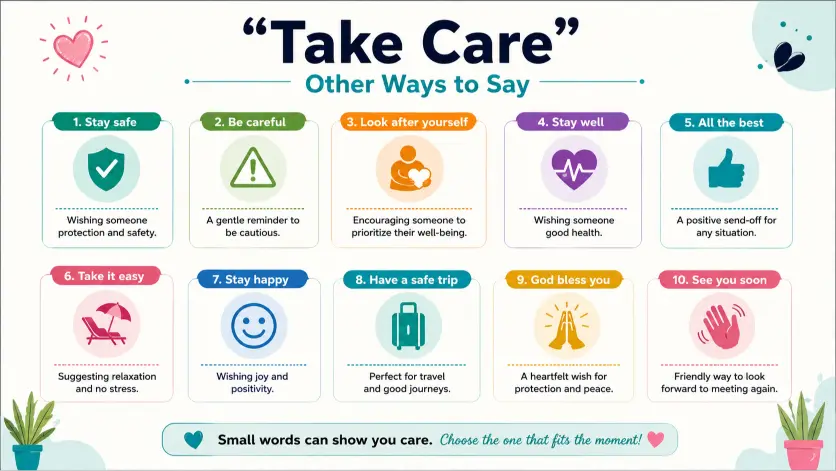
Sometimes, a simple “take care” is enough, but there are moments when you want your words to feel warmer, more personal, or a little more memorable. For you are saying goodbye to a friend, ending a text conversation, wishing someone well, or showing concern for someone special, choosing the right expression can make your message feel more genuine. That is why learning different ways to say “take care” can help you communicate with greater warmth and confidence.
In this guide, you’ll discover natural alternatives to “take care” that work for casual chats, professional conversations, friendships, family messages, and romantic situations. The phrases are organized around real-life communication needs, with clear examples so you can choose an expression that matches the situation and relationship. Drawing on common English usage and practical communication principles, this guide focuses on phrases that sound natural rather than overly formal or forced. From simple alternatives like “stay safe” to warmer expressions such as “look after yourself,” you’ll find plenty of thoughtful ways to end a conversation on a positive note
Quick Categories
Formal alternatives to “take care”
- Stay well
- Wishing you well
- All the best
- I wish you well
Pro Tip: Use these expressions when you want to sound courteous and respectful without being overly personal.
Casual alternatives
- Stay safe
- Look after yourself
- Have a good one
- Take it easy
Pro Tip: These expressions work naturally with friends, familiar coworkers, and people you regularly interact with.
Professional alternatives
- Have a great day
- Best wishes
- Wishing you all the best
- I hope everything goes well
Pro Tip: For workplace communication, choose phrases that sound warm but do not become unnecessarily personal.
Informal expressions
- See you soon
- Catch you later
- Stay good
- Keep well
Pro Tip: Informal expressions in English are best reserved for relaxed conversations where the relationship and context are already familiar.
“The best alternative is not always the most formal one. It is the phrase that fits the relationship and situation.”
Common Mistakes
1. Using “take care” in every situation
Repeating the same phrase can make your English sound less varied.
Example: “Bye, take care. Take care tomorrow. Take care at work.”
2. Using an overly casual expression with a client
Expressions such as “Catch you later” may sound too relaxed in formal business communication.
Example: “Thank you for meeting with us. Catch you later.”
3. Assuming “take care” always means concern
It can simply be a friendly way to end a conversation.
Example: “Thanks for your help. Take care!”
4. Using “stay safe” without a relevant reason
“Stay safe” can imply concern about danger or risk.
Example: “Goodbye, stay safe” after an ordinary office meeting may sound unnecessarily serious.
5. Using a formal phrase with close friends
Expressions such as “I wish you well” can sound distant in a casual friendship.
Example: “It was great hanging out. I wish you well.”
What Does “Take Care” Mean?
“Take care” is an expression used to wish someone well, show concern for their wellbeing, or politely end a conversation.
It is especially common as a farewell and does not usually function as a literal instruction to take care of something.
Example: “Thanks for coming. Take care!”
Grammatically, “take care” is an imperative expression. The implied subject is you, meaning “you should take care of yourself” or “I hope you stay well.”
When to Use “Take Care”
You can use “take care” in several common situations:
- When saying goodbye to a friend
- At the end of a phone call
- After meeting an acquaintance
- When showing friendly concern
- When someone is traveling
- After offering help or support
- In casual text messages
- At the end of an informal email
Spoken vs. Written
Spoken: “Thanks for stopping by. Take care!”
Written: “It was great speaking with you. Take care.”
In writing, especially professional writing, alternatives such as Best wishes, Wishing you well, or Have a great day may sound more appropriate.
Formal vs. Informal
“Take care” is generally friendly and informal to neutral. It can be polite, but it is not usually considered a formal business closing.
Is It Professional or Polite to Say “Take Care”?
“Take care” is polite and friendly, but it is generally not the strongest choice for highly formal professional communication. In business settings, the relationship, company culture, and communication channel matter.
Polite? ✔ Yes
Professional? No, in most highly formal situations
Business-style example:
“Thank you for taking the time to speak with me. I appreciate your help. Wishing you all the best.”
For a familiar coworker, however, “Take care” can be completely natural.
“Professional English is about choosing language that matches the relationship, not simply choosing the longest or most formal phrase.”
Pros and Cons of Using “Take Care”
Pros
- Simple and natural: Easy for almost every English learner to understand and use.
- Friendly tone: Communicates warmth and goodwill.
- Common usage: Frequently heard in everyday English.
- Easy to understand: Its meaning is clear from context.
Cons
- Too informal for work: It may not suit highly formal correspondence.
- Overused: Repeating it can limit vocabulary variety.
- Limited emotional range: It does not always communicate a specific feeling.
- Not suitable for formal writing: More conventional professional closings may be preferable.
Other Ways to Say “Take Care” With Examples
These alternatives will help you sound more fluent, confident, and natural in different situations.
Use them according to tone, context, and audience to express concern, warmth, encouragement, or goodwill.
1. Phrase: Stay Safe
- Meaning: A wish for someone to remain safe and well.
- Explanation: It is especially appropriate when someone is traveling or facing a potentially risky situation.
- Example Sentence: “Have a safe trip, and stay safe!”
- Best Use: Travel situations
- Worst Use: Routine meetings
- Tone: Caring, friendly, concerned
- Context Variability: Casual: “Stay safe out there.” Professional: “Please stay safe during your travels.” Spoken: “Take care and stay safe.”
2. Phrase: Look After Yourself
- Meaning: A friendly request or wish for someone to care for their wellbeing.
- Explanation: It sounds warm and personal without being overly emotional.
- Example Sentence: “It was lovely seeing you. Look after yourself.”
- Best Use: Friendly farewells
- Worst Use: Formal letters
- Tone: Warm, caring, personal
- Context Variability: Casual: “Look after yourself.” Professional: “Please look after yourself during the busy period.” Spoken: “Look after yourself, okay?”
3. Phrase: Stay Well
- Meaning: A wish that someone remains healthy and well.
- Explanation: It is short, polite, and slightly more neutral than “take care.”
- Example Sentence: “Thank you for everything. Stay well.”
- Best Use: Polite farewells
- Worst Use: Highly formal documents
- Tone: Polite, warm, neutral
- Context Variability: Casual: “Stay well.” Professional: “Wishing you well and continued success.” Spoken: “Thanks again. Stay well.”
4. Phrase: All the Best
- Meaning: A general wish for future success and wellbeing.
- Explanation: It is widely used in both personal and professional communication.
- Example Sentence: “It was great working with you. All the best!”
- Best Use: Farewell messages
- Worst Use: Emergency situations
- Tone: Friendly, positive, professional
- Context Variability: Casual: “All the best!” Professional: “All the best in your new role.” Spoken: “All the best for the future.”
5. Phrase: Wishing You Well
- Meaning: A polite expression of goodwill.
- Explanation: It works particularly well when someone is beginning a new chapter or leaving a situation.
- Example Sentence: “Wishing you well in your new position.”
- Best Use: Professional farewells
- Worst Use: Casual banter
- Tone: Respectful, warm, sincere
- Context Variability: Casual: “Wishing you well.” Professional: “Wishing you well in your future endeavors.” Spoken: “I’m wishing you well.”
6. Phrase: Have a Good Day
- Meaning: A wish that someone enjoys the rest of their day.
- Explanation: It is one of the safest alternatives for everyday conversations and customer interactions.
- Example Sentence: “Thank you for your help. Have a good day.”
- Best Use: Daily interactions
- Worst Use: Emotional farewells
- Tone: Polite, friendly, neutral
- Context Variability: Casual: “Have a good day!” Professional: “Thank you for your time. Have a good day.” Spoken: “Have a good day.”
7. Phrase: Have a Great Day
- Meaning: A warmer version of “have a good day.”
- Explanation: It adds a little more positivity while remaining appropriate in many professional situations.
- Example Sentence: “Thanks for your time. Have a great day.”
- Best Use: Friendly service
- Worst Use: Serious situations
- Tone: Positive, friendly, professional
- Context Variability: Casual: “Have a great day!” Professional: “Thank you for meeting with me. Have a great day.” Spoken: “Have a great day.”
8. Phrase: Take Good Care
- Meaning: A warmer and slightly more affectionate version of “take care.”
- Explanation: It emphasizes genuine concern for someone’s wellbeing.
- Example Sentence: “I hope everything goes well. Take good care.”
- Best Use: Personal farewells
- Worst Use: Formal emails
- Tone: Warm, caring, affectionate
- Context Variability: Casual: “Take good care.” Professional: “Please take good care while traveling.” Spoken: “Take good care of yourself.”
9. Phrase: I Wish You Well
- Meaning: A sincere expression of goodwill.
- Explanation: It is suitable when parting from someone or wishing them success.
- Example Sentence: “I wish you well in your future career.”
- Best Use: Meaningful farewells
- Worst Use: Quick greetings
- Tone: Sincere, respectful, formal
- Context Variability: Casual: “I wish you well.” Professional: “I wish you well in your new role.” Spoken: “I truly wish you well.”
10. Phrase: Best Wishes
- Meaning: A polite expression of goodwill.
- Explanation: It is especially common in written messages and professional correspondence.
- Example Sentence: “Best wishes for your new position.”
- Best Use: Written messages
- Worst Use: Urgent situations
- Tone: Polite, positive, professional
- Context Variability: Casual: “Best wishes!” Professional: “Best wishes for your continued success.” Spoken: “My best wishes to you.”
“When you know the purpose behind a phrase, choosing the right alternative becomes much easier.”
11. Phrase: Wishing You All the Best
- Meaning: A warm wish for future happiness or success.
- Explanation: It is a flexible expression that works well in farewell messages.
- Example Sentence: “Wishing you all the best in your new role.”
- Best Use: Professional farewells
- Worst Use: Casual greetings
- Tone: Warm, respectful, positive
- Context Variability: Casual: “Wishing you all the best.” Professional: “Wishing you all the best in your future endeavors.” Spoken: “I’m wishing you all the best.”
12. Phrase: Have a Safe Trip
- Meaning: A wish that someone’s journey is safe.
- Explanation: It is more specific than “take care” and is ideal before travel.
- Example Sentence: “Have a safe trip and enjoy your vacation.”
- Best Use: Travel situations
- Worst Use: Staying home
- Tone: Caring, friendly, practical
- Context Variability: Casual: “Have a safe trip!” Professional: “Have a safe trip home.” Spoken: “Have a safe trip.”
13. Phrase: Travel Safely
- Meaning: A direct wish for safe travel.
- Explanation: It is useful when someone is leaving for a journey.
- Example Sentence: “Thank you for visiting. Travel safely.”
- Best Use: Travel farewells
- Worst Use: Office departures
- Tone: Caring, polite, practical
- Context Variability: Casual: “Travel safely!” Professional: “Please travel safely.” Spoken: “Travel safely and call when you arrive.”
14. Phrase: See You Soon
- Meaning: A friendly indication that you expect to meet again.
- Explanation: It focuses on future contact rather than wellbeing.
- Example Sentence: “Thanks for coming over. See you soon!”
- Best Use: Friendly farewells
- Worst Use: Permanent departures
- Tone: Friendly, casual, optimistic
- Context Variability: Casual: “See you soon.” Professional: “I look forward to seeing you soon.” Spoken: “See you soon!”
15. Phrase: See You Around
- Meaning: A casual way to say goodbye when you expect to meet again.
- Explanation: It is common among acquaintances and friends.
- Example Sentence: “Thanks for your help. See you around.”
- Best Use: Casual goodbyes
- Worst Use: Formal meetings
- Tone: Casual, relaxed, friendly
- Context Variability: Casual: “See you around.” Professional: Usually avoid. Spoken: “See you around.”
16. Phrase: Take It Easy
- Meaning: A relaxed way to wish someone well.
- Explanation: It can suggest that someone should relax or avoid unnecessary stress.
- Example Sentence: “You’ve had a long day. Take it easy tonight.”
- Best Use: Friendly conversations
- Worst Use: Formal correspondence
- Tone: Casual, relaxed, friendly
- Context Variability: Casual: “Take it easy.” Professional: Rarely appropriate. Spoken: “Take it easy and get some rest.”
17. Phrase: Keep Well
- Meaning: A wish for someone to remain healthy and well.
- Explanation: It is friendly and slightly more traditional than “stay well.”
- Example Sentence: “Thanks again for everything, and keep well.”
- Best Use: Polite farewells
- Worst Use: Formal contracts
- Tone: Warm, polite, traditional
- Context Variability: Casual: “Keep well.” Professional: “Keep well, and I hope we speak again soon.” Spoken: “Keep well.”
18. Phrase: Have a Good One
- Meaning: A casual way to wish someone a pleasant day or experience.
- Explanation: The phrase is intentionally general and is common in relaxed spoken English.
- Example Sentence: “Thanks for stopping by. Have a good one!”
- Best Use: Casual conversations
- Worst Use: Formal emails
- Tone: Casual, friendly, relaxed
- Context Variability: Casual: “Have a good one.” Professional: Avoid in formal writing. Spoken: “Thanks, have a good one!”
19. Phrase: Catch You Later
- Meaning: A casual way to say you expect to speak or meet again.
- Explanation: It is highly informal and mainly used in conversation.
- Example Sentence: “I’ve got to go now. Catch you later.”
- Best Use: Close friendships
- Worst Use: Client communication
- Tone: Informal, relaxed, friendly
- Context Variability: Casual: “Catch you later.” Professional: Usually avoid. Spoken: “All right, catch you later.”
20. Phrase: See You Next Time
- Meaning: A friendly farewell suggesting another meeting.
- Explanation: It works well when the next interaction is reasonably expected.
- Example Sentence: “Thanks for joining us. See you next time!”
- Best Use: Recurring events
- Worst Use: Permanent farewells
- Tone: Friendly, positive, casual
- Context Variability: Casual: “See you next time.” Professional: “Thank you for joining us. See you next time.” Spoken: “See you next time.”
21. Phrase: Hope Everything Goes Well
- Meaning: A wish for a positive outcome.
- Explanation: It is useful when someone is dealing with an upcoming event or challenge.
- Example Sentence: “Good luck with the interview. I hope everything goes well.”
- Best Use: Supportive situations
- Worst Use: Routine goodbyes
- Tone: Supportive, sincere, encouraging
- Context Variability: Casual: “Hope everything goes well.” Professional: “I hope everything goes well with the presentation.” Spoken: “I hope everything goes well.”
22. Phrase: Good Luck
- Meaning: A wish for success.
- Explanation: It is appropriate when someone is about to face an important event or task.
- Example Sentence: “Good luck with your presentation tomorrow!”
- Best Use: Upcoming challenges
- Worst Use: Ordinary farewells
- Tone: Encouraging, positive, friendly
- Context Variability: Casual: “Good luck!” Professional: “Good luck with your presentation.” Spoken: “Good luck tomorrow.”
23. Phrase: Stay Strong
- Meaning: A supportive wish encouraging someone to remain resilient.
- Explanation: It is most appropriate during difficult or challenging circumstances.
- Example Sentence: “I know this is difficult. Stay strong.”
- Best Use: Difficult situations
- Worst Use: Routine farewells
- Tone: Supportive, encouraging, sincere
- Context Variability: Casual: “Stay strong.” Professional: “Stay strong during this challenging period.” Spoken: “Stay strong. Things will improve.”
24. Phrase: Be Well
- Meaning: A concise wish for someone’s wellbeing.
- Explanation: It can sound thoughtful and slightly more formal than “take care.”
- Example Sentence: “Thank you for everything. Be well.”
- Best Use: Thoughtful farewells
- Worst Use: Casual banter
- Tone: Respectful, warm, thoughtful
- Context Variability: Casual: “Be well.” Professional: “Thank you again, and be well.” Spoken: “Be well.”
25. Phrase: Hope You Have a Good Day
- Meaning: A friendly wish for someone to enjoy their day.
- Explanation: It is particularly natural in customer service and everyday interactions.
- Example Sentence: “Thank you for your order. Hope you have a good day.”
- Best Use: Customer interactions
- Worst Use: Serious farewells
- Tone: Friendly, polite, positive
- Context Variability: Casual: “Hope you have a good day.” Professional: “Thank you for contacting us. I hope you have a good day.” Spoken: “Hope you have a good day.”
26. Phrase: Have a Wonderful Day
- Meaning: A warm wish for an enjoyable day.
- Explanation: It is more enthusiastic than “have a good day” while remaining polite.
- Example Sentence: “Thank you for visiting. Have a wonderful day!”
- Best Use: Friendly service
- Worst Use: Serious conversations
- Tone: Warm, positive, enthusiastic
- Context Variability: Casual: “Have a wonderful day!” Professional: “Thank you for your time. Have a wonderful day.” Spoken: “Have a wonderful day.”
27. Phrase: I Hope You’re Doing Well
- Meaning: An expression of concern or interest in someone’s wellbeing.
- Explanation: It is especially useful for beginning emails or reconnecting with someone.
- Example Sentence: “I hope you’re doing well. I wanted to follow up on our discussion.”
- Best Use: Email openings
- Worst Use: Immediate farewells
- Tone: Polite, professional, considerate
- Context Variability: Casual: “Hope you’re doing well.” Professional: “I hope you’re doing well and having a productive week.” Spoken: “I hope you’re doing well.”
28. Phrase: Please Look After Yourself
- Meaning: A polite and caring request for someone to care for their wellbeing.
- Explanation: It sounds more deliberate and caring than simply saying “take care.”
- Example Sentence: “Thank you for everything. Please look after yourself.”
- Best Use: Personal support
- Worst Use: Quick business closings
- Tone: Caring, respectful, sincere
- Context Variability: Casual: “Please look after yourself.” Professional: “Please look after yourself during the busy period.” Spoken: “Please look after yourself.”
29. Phrase: Wishing You a Safe Journey
- Meaning: A polite wish for safe travel.
- Explanation: It is particularly suitable for written messages or formal travel-related farewells.
- Example Sentence: “Thank you for visiting us. Wishing you a safe journey home.”
- Best Use: Travel farewells
- Worst Use: Local departures
- Tone: Polite, thoughtful, formal
- Context Variability: Casual: “Wishing you a safe journey.” Professional: “Wishing you a safe journey home.” Spoken: “Wishing you a safe journey.”
30. Phrase: I Hope You Stay Safe and Well
- Meaning: A comprehensive expression of concern for someone’s wellbeing.
- Explanation: It combines the ideas of safety and good health in one natural phrase.
- Example Sentence: “Thank you for your support. I hope you stay safe and well.”
- Best Use: Caring messages
- Worst Use: Quick greetings
- Tone: Caring, sincere, respectful
- Context Variability: Casual: “Stay safe and well.” Professional: “I hope you stay safe and well during your travels.” Spoken: “I hope you stay safe and well.”
“Fluent English is not about memorizing more words; it is about knowing which expression fits the moment.”
See Also
- Other Ways to Say “Thank You”: Learn natural alternatives for showing appreciation in casual and professional English.
- Professional English Guide: Explore practical phrases for clearer workplace conversations, emails, and business communication.
Mini Quiz: Test Your Knowledge
1. You are saying goodbye to a close friend after a normal day. Which sounds most natural?
A. I wish you well.
B. Catch you later.
C. Wishing you a safe journey.
D. I hope everything goes well.
Answer: B. Catch you later.
2. Which expression is appropriate for a professional farewell?
A. Catch you later
B. Have a good one
C. Wishing you all the best
D. See you around
Answer: C. Wishing you all the best.
3. Your friend is leaving for a long trip. Which phrase is most appropriate?
A. Have a safe trip
B. See you around
C. Have a good one
D. Catch you later
Answer: A. Have a safe trip.
4. Which phrase can sound overly serious for an ordinary office goodbye?
A. Have a great day
B. Stay safe
C. Best wishes
D. All the best
Answer: B. Stay safe.
Comparison Table: Top Alternatives
| Phrase | Tone | Best Use |
| Stay safe | Caring, friendly | Travel or safety |
| Look after yourself | Warm, personal | Friendly farewells |
| Stay well | Polite, neutral | General farewells |
| All the best | Positive, professional | Work and farewells |
| Wishing you well | Respectful, sincere | Professional departures |
| Have a good day | Friendly, neutral | Daily interactions |
| Best wishes | Polite, professional | Written messages |
| Take good care | Warm, caring | Personal farewells |
| Good luck | Encouraging, positive | Upcoming challenges |
| Be well | Thoughtful, respectful | Meaningful farewells |
FAQs
1. What are the best alternatives to “take care”?
Some natural alternatives include stay safe, look after yourself, stay well, all the best, best wishes, and wishing you well. The best option depends on your relationship and context.
2. Is “take care” professional English?
“Take care” is polite and widely understood, but it is generally informal to neutral. In highly formal business communication, best wishes or wishing you well may be more suitable.
3. What can I say instead of “take care” in an email?
For professional emails, try all the best, best wishes, wishing you well, or have a great day. Choose the expression according to the formality of the relationship.
4. What is a friendly way to say “take care”?
Stay safe, look after yourself, take good care, stay well, and have a good day are friendly choices. For close friends, taking it easy or catching you later can also work.
5. What are professional reaction phrases similar to “take care”?
Professional reaction phrases should match the purpose of the message. Wishing you all the best, I hope everything goes well, best wishes, and have a great day that can work well in professional contexts.
Conclusion
Learning different alternatives to “take care” gives you more control over tone, meaning, and context. Instead of relying on one familiar expression, you can choose to stay safe for travel, all the best for professional farewells, look after yourself for personal conversations, or best wishes for written communication. This variety makes your English sound more natural and intentional.
The key is to practice these phrases in real situations. Pay attention to whether you are speaking with a friend, coworker, client, customer, or acquaintance. Understanding the difference between casual expressions, professional English, and informal expressions in English will help you communicate with greater confidence and precision.









