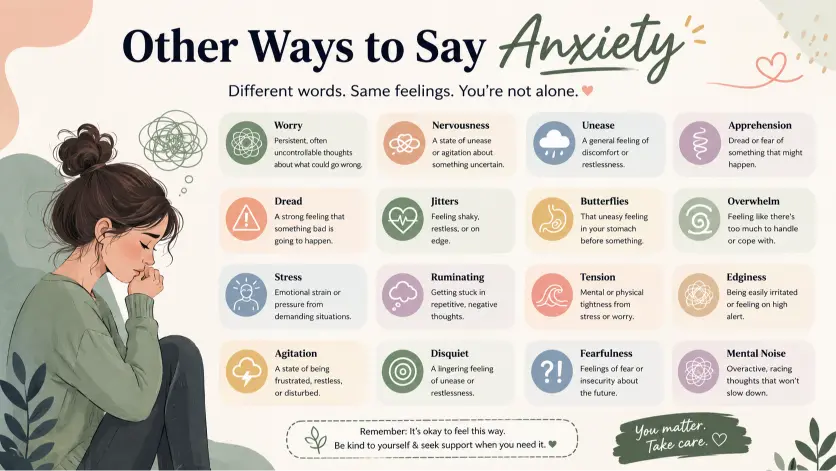
Feeling anxious but struggling to find the right words? Sometimes “anxiety” feels too general to describe exactly what you mean. You might be experiencing nervousness before an important event, worrying about something that has not happened yet, or feeling uneasy in an unfamiliar situation. Having a wider vocabulary helps you communicate these emotions more clearly and naturally. From everyday conversations to professional writing, choosing the right expression can make your message more precise and meaningful.
In this guide, we’ll explore 30 other ways to say anxiety, including natural synonyms, formal alternatives, conversational expressions, and phrases that describe specific types of worry or nervousness. Each option is explained with its meaning and appropriate context so you can confidently choose the right word for the situation. For you are an English learner, a student, or a professional improving your communication skills, these alternatives can help you express yourself with greater accuracy and confidence
Quick Categories
Formal alternatives to “anxiety”
- Apprehension
- Unease
- Concern
- Distress
These expressions work well in formal conversations, reports, academic writing, and serious discussions.
Pro Tip: Use apprehension or concern when you want to describe worry without sounding overly emotional.
Casual alternatives
- Worry
- Nervousness
- Feeling uneasy
- Feeling stressed
These expressions are natural in everyday conversations with friends, family, and acquaintances.
Pro Tip: In casual speech, choose familiar words such as worry or nervousness instead of unnecessarily complicated vocabulary.
Professional alternatives
- Concern
- Uncertainty
- Apprehension
- Stress
These phrases are useful when discussing workplace concerns, deadlines, presentations, meetings, or important decisions.
Pro Tip: In professional communication, describe the specific source of concern whenever possible.
Informal expressions
- Feeling on edge
- Feeling tense
- Feeling stressed out
- Having a lot on my mind
These expressions are conversational and work best when speaking naturally with people you know.
Pro Tip: Informal expressions can make conversations sound natural, but avoid overly casual wording in formal emails and reports.
Vocabulary becomes powerful when you match the word to the situation.
Common Mistakes
1. Using “anxiety” for every level of nervousness
Mistake: “I have anxiety about my presentation.”
Better: “I feel nervous about my presentation.”
Nervousness may be more appropriate when describing temporary tension before an event.
2. Confusing concern with severe emotional distress
Mistake: “I have serious anxiety about the meeting,” when you only mean mild concern.
Better: “I have some concerns about the meeting.”
The word concern often sounds more measured and professional.
3. Using informal expressions in formal writing
Mistake: “I am really stressed out about the project” in a formal report.
Better: “I have some concerns regarding the project.”
4. Treating every synonym as exactly identical
Mistake: Assuming worry, apprehension, and unease always have the same meaning.
Better: Choose the expression according to emotional intensity and context.
5. Using “anxiety” when you mean excitement
Mistake: “I feel anxious because I am going to the concert,” when you actually mean enthusiastic anticipation.
Better: “I am excited about going to the concert.”
Context matters because anxious can sometimes be misunderstood as worried rather than excited.
What Does “Anxiety” Mean?
Anxiety is a feeling of worry, nervousness, fear, or uneasiness about a possible situation, outcome, or uncertainty.
As a noun, anxiety commonly follows verbs such as feel, experience, cause, or reduce.
Example:
“I felt anxiety before the interview.”
In everyday English, the word can describe anything from temporary worry to more serious emotional experiences. The exact meaning depends on context.
When to Use “Anxiety”
You can use the word in many contexts, including:
- Before an important interview or examination
- Before giving a presentation
- When discussing uncertainty about the future
- When describing worries about an important decision
- In personal conversations about emotional experiences
- In academic or professional discussions
- When discussing reactions to stressful situations
Spoken vs Written
Spoken:
“I felt a lot of anxiety before the presentation.”
Written:
“The uncertainty created considerable anxiety among employees.”
Formal vs Informal
Formal:
“The decision caused considerable apprehension.”
Informal:
“I was really nervous about it.”
Precision matters more than using the most complicated synonym.
Is It Professional or Polite to Say “Anxiety”?
Polite? ✔️ Yes
Professional? ❌ No, in most cases
The word itself is not impolite or grammatically inappropriate in professional communication. However, workplace writing often benefits from more specific and neutral terms such as concern, uncertainty, apprehension, or stress, especially when discussing a project, decision, deadline, or organizational issue.
Business example:
“We have some concerns about the proposed timeline and would appreciate clarification regarding the next steps.”
This sounds more professional than simply saying:
“I have anxiety about the project.”
Pros and Cons of Using “Anxiety”
Pros
- Simple and natural: Most English speakers understand it immediately.
- Friendly tone: It can work naturally in personal conversations.
- Common usage: The word appears frequently in spoken and written English.
- Easy to understand: Its meaning is generally clear from context.
Cons
- Too informal for work: It may not always be the most precise workplace expression.
- Overused: Repeating it can make your vocabulary sound limited.
- Limited emotional range: It does not always show exactly how mild or intense the feeling is.
- Not suitable for formal writing: More precise alternatives may communicate the intended meaning better.
Other Ways to Say “Anxiety” With Examples
These alternatives will help you sound more fluent, confident, and natural in different situations.
Use them according to tone, context, and audience to express excitement, admiration, approval, concern, or other emotional reactions accurately.
1. Phrase: Nervousness
Meaning: A feeling of worry or tension before or during an uncertain situation.
Explanation: This is one of the most natural alternatives when describing temporary nervous feelings.
Example Sentence: “Her nervousness disappeared once the presentation began.”
Best Use: Everyday situations
Worst Use: Technical writing
Tone: Natural, neutral, friendly
Context Variability: Casual / professional / spoken
2. Phrase: Worry
Meaning: Concern about something that might happen.
Explanation: Worry is simple, common, and widely understood in everyday English.
Example Sentence: “His worry about the upcoming exam kept him awake.”
Best Use: Everyday conversation
Worst Use: Formal reports
Tone: Simple, natural, direct
Context Variability: Casual / professional / spoken
3. Phrase: Concern
Meaning: A feeling that something may be problematic.
Explanation: Concern is especially useful in professional communication because it sounds measured.
Example Sentence: “We have some concerns about the proposed deadline.”
Best Use: Workplace communication
Worst Use: Casual emotions
Tone: Professional, polite, measured
Context Variability: Casual / professional / written
4. Phrase: Unease
Meaning: A feeling that something is uncomfortable or uncertain.
Explanation: This word communicates mild emotional discomfort without necessarily suggesting intense fear.
Example Sentence: “The sudden change in plans created a sense of unease.”
Best Use: Formal descriptions
Worst Use: Casual texting
Tone: Formal, subtle, serious
Context Variability: Professional / written / spoken
5. Phrase: Apprehension
Meaning: Concern or fear about something that may happen.
Explanation: Apprehension is useful when someone anticipates an uncertain or potentially difficult situation.
Example Sentence: “She approached the interview with some apprehension.”
Best Use: Formal communication
Worst Use: Casual chat
Tone: Formal, thoughtful, serious
Context Variability: Professional / written / spoken
6. Phrase: Stress
Meaning: Mental or emotional pressure caused by demanding circumstances.
Explanation: Stress focuses more on pressure or demands than on fear alone.
Example Sentence: “The tight deadline has caused considerable stress.”
Best Use: Workplace situations
Worst Use: Emotional nuance
Tone: Neutral, professional, direct
Context Variability: Casual / professional / spoken
7. Phrase: Tension
Meaning: A state of mental or emotional strain.
Explanation: Tension can describe an internal feeling or a difficult atmosphere.
Example Sentence: “There was noticeable tension before the announcement.”
Best Use: Serious situations
Worst Use: Friendly conversations
Tone: Neutral, serious, descriptive
Context Variability: Professional / written / spoken
8. Phrase: Nervous tension
Meaning: A combination of nervousness and emotional strain.
Explanation: This phrase emphasizes physical or emotional tension caused by nervous feelings.
Example Sentence: “You could sense the nervous tension before the interview started.”
Best Use: Descriptive writing
Worst Use: Formal reports
Tone: Descriptive, natural, expressive
Context Variability: Casual / written / spoken
9. Phrase: Feeling uneasy
Meaning: Feeling uncomfortable, uncertain, or worried.
Explanation: This conversational phrase is useful when you want to describe mild anxiety naturally.
Example Sentence: “I am feeling uneasy about the decision.”
Best Use: Personal conversations
Worst Use: Formal documents
Tone: Natural, gentle, conversational
Context Variability: Casual / professional / spoken
10. Phrase: Feeling on edge
Meaning: Feeling tense, nervous, or easily worried.
Explanation: This is a common informal expression for being mentally or emotionally unsettled.
Example Sentence: “I have been feeling on edge all morning.”
Best Use: Informal conversation
Worst Use: Business reports
Tone: Informal, conversational, expressive
Context Variability: Casual / spoken / informal
11. Phrase: Distress
Meaning: Significant emotional difficulty or suffering.
Explanation: Distress is stronger than ordinary worry and is often used in serious contexts.
Example Sentence: “The uncertainty caused considerable distress among the team.”
Best Use: Serious contexts
Worst Use: Light conversations
Tone: Formal, serious, strong
Context Variability: Professional / written / spoken
12. Phrase: Fear
Meaning: A strong emotional reaction to perceived danger or an unwanted outcome.
Explanation: Fear is stronger and more direct than many alternatives.
Example Sentence: “He expressed fear about losing his job.”
Best Use: Strong emotions
Worst Use: Mild concerns
Tone: Direct, strong, serious
Context Variability: Casual / professional / spoken
13. Phrase: Insecurity
Meaning: A lack of confidence or certainty about oneself or a situation.
Explanation: This word is useful when worry comes from self doubt or uncertainty.
Example Sentence: “Her insecurity made her nervous about speaking in front of the group.”
Best Use: Personal situations
Worst Use: Formal complaints
Tone: Personal, reflective, serious
Context Variability: Casual / written / spoken
14. Phrase: Uncertainty
Meaning: A lack of confidence about what will happen.
Explanation: Uncertainty focuses on not knowing the outcome rather than emotional fear.
Example Sentence: “The uncertainty surrounding the decision is frustrating.”
Best Use: Professional communication
Worst Use: Emotional conversations
Tone: Neutral, professional, precise
Context Variability: Professional / written / spoken
15. Phrase: Concern about the future
Meaning: Worry about what may happen later.
Explanation: This phrase is useful when the source of worry is specifically future events.
Example Sentence: “Many employees have concerns about the future of the company.”
Best Use: Workplace discussions
Worst Use: Casual greetings
Tone: Professional, thoughtful, neutral
Context Variability: Professional / written / spoken
16. Phrase: Fear of the unknown
Meaning: Worry caused by uncertainty about future events.
Explanation: This expression highlights uncertainty rather than a specific known problem.
Example Sentence: “Her fear of the unknown made the transition difficult.”
Best Use: Reflective writing
Worst Use: Business emails
Tone: Reflective, serious, expressive
Context Variability: Casual / written / spoken
17. Phrase: Emotional strain
Meaning: Mental or emotional pressure caused by difficult circumstances.
Explanation: This phrase works well when describing prolonged pressure.
Example Sentence: “The prolonged uncertainty placed considerable emotional strain on the team.”
Best Use: Formal writing
Worst Use: Casual chat
Tone: Formal, serious, measured
Context Variability: Professional / written / spoken
18. Phrase: Mental strain
Meaning: Psychological pressure resulting from demanding circumstances.
Explanation: It emphasizes the effect of pressure on someone’s mental state.
Example Sentence: “The demanding schedule created significant mental strain.”
Best Use: Professional contexts
Worst Use: Friendly chat
Tone: Formal, serious, neutral
Context Variability: Professional / written / spoken
19. Phrase: Restlessness
Meaning: An inability to relax or remain calm.
Explanation: Restlessness can be one noticeable result of worry or emotional tension.
Example Sentence: “His restlessness made it difficult to concentrate.”
Best Use: Descriptive writing
Worst Use: Formal requests
Tone: Descriptive, neutral, thoughtful
Context Variability: Casual / written / spoken
20. Phrase: Nervous anticipation
Meaning: A mixture of expectation and nervousness.
Explanation: This phrase is appropriate when someone is waiting for an important event.
Example Sentence: “She waited with nervous anticipation for the interview results.”
Best Use: Event descriptions
Worst Use: Business complaints
Tone: Expressive, neutral, descriptive
Context Variability: Casual / written / spoken
21. Phrase: Feeling tense
Meaning: Experiencing mental or physical tightness caused by pressure.
Explanation: This conversational expression is useful for describing a temporary state.
Example Sentence: “I am feeling tense about tomorrow’s meeting.”
Best Use: Everyday speech
Worst Use: Formal reports
Tone: Casual, natural, direct
Context Variability: Casual / spoken / informal
22. Phrase: Feeling stressed
Meaning: Experiencing pressure or emotional strain.
Explanation: This is one of the most common everyday expressions for stress related worry.
Example Sentence: “I have been feeling stressed because of the deadline.”
Best Use: Everyday communication
Worst Use: Formal documents
Tone: Natural, casual, direct
Context Variability: Casual / professional / spoken
23. Phrase: Having a lot on my mind
Meaning: Having many thoughts or worries occupying your attention.
Explanation: This informal expression avoids directly naming the emotion while clearly communicating mental pressure.
Example Sentence: “Sorry I seem distracted; I have a lot on my mind.”
Best Use: Personal conversations
Worst Use: Formal reports
Tone: Informal, natural, personal
Context Variability: Casual / spoken / informal
24. Phrase: Feeling overwhelmed
Meaning: Feeling unable to comfortably manage many demands or emotions.
Explanation: This expression focuses on having more pressure than you feel able to handle.
Example Sentence: “I am feeling overwhelmed by everything I need to finish.”
Best Use: Personal situations
Worst Use: Formal reports
Tone: Emotional, natural, direct
Context Variability: Casual / professional / spoken
25. Phrase: Emotional discomfort
Meaning: An uncomfortable emotional state.
Explanation: This phrase provides a neutral and somewhat formal way to describe difficult feelings.
Example Sentence: “The uncertainty created considerable emotional discomfort.”
Best Use: Formal discussion
Worst Use: Casual chat
Tone: Formal, neutral, restrained
Context Variability: Professional / written / spoken
26. Phrase: Feelings of worry
Meaning: Emotional reactions involving concern about something.
Explanation: This phrase is clear and flexible in both spoken and written English.
Example Sentence: “She experienced feelings of worry before making the decision.”
Best Use: Clear explanations
Worst Use: Casual slang
Tone: Neutral, clear, gentle
Context Variability: Casual / professional / written
27. Phrase: Sense of apprehension
Meaning: A feeling that something difficult or unpleasant may happen.
Explanation: This phrase is especially useful in descriptive and formal writing.
Example Sentence: “There was a growing sense of apprehension among employees.”
Best Use: Formal writing
Worst Use: Casual texting
Tone: Formal, serious, polished
Context Variability: Professional / written / spoken
28. Phrase: Fear and uncertainty
Meaning: A combination of concern about danger and lack of confidence about the future.
Explanation: This phrase is useful when both emotional fear and unclear outcomes are involved.
Example Sentence: “The sudden change created fear and uncertainty among residents.”
Best Use: Serious situations
Worst Use: Casual greetings
Tone: Serious, direct, formal
Context Variability: Professional / written / spoken
29. Phrase: Feeling unsettled
Meaning: Feeling uncomfortable, uncertain, or unable to relax.
Explanation: This expression is softer than fear and works well for mild emotional discomfort.
Example Sentence: “I have been feeling unsettled since the announcement.”
Best Use: Personal discussions
Worst Use: Formal reports
Tone: Gentle, natural, reflective
Context Variability: Casual / spoken / written
30. Phrase: Apprehensive feelings
Meaning: Feelings of worry about an expected event or outcome.
Explanation: This phrase emphasizes anticipation and concern about something that has not happened yet.
Example Sentence: “She had apprehensive feelings before starting her new position.”
Best Use: Reflective writing
Worst Use: Casual chat
Tone: Formal, reflective, serious
Context Variability: Professional / written / spoken
Fluent English is not about knowing one synonym; it is about knowing which expression fits the moment.
How to Choose the Right Alternative
Choosing the best alternative depends on the exact emotion you want to communicate.
For mild worry
Use:
- Concern
- Unease
- Feeling uneasy
- Uncertainty
Example:
“I have some concerns about the new schedule.”
For temporary nervousness
Use:
- Nervousness
- Feeling tense
- Nervous anticipation
- Feeling on edge
Example:
“I felt nervous before my presentation.”
For professional communication
Use:
- Concern
- Apprehension
- Uncertainty
- Emotional strain
Example:
“We have some concerns regarding the proposed timeline.”
For stronger emotional reactions
Use:
- Fear
- Distress
- Emotional strain
- Feeling overwhelmed
Example:
“The sudden change caused considerable distress.”
For informal conversations
Use:
- Feeling stressed
- Feeling uneasy
- Feeling on edge
- Having a lot on my mind
Example:
“I have a lot on my mind right now.”
Professional Reaction Phrases
In workplace communication, it is often better to describe the source of concern rather than simply label the emotion.
Instead of:
“I am anxious about the project.”
Try:
- “I have some concerns about the project timeline.”
- “I am uncertain about the proposed approach.”
- “I have some reservations about the current plan.”
- “The deadline is creating some pressure.”
- “I would appreciate clarification regarding the next steps.”
These professional reaction phrases sound specific, calm, and constructive.
Informal Expressions in English
Informal expressions can make conversations sound more natural when you are speaking with friends or people you know well.
Examples include:
- “I am feeling a little uneasy.”
- “I am pretty nervous about it.”
- “I have a lot on my mind.”
- “I have been feeling on edge.”
- “I am feeling stressed about tomorrow.”
Use these expressions naturally rather than forcing a formal synonym into a casual conversation.
See Also
- See also: Other Ways to Say Pardon for more natural alternatives in everyday and professional English.
- See also: A Professional English guide for improving workplace vocabulary, tone, and communication.
Mini Quiz: Test Your Understanding
1. Which phrase is most suitable for a formal business email?
A. I am super stressed out.
B. I am freaking out.
C. I have some concerns about the timeline.
D. I am feeling weird about it.
Answer: C
2. Which expression is most natural in a casual conversation?
A. Feeling on edge
B. Considerable apprehension
C. Emotional distress
D. Significant uncertainty
Answer: A
3. You are nervous before giving a presentation. Which sentence sounds most natural?
A. “I am experiencing substantial emotional distress.”
B. “I feel nervous before presentations.”
C. “I possess apprehension.”
D. “I have formal uncertainty.”
Answer: B
4. Which word focuses most directly on not knowing what will happen?
A. Uncertainty
B. Nervousness
C. Tension
D. Restlessness
Answer: A
Comparison Table: Top Alternatives
| Phrase | Tone | Best Use |
| Nervousness | Natural, neutral | Presentations and events |
| Worry | Simple, direct | Everyday conversations |
| Concern | Professional, polite | Workplace communication |
| Unease | Formal, subtle | Serious discussions |
| Apprehension | Formal, serious | Future events |
| Stress | Neutral, direct | Work pressure |
| Tension | Serious, descriptive | Difficult situations |
| Feeling uneasy | Conversational, gentle | Personal discussions |
| Feeling on edge | Informal, expressive | Casual conversations |
| Uncertainty | Professional, precise | Decisions and outcomes |
Frequently Asked Questions
1. What are the best alternatives to anxiety?
Some of the most useful alternatives are nervousness, worry, concern, unease, apprehension, stress, tension, and uncertainty. The best choice depends on the intensity and context.
2. What is a professional way to say anxiety?
Concern, apprehension, uncertainty, stress, and emotional strain can work well in professional settings. Concern is particularly useful in workplace emails and discussions.
3. What is a casual way to say anxiety?
Natural casual expressions include feeling nervous, feeling uneasy, feeling stressed, feeling on edge, and having a lot on my mind.
4. Is “nervousness” the same as “anxiety”?
Not always. Nervousness often describes temporary tension before an event, while anxiety can describe a broader or stronger feeling of worry and unease.
5. How can I improve my vocabulary for describing anxiety?
Learn synonyms by context rather than memorizing isolated words. Practice using different expressions in casual conversations, workplace emails, presentations, and formal writing.
Conclusion
Learning different ways to describe anxiety helps you communicate emotions with greater accuracy and confidence. Words such as nervousness, worry, concern, unease, apprehension, and uncertainty each carry slightly different meanings and levels of formality.
The key is to match your vocabulary to your audience and situation. Practice replacing repetitive words with appropriate alternatives in everyday conversations, professional emails, presentations, and writing. The more you notice tone and context, the more naturally these expressions will become part of your English vocabulary.









