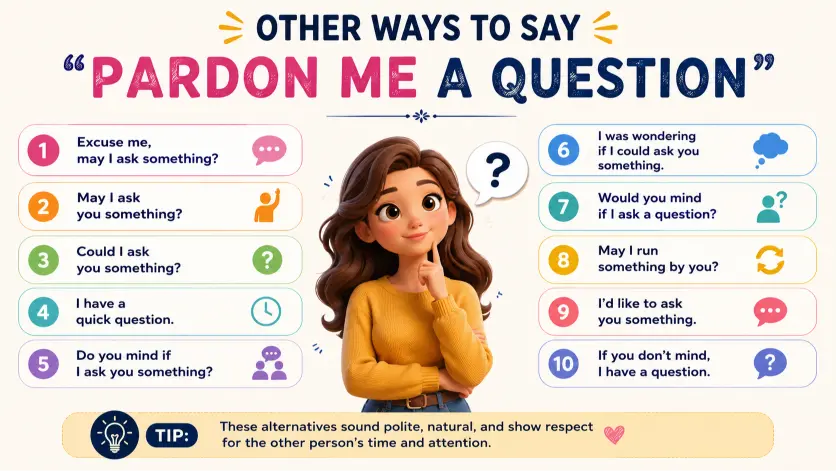
Have you ever said “pardon” and wondered if there was a more natural, polite, or professional way to express yourself? You’re not alone. In everyday English, the right phrase can make a conversation sound smoother and help you communicate with confidence. From asking someone to repeat what they said to politely getting their attention, there are many useful alternatives to “pardon.”
Learning these expressions is especially valuable for English learners and professionals who want to adapt their language to different situations. A casual conversation with a friend may call for a simple “Sorry?” while a workplace discussion may sound better with “Could you repeat that, please?” This guide brings together practical alternatives with clear explanations and examples, helping you understand not just what to say, but when to say it. With commonly used expressions, context-based guidance, and professional communication tips, you’ll be able to choose the right alternative naturally and confidently.
Quick Categories
Formal Alternatives to “Pardon”
- I beg your pardon
- I apologize
- Could you repeat that, please?
- Would you mind repeating that?
These expressions work well when you want to sound respectful, careful, and courteous.
Pro Tip: In formal situations, choose a complete sentence instead of relying on a one word response.
Casual Alternatives
- Sorry?
- Excuse me?
- What was that?
- Could you say that again?
These expressions are natural in everyday conversations with friends, family, classmates, or familiar colleagues.
Pro Tip: Use your voice and facial expression carefully because short expressions such as “What?” can sound impatient.
Professional Alternatives
- Could you clarify that?
- Could you repeat that, please?
- Would you mind clarifying?
- Could you say that again for me?
These phrases are particularly useful in meetings, presentations, interviews, customer service, and workplace conversations.
Pro Tip: In professional communication, polite wording plus “please” can make a simple request sound considerably more respectful.
Informal Expressions
- Sorry, I missed that.
- Can you say that again?
- I didn’t catch that.
- Come again?
These informal expressions are common in relaxed conversations.
Pro Tip: Avoid very informal expressions when speaking to clients, senior colleagues, or people you have just met.
Tone changes meaning. “What?” and “Could you repeat that, please?” may have the same purpose, but they create very different impressions.
Common Mistakes
1. Using “Pardon?” with an annoyed tone
Mistake: Saying “Pardon?” sharply can make it sound like you are challenging someone.
Example: “Pardon?” with an irritated tone.
Better: “Sorry, could you repeat that, please?”
2. Using “What?” in formal conversations
Mistake: “What?” is understandable but can sound abrupt.
Example: “What? I didn’t hear you.”
Better: “Could you say that again, please?”
3. Confusing “pardon” with an apology
Mistake: Assuming pardon always means “I am sorry.”
Example: “Pardon, I broke your laptop.”
Better: “I apologize for breaking your laptop.”
4. Overusing “I beg your pardon”
Mistake: Using this expression for every small misunderstanding can sound overly formal.
Example: “I beg your pardon?” during a casual conversation with a close friend.
Better: “Sorry?” or “Could you say that again?”
5. Forgetting context
Mistake: Choosing an expression without considering the listener.
Example: “Come again?” during a formal interview.
Better: “Would you mind repeating the question?”
What Does “Pardon” Mean?
Pardon is a polite expression used to ask someone to repeat something you did not hear or understand. It can also be used as a verb meaning to forgive someone for an offense or mistake.
In conversation, “Pardon?” usually means that you want the speaker to repeat what they said.
Example: “Pardon? I didn’t hear the last part.”
The expression can be polite, but its appropriateness depends on tone and context.
When to Use “Pardon”
You can use pardon in several situations:
- When you did not hear someone clearly
- When you want someone to repeat a statement
- When you want to politely interrupt someone
- When you need clarification
- In formal or traditional conversational settings
- When speaking to someone you do not know well
Spoken vs Written
Spoken: “Pardon? Could you repeat that?”
Written: “Could you please clarify your previous point?”
In written communication, especially professional email, a complete request is usually clearer than simply writing “Pardon?”
Formal vs Informal
Formal: “Would you mind repeating that, please?”
Neutral: “Could you say that again?”
Informal: “Sorry, I missed that.”
Is It Professional or Polite to Say “Pardon”?
Polite? ✔️ Yes
Professional? ❌ No, in most cases
“Pardon” is certainly polite, but it can sound somewhat traditional or formal depending on the speaker and region. In modern professional English, clearer expressions such as “Could you repeat that, please?” are often more natural.
Business Example
“I’m sorry, could you repeat the deadline for the project, please?”
This sounds professional, respectful, and easy to understand.
Professional English is not about using the most complicated phrase. It is about choosing clear and appropriate language.
Pros and Cons of Using “Pardon”
Pros
- Simple and natural: It is short and easy to say.
- Friendly tone: It can sound polite when delivered warmly.
- Common usage: Many English speakers understand it immediately.
- Easy to understand: Its meaning is usually clear from context.
Cons
- Too informal for work: A single “Pardon?” may sound less polished in some workplaces.
- Overused: Repeating it frequently can make your speech sound limited.
- Limited emotional range: It does not communicate much about your exact reaction.
- Not suitable for formal writing: A complete sentence is usually better in emails and business documents.
Other Ways to Say “Pardon” With Examples
These alternatives will help you sound more fluent, confident, and natural in different situations.
Use them according to tone, context, and audience. They can help you express clarification, surprise, apology, or polite attention more naturally. While they are not all used to express excitement in English, they give you a broader collection of professional reaction phrases and informal expressions in English.
1. Phrase: Excuse me?
Meaning: A polite request for someone to repeat or clarify something.
Explanation: This is one of the most versatile alternatives in everyday English.
Example Sentence: “Excuse me? Could you repeat the last part?”
Best Use: Everyday conversation
Worst Use: Formal writing
Tone: Polite, neutral, courteous
Context Variability: Casual and professional spoken English.
2. Phrase: Sorry?
Meaning: A short way to ask someone to repeat themselves.
Explanation: It is extremely common in conversational English.
Example Sentence: “Sorry? I didn’t hear your question.”
Best Use: Casual conversation
Worst Use: Formal documents
Tone: Friendly, natural, polite
Context Variability: Casual spoken English.
3. Phrase: Could you repeat that, please?
Meaning: A polite request for repetition.
Explanation: This is one of the safest choices in professional communication.
Example Sentence: “Could you repeat that, please? I want to make sure I understood correctly.”
Best Use: Workplace communication
Worst Use: Very casual chats
Tone: Professional, courteous, clear
Context Variability: Professional and spoken English.
4. Phrase: Could you say that again?
Meaning: A request for someone to repeat their statement.
Explanation: It sounds natural without being excessively formal.
Example Sentence: “Could you say that again? I was distracted for a moment.”
Best Use: Everyday conversation
Worst Use: Formal documents
Tone: Neutral, friendly, direct
Context Variability: Casual and workplace speech.
5. Phrase: Would you mind repeating that?
Meaning: A polite request for repetition.
Explanation: This expression adds extra politeness through the phrase “would you mind.”
Example Sentence: “Would you mind repeating that? I didn’t catch the figure.”
Best Use: Professional settings
Worst Use: Fast casual chats
Tone: Respectful, formal, courteous
Context Variability: Professional spoken English.
6. Phrase: I didn’t catch that.
Meaning: You did not hear or understand something.
Explanation: “Catch” means understand or hear something successfully in this context.
Example Sentence: “Sorry, I didn’t catch that. Could you repeat it?”
Best Use: Everyday speech
Worst Use: Formal reports
Tone: Natural, friendly, conversational
Context Variability: Casual and workplace speech.
7. Phrase: I didn’t hear you.
Meaning: You were unable to hear what someone said.
Explanation: It directly explains why you need the speaker to repeat themselves.
Example Sentence: “I didn’t hear you. Could you speak a little louder?”
Best Use: Noisy situations
Worst Use: Formal email
Tone: Direct, neutral, natural
Context Variability: Spoken English.
8. Phrase: Could you clarify that?
Meaning: A request for a clearer explanation.
Explanation: Use this when you heard the words but did not fully understand the meaning.
Example Sentence: “Could you clarify that point before we continue?”
Best Use: Professional discussion
Worst Use: Casual greetings
Tone: Professional, precise, respectful
Context Variability: Workplace and academic English.
9. Phrase: Could you clarify what you mean?
Meaning: A request for an explanation of someone’s meaning.
Explanation: This works better than a repetition request when the original statement was unclear.
Example Sentence: “Could you clarify what you mean by the final requirement?”
Best Use: Business discussion
Worst Use: Casual small talk
Tone: Professional, thoughtful, direct
Context Variability: Professional spoken and written English.
10. Phrase: Would you mind clarifying?
Meaning: A polite request for additional information.
Explanation: It is useful when you understand the words but need more detail.
Example Sentence: “Would you mind clarifying the second point?”
Best Use: Formal discussion
Worst Use: Informal texting
Tone: Formal, respectful, polished
Context Variability: Professional and academic English.
11. Phrase: Could you say that once more?
Meaning: A polite request for repetition.
Explanation: “Once more” gives the phrase a slightly more formal sound.
Example Sentence: “Could you say that once more, please?”
Best Use: Polite conversation
Worst Use: Casual texting
Tone: Courteous, formal, calm
Context Variability: Spoken formal English.
12. Phrase: Could you repeat yourself?
Meaning: A direct request for someone to say something again.
Explanation: It is clear but can sound slightly direct without “please.”
Example Sentence: “Could you repeat yourself, please? The connection was unclear.”
Best Use: Clear communication
Worst Use: Heated conversation
Tone: Direct, neutral, polite
Context Variability: Spoken professional English.
13. Phrase: I beg your pardon?
Meaning: A very polite request for repetition or clarification.
Explanation: It can also express surprise or disagreement depending on tone.
Example Sentence: “I beg your pardon? Did you say the meeting starts at six?”
Best Use: Formal conversation
Worst Use: Casual texting
Tone: Formal, traditional, courteous
Context Variability: Formal spoken English.
14. Phrase: Sorry, I missed that.
Meaning: You did not hear or understand something.
Explanation: It sounds natural and friendly in everyday conversation.
Example Sentence: “Sorry, I missed that. What time should we meet?”
Best Use: Everyday speech
Worst Use: Formal reports
Tone: Friendly, natural, relaxed
Context Variability: Casual and workplace speech.
15. Phrase: Can you say that again?
Meaning: A straightforward request for repetition.
Explanation: It is common among friends, classmates, and familiar colleagues.
Example Sentence: “Can you say that again? I wasn’t listening carefully.”
Best Use: Familiar conversations
Worst Use: Formal interviews
Tone: Casual, direct, friendly
Context Variability: Casual spoken English.
16. Phrase: Can you repeat that?
Meaning: A direct request to hear something again.
Explanation: It is simple and useful when clarity matters.
Example Sentence: “Can you repeat that? The audio cut out.”
Best Use: Everyday communication
Worst Use: Formal letters
Tone: Neutral, direct, practical
Context Variability: Spoken English.
17. Phrase: What was that?
Meaning: A request for someone to repeat what they said.
Explanation: It is common in informal conversations but can sound abrupt.
Example Sentence: “What was that? I couldn’t hear you over the music.”
Best Use: Casual conversation
Worst Use: Formal meetings
Tone: Informal, direct, conversational
Context Variability: Casual spoken English.
18. Phrase: Come again?
Meaning: An informal request for repetition.
Explanation: It is conversational and should generally be avoided in formal settings.
Example Sentence: “Come again? I didn’t understand the last part.”
Best Use: Friendly conversation
Worst Use: Business meetings
Tone: Informal, relaxed, conversational
Context Variability: Casual spoken English.
19. Phrase: Please say that again.
Meaning: A polite request for repetition.
Explanation: Adding “please” makes the direct request more courteous.
Example Sentence: “Please say that again. I want to write it down correctly.”
Best Use: Clear conversation
Worst Use: Formal reports
Tone: Polite, direct, respectful
Context Variability: Spoken English.
20. Phrase: I’m sorry, could you repeat that?
Meaning: A polite request for someone to repeat their words.
Explanation: The apology softens the request and makes it suitable for professional settings.
Example Sentence: “I’m sorry, could you repeat that? I want to make sure I have the correct number.”
Best Use: Workplace conversation
Worst Use: Casual greetings
Tone: Polite, professional, respectful
Context Variability: Professional spoken English.
21. Phrase: Could you go over that again?
Meaning: A request for someone to explain or repeat information.
Explanation: This works particularly well for instructions, processes, and presentations.
Example Sentence: “Could you go over that again? I want to understand the procedure.”
Best Use: Learning situations
Worst Use: Simple greetings
Tone: Professional, curious, respectful
Context Variability: Academic and workplace English.
22. Phrase: Could you explain that again?
Meaning: A request for another explanation.
Explanation: Use this when repetition alone may not solve the problem.
Example Sentence: “Could you explain that again in simpler terms?”
Best Use: Learning contexts
Worst Use: Quick casual replies
Tone: Polite, clear, thoughtful
Context Variability: Academic and professional English.
23. Phrase: Could you speak up?
Meaning: A request for someone to speak louder.
Explanation: Use this when the problem is volume rather than understanding.
Example Sentence: “Could you speak up, please? I can’t hear you from here.”
Best Use: Noisy environments
Worst Use: Formal writing
Tone: Direct, practical, polite
Context Variability: Spoken English.
24. Phrase: Could you repeat the question?
Meaning: A request for a question to be asked again.
Explanation: This is particularly useful in interviews, presentations, and examinations.
Example Sentence: “Could you repeat the question, please? I want to answer it accurately.”
Best Use: Interviews
Worst Use: Casual chats
Tone: Professional, respectful, clear
Context Variability: Academic and professional speech.
25. Phrase: Could you repeat the last part?
Meaning: A request to repeat only the part you missed.
Explanation: It is efficient because it identifies exactly what needs repeating.
Example Sentence: “Could you repeat the last part? I missed the deadline.”
Best Use: Meetings
Worst Use: Casual greetings
Tone: Clear, professional, focused
Context Variability: Workplace spoken English.
26. Phrase: Sorry, what did you say?
Meaning: A friendly request for repetition.
Explanation: This expression is natural but more conversational than formal.
Example Sentence: “Sorry, what did you say? I was checking my notes.”
Best Use: Casual conversation
Worst Use: Formal presentations
Tone: Friendly, conversational, polite
Context Variability: Casual spoken English.
27. Phrase: I’m not sure I heard you correctly.
Meaning: You are uncertain about what you heard.
Explanation: This is useful when accuracy is important.
Example Sentence: “I’m not sure I heard you correctly. Did you say Thursday?”
Best Use: Important details
Worst Use: Casual greetings
Tone: Careful, professional, respectful
Context Variability: Workplace and formal speech.
28. Phrase: Did you say…?
Meaning: A request to confirm what you think you heard.
Explanation: It allows you to check specific information instead of asking for everything again.
Example Sentence: “Did you say the appointment is at three?”
Best Use: Confirmation
Worst Use: Formal documents
Tone: Neutral, focused, conversational
Context Variability: Spoken casual and professional English.
29. Phrase: Could you clarify your point?
Meaning: A request for a clearer explanation of someone’s argument or idea.
Explanation: This phrase is especially useful during professional or academic discussions.
Example Sentence: “Could you clarify your point regarding the proposed changes?”
Best Use: Professional discussion
Worst Use: Casual conversation
Tone: Formal, analytical, respectful
Context Variability: Professional and academic English.
30. Phrase: May I ask you to repeat that?
Meaning: A very polite request for repetition.
Explanation: This formal structure is useful when you want to sound particularly courteous.
Example Sentence: “May I ask you to repeat that, please? I want to record the information correctly.”
Best Use: Formal situations
Worst Use: Casual chats
Tone: Formal, courteous, respectful
Context Variability: Formal spoken English.
When in doubt, “Could you repeat that, please?” is one of the safest choices for professional communication.
How to Choose the Right Alternative
Choosing among these alternatives depends mainly on three factors: relationship, setting, and intention.
If you simply did not hear someone, use “Sorry?”, “I didn’t catch that,” or “Could you repeat that, please?”
If you heard the words but did not understand the meaning, use “Could you clarify that?” or “Could you explain that again?”
If you are speaking to a client, manager, interviewer, or unfamiliar professional, choose a respectful expression such as “Would you mind repeating that?”
For friends and familiar colleagues, expressions such as “Can you say that again?” are usually natural.
See Also
Other Ways to Say “Understood” can help you build a wider vocabulary for acknowledging information clearly.
Professional English Guide: Learn how to choose polite, precise expressions for workplace conversations and written communication.
Mini Quiz and Self Check
1. You are in a business meeting and did not hear the manager’s deadline. What is the best option?
A. What?
B. Come again?
C. Could you repeat that, please?
D. Huh?
Answer: C
2. Your friend says something you cannot hear because of loud music. Which phrase sounds natural?
A. Sorry, I missed that.
B. I beg your pardon, esteemed colleague.
C. May I ask you to repeat that?
D. I hereby request clarification.
Answer: A
3. You heard someone’s words but do not understand their meaning. What should you say?
A. Could you clarify that?
B. What?
C. Come again?
D. Pardon me?
Answer: A
4. Which expression is more formal?
A. What was that?
B. Come again?
C. Would you mind repeating that?
D. Can you say that again?
Answer: C
Comparison Table: Top Alternatives
| Phrase | Tone | Best Use |
| Excuse me? | Polite, neutral | Everyday conversation |
| Sorry? | Friendly, natural | Casual conversation |
| Could you repeat that, please? | Professional, courteous | Workplace communication |
| Could you clarify that? | Professional, precise | Meetings |
| Would you mind repeating that? | Formal, respectful | Professional situations |
| I didn’t catch that | Casual, natural | Everyday speech |
| Could you say that again? | Neutral, friendly | Familiar conversations |
| I beg your pardon? | Formal, traditional | Formal conversation |
| Sorry, I missed that | Friendly, relaxed | Everyday speech |
| Could you explain that again? | Polite, thoughtful | Learning situations |
FAQs
What are the best alternatives to “pardon”?
Some of the most useful alternatives are excuse me, sorry, could you repeat that, could you clarify that, and would you mind repeating that? The best option depends on your context.
Is “pardon” polite in English?
Yes. “Pardon” is generally polite, especially when asking someone to repeat something. However, its tone can sound traditional in some modern professional settings.
What is a professional way to say “pardon”?
A strong professional alternative is “Could you repeat that, please?” Another excellent choice is “Would you mind repeating that?”
Is “sorry” a good alternative to “pardon”?
Yes. “Sorry?” is extremely common in spoken English when you did not hear someone. It is especially natural in everyday conversations.
What should I say instead of “pardon” in an email?
Instead of simply writing “Pardon,” use a complete expression such as “Could you please clarify this point?” or “Could you please repeat the information?” These sound clearer and more professional.
Fluent English means knowing not only what to say, but also when and how to say it.
Conclusion
Learning different alternatives to pardon gives you more control over your English. Instead of relying on one expression, you can choose language that matches the situation, from casual conversations with friends to formal workplace discussions. Expressions such as “Sorry?”, “I didn’t catch that,” and “Could you repeat that, please?” make your communication more flexible and natural.
The key is to practice tone awareness. Notice how native and proficient English speakers adjust their wording according to the audience and setting. Add a few professional reaction phrases and informal expressions in English to your daily vocabulary, then practice using them in realistic conversations. With regular practice, choosing the right phrase will become automatic.









