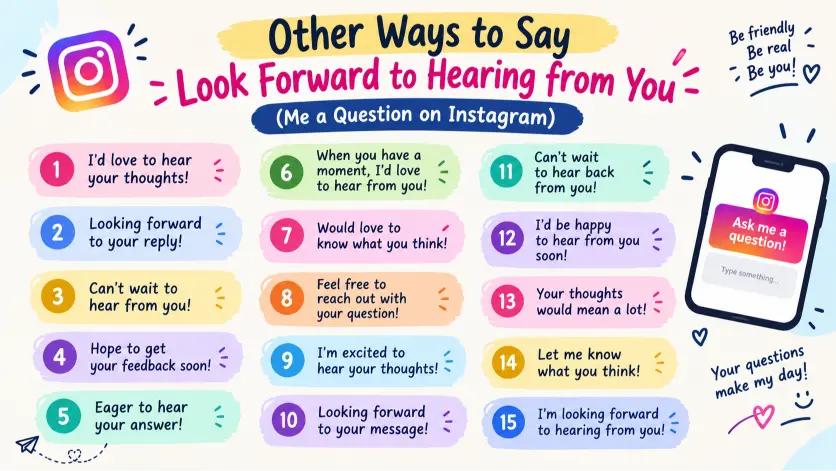
n professional emails, the closing line can shape how your message feels after the reader reaches the final sentence. “Look forward to hearing from you” is a widely used phrase, but repeating it in every email can make your communication sound predictable. Finding suitable alternatives allows you to match your closing with the situation, relationship, and level of formality. From polite business correspondence to friendly follow-ups, the right expression can make your message sound clearer and more natural.
This guide explores practical other ways to say “look forward to hearing from you”, with examples for emails, workplace communication, formal letters, and everyday professional conversations. The alternatives are organized by tone and purpose so English learners and professionals can quickly find an expression that fits their message. Each phrase should be chosen according to context rather than simply replacing one expression with another. This approach helps you communicate with greater precision, maintain a professional tone, and avoid repetitive email language.
Quick Categories
Formal alternatives to “look forward to hearing from you”
- I await your response.
- I would appreciate your response.
- I look forward to your reply.
- I await your further communication.
Pro Tip: Use these expressions for official correspondence, applications, business letters, and formal requests.
Casual alternatives
- I hope to hear from you soon.
- Hope to hear from you soon.
- Let me know what you think.
- I would love to hear your thoughts.
Pro Tip: Choose these when communicating with someone you already know or when the conversation has a relaxed tone.
Professional alternatives
- I look forward to your feedback.
- I look forward to your response.
- Please let me know your thoughts.
- I would welcome your feedback.
Pro Tip: Match the closing phrase to your purpose. Ask for feedback when you need an opinion and a response when you need an answer.
Informal expressions
- Let me know what you decide.
- Keep me posted.
- Let me know when you can.
- I hope to hear back from you.
Pro Tip: Save these informal expressions in English for friendly messages, familiar colleagues, and everyday conversations.
Professional English becomes stronger when you choose a phrase for its purpose rather than simply repeating a familiar expression.
Common Mistakes
1. Using “look forward to hear from you”
The correct grammar is “look forward to hearing from you.”
Example: I look forward to hearing from you regarding the proposal.
2. Using “looking forward to hear from you”
After looking forward to, use a noun or gerund form.
Example: I am looking forward to hearing from you.
3. Using a formal phrase in a casual message
A phrase such as “I await your response” may sound unnecessarily formal with a close friend.
Example: Instead, say, “Let me know what you think.”
4. Making the phrase sound demanding
“I expect to hear from you immediately” can sound forceful or impatient.
Example: Use “I would appreciate your response when convenient” when appropriate.
5. Repeating the same closing in every email
Using the same expression repeatedly can make your writing feel mechanical.
Example: Try “I look forward to your feedback” when you specifically need feedback.
What Does “Look Forward to Hearing From You” Mean?
“Look forward to hearing from you” means that you expect, welcome, or feel positive about receiving a response from someone.
Grammatically, look forward to is followed by a noun or gerund. Therefore, hearing is correct rather than hear.
Example:
I look forward to hearing from you about the position.
The expression is especially common at the end of professional emails and formal correspondence.
When to Use “Look Forward to Hearing From You”
You can use this phrase when:
- Ending a professional email
- Waiting for a client’s response
- Following up on an application
- Asking someone to provide information
- Responding to a business inquiry
- Communicating with a potential employer
- Following up after a meeting
- Waiting for feedback
- Continuing a professional conversation
- Requesting confirmation
Spoken vs Written
The expression is much more common in written English, particularly emails and letters. In spoken English, people often use simpler expressions such as “I hope to hear from you soon” or “Let me know what you think.”
Formal vs Informal
The original phrase works across several situations, but its tone is generally polite and professional. More formal alternatives can sound better in official correspondence, while shorter alternatives may feel more natural in everyday communication.
A natural English speaker does not use the most formal phrase every time. They choose language that fits the situation.
Is “Look Forward to Hearing From You” Professional or Polite?
Polite? ✔️ Yes
Professional? ❌ No, in most cases
The phrase is certainly polite and commonly accepted in professional communication. However, it can become repetitive, especially when used as a standard closing in every business email.
For more specific professional communication, consider alternatives such as “I look forward to your feedback” or “I would appreciate your response.”
Business example:
“I look forward to your feedback on the attached proposal.”
Pros and Cons of Using “Look Forward to Hearing From You”
Pros
- Simple and natural: Most readers understand it immediately.
- Friendly tone: It communicates positive expectations.
- Common usage: It is familiar in professional correspondence.
- Easy to understand: There is little risk of confusion.
Cons
- Too informal for some work situations: Highly official communication may require more precise language.
- Overused: Repetition can make emails sound formulaic.
- Limited emotional range: It does not clearly communicate urgency, appreciation, or enthusiasm.
- Not suitable for some formal writing: Certain official contexts benefit from more direct wording.
Other Ways to Say “Look Forward to Hearing From You”
These alternatives will help you sound more fluent, confident, and natural in different situations.
Use them according to tone, context, and audience to express excitement, admiration, or approval.
1. Phrase: I look forward to your reply
Meaning: You are positively expecting the person’s response.
Explanation: This is a polished alternative that works well in professional emails.
Example Sentence: I look forward to your reply regarding the proposed meeting date.
Best Use: Business emails
Worst Use: Close friendships
Tone: Professional, polite, confident
Context Variability: Casual: less common; Professional: excellent; Spoken: acceptable
2. Phrase: I look forward to your response
Meaning: You expect and welcome an answer.
Explanation: This phrase is direct and appropriate for workplace communication.
Example Sentence: I look forward to your response regarding the application.
Best Use: Formal correspondence
Worst Use: Casual chats
Tone: Formal, professional, respectful
Context Variability: Casual: uncommon; Professional: excellent; Spoken: formal
3. Phrase: I hope to hear from you soon
Meaning: You would like the person to respond soon.
Explanation: It sounds warmer and less formal than the original phrase.
Example Sentence: I hope to hear from you soon about the position.
Best Use: Follow up emails
Worst Use: Legal notices
Tone: Warm, polite, friendly
Context Variability: Casual: excellent; Professional: good; Spoken: natural
4. Phrase: Please let me know your thoughts
Meaning: You are asking someone to share an opinion.
Explanation: This is useful when you specifically want feedback rather than a general response.
Example Sentence: Please let me know your thoughts on the proposed changes.
Best Use: Requesting feedback
Worst Use: Simple confirmations
Tone: Professional, open, courteous
Context Variability: Casual: good; Professional: excellent; Spoken: natural
5. Phrase: I would appreciate your response
Meaning: You politely request a response.
Explanation: This phrase is useful when receiving an answer is important.
Example Sentence: I would appreciate your response by Friday.
Best Use: Formal requests
Worst Use: Friendly texts
Tone: Formal, courteous, direct
Context Variability: Casual: uncommon; Professional: excellent; Spoken: formal
6. Phrase: I await your response
Meaning: You are waiting for the person’s answer.
Explanation: This is a formal expression often used in official correspondence.
Example Sentence: I await your response regarding the matter discussed above.
Best Use: Official letters
Worst Use: Casual messages
Tone: Formal, direct, traditional
Context Variability: Casual: poor fit; Professional: excellent; Spoken: very formal
7. Phrase: I would welcome your feedback
Meaning: You would be pleased to receive someone’s opinion.
Explanation: This is especially useful when collaboration or review is involved.
Example Sentence: I would welcome your feedback on the revised proposal.
Best Use: Professional feedback
Worst Use: Urgent answers
Tone: Collaborative, professional, positive
Context Variability: Casual: good; Professional: excellent; Spoken: natural
8. Phrase: I look forward to your feedback
Meaning: You expect to receive someone’s comments or opinion.
Explanation: This phrase clearly identifies the type of response you want.
Example Sentence: I look forward to your feedback on the presentation.
Best Use: Workplace reviews
Worst Use: Personal messages
Tone: Professional, positive, focused
Context Variability: Casual: moderate; Professional: excellent; Spoken: natural
9. Phrase: I hope to hear back from you
Meaning: You hope the person will respond.
Explanation: This is a natural and friendly alternative for less formal communication.
Example Sentence: I hope to hear back from you after you review the documents.
Best Use: Friendly follow ups
Worst Use: Official notices
Tone: Friendly, polite, relaxed
Context Variability: Casual: excellent; Professional: good; Spoken: excellent
10. Phrase: Please keep me updated
Meaning: You want someone to provide new information as things develop.
Explanation: Use this when you expect ongoing communication rather than one response.
Example Sentence: Please keep me updated on the project’s progress.
Best Use: Ongoing projects
Worst Use: One time requests
Tone: Direct, professional, practical
Context Variability: Casual: good; Professional: excellent; Spoken: natural
11. Phrase: Please keep me posted
Meaning: You want someone to tell you about future developments.
Explanation: This is more conversational than “please keep me updated.”
Example Sentence: Please keep me posted about any changes to the schedule.
Best Use: Team communication
Worst Use: Formal letters
Tone: Casual, friendly, practical
Context Variability: Casual: excellent; Professional: good; Spoken: excellent
12. Phrase: Let me know what you think
Meaning: You are asking for someone’s opinion.
Explanation: This is one of the most natural alternatives in everyday and workplace English.
Example Sentence: Let me know what you think about the new design.
Best Use: Asking opinions
Worst Use: Official applications
Tone: Friendly, natural, approachable
Context Variability: Casual: excellent; Professional: good; Spoken: excellent
13. Phrase: Please let me know
Meaning: You are politely asking for information or confirmation.
Explanation: This flexible expression works in many professional situations.
Example Sentence: Please let me know if you need any additional information.
Best Use: General requests
Worst Use: Emotional messages
Tone: Polite, neutral, professional
Context Variability: Casual: good; Professional: excellent; Spoken: natural
14. Phrase: I hope we can connect soon
Meaning: You hope to communicate or speak with someone soon.
Explanation: This works particularly well when suggesting future communication.
Example Sentence: I hope we can connect soon to discuss the opportunity.
Best Use: Networking emails
Worst Use: Formal complaints
Tone: Warm, professional, optimistic
Context Variability: Casual: excellent; Professional: excellent; Spoken: natural
15. Phrase: I look forward to connecting with you
Meaning: You are positive about communicating in the future.
Explanation: This is popular in networking and professional relationship building.
Example Sentence: I look forward to connecting with you next week.
Best Use: Networking
Worst Use: Simple confirmations
Tone: Professional, warm, optimistic
Context Variability: Casual: good; Professional: excellent; Spoken: natural
16. Phrase: I look forward to speaking with you
Meaning: You are pleased about a future conversation.
Explanation: This is particularly appropriate before a scheduled call or interview.
Example Sentence: I look forward to speaking with you about the position.
Best Use: Scheduled calls
Worst Use: Written approvals
Tone: Professional, courteous, positive
Context Variability: Casual: good; Professional: excellent; Spoken: excellent
17. Phrase: I look forward to discussing this further
Meaning: You want to continue a discussion.
Explanation: This phrase works well when a topic requires additional conversation.
Example Sentence: I look forward to discussing this further during our meeting.
Best Use: Business discussions
Worst Use: Personal texts
Tone: Professional, confident, collaborative
Context Variability: Casual: moderate; Professional: excellent; Spoken: natural
18. Phrase: I hope we can speak soon
Meaning: You would like to have a conversation soon.
Explanation: This is a warm alternative for both professional and personal communication.
Example Sentence: I hope we can speak soon about the next steps.
Best Use: Follow up
Worst Use: Formal notices
Tone: Warm, polite, approachable
Context Variability: Casual: excellent; Professional: good; Spoken: excellent
19. Phrase: I would be glad to hear from you
Meaning: You would be pleased to receive a response.
Explanation: This phrase communicates positive interest without sounding demanding.
Example Sentence: I would be glad to hear from you when you have had a chance to review the proposal.
Best Use: Professional follow ups
Worst Use: Urgent requests
Tone: Warm, courteous, professional
Context Variability: Casual: good; Professional: excellent; Spoken: natural
20. Phrase: I would be pleased to hear from you
Meaning: You would welcome the person’s response.
Explanation: This is a polite expression suited to moderately formal communication.
Example Sentence: I would be pleased to hear from you regarding your availability.
Best Use: Formal emails
Worst Use: Casual texts
Tone: Polite, formal, positive
Context Variability: Casual: poor fit; Professional: excellent; Spoken: formal
21. Phrase: I hope to receive your response soon
Meaning: You expect a response and hope it arrives soon.
Explanation: This is more direct about the desired response than the original expression.
Example Sentence: I hope to receive your response soon so we can finalize the arrangements.
Best Use: Time sensitive requests
Worst Use: Friendly chats
Tone: Formal, direct, courteous
Context Variability: Casual: uncommon; Professional: excellent; Spoken: formal
22. Phrase: I would appreciate hearing from you
Meaning: You would value receiving a response.
Explanation: This polite phrase works well when you want to emphasize the importance of communication.
Example Sentence: I would appreciate hearing from you regarding the available options.
Best Use: Professional requests
Worst Use: Casual invitations
Tone: Respectful, professional, courteous
Context Variability: Casual: moderate; Professional: excellent; Spoken: formal
23. Phrase: Please let me know at your convenience
Meaning: You are inviting a response whenever the person has time.
Explanation: This reduces pressure and creates a considerate tone.
Example Sentence: Please let me know at your convenience if you would like to proceed.
Best Use: Flexible requests
Worst Use: Urgent matters
Tone: Considerate, professional, relaxed
Context Variability: Casual: good; Professional: excellent; Spoken: natural
24. Phrase: I would value your response
Meaning: You consider the person’s response important.
Explanation: This phrase is useful when addressing someone whose input matters to the decision.
Example Sentence: I would value your response before we finalize the proposal.
Best Use: Important decisions
Worst Use: Routine messages
Tone: Respectful, professional, appreciative
Context Variability: Casual: moderate; Professional: excellent; Spoken: natural
25. Phrase: I welcome your thoughts
Meaning: You are inviting someone’s opinion or suggestions.
Explanation: This phrase encourages open communication and collaboration.
Example Sentence: I welcome your thoughts on how we can improve the process.
Best Use: Collaborative work
Worst Use: Formal applications
Tone: Open, positive, professional
Context Variability: Casual: good; Professional: excellent; Spoken: natural
26. Phrase: I am eager to hear from you
Meaning: You are genuinely interested in receiving a response.
Explanation: This communicates more enthusiasm than the standard expression.
Example Sentence: I am eager to hear from you about the opportunity.
Best Use: Positive follow ups
Worst Use: Formal complaints
Tone: Enthusiastic, warm, positive
Context Variability: Casual: excellent; Professional: good; Spoken: natural
27. Phrase: I am interested to hear your thoughts
Meaning: You want to know someone’s opinion.
Explanation: This expression communicates curiosity about the other person’s perspective.
Example Sentence: I am interested to hear your thoughts on the proposed strategy.
Best Use: Discussions
Worst Use: Simple confirmations
Tone: Curious, professional, engaged
Context Variability: Casual: good; Professional: excellent; Spoken: natural
28. Phrase: I look forward to your confirmation
Meaning: You expect someone to confirm something.
Explanation: This is more specific and useful than a general request for a response.
Example Sentence: I look forward to your confirmation of the meeting time.
Best Use: Scheduling
Worst Use: Opinion requests
Tone: Professional, direct, courteous
Context Variability: Casual: good; Professional: excellent; Spoken: natural
29. Phrase: Let me know when you have a chance
Meaning: You are asking for a response when the person has time.
Explanation: This friendly expression avoids creating unnecessary pressure.
Example Sentence: Let me know when you have a chance to review the document.
Best Use: Everyday work
Worst Use: Strict deadlines
Tone: Friendly, relaxed, considerate
Context Variability: Casual: excellent; Professional: good; Spoken: excellent
30. Phrase: I hope to continue our conversation
Meaning: You would like future communication to continue.
Explanation: This is useful after a meaningful professional or personal discussion.
Example Sentence: I hope to continue our conversation about the partnership soon.
Best Use: Relationship building
Worst Use: Simple requests
Tone: Warm, positive, professional
Context Variability: Casual: excellent; Professional: excellent; Spoken: natural
Do not simply replace one phrase with another. Choose an expression that tells the reader exactly what kind of response you need.
See Also
- Other Ways to Say “Take Care” for polite, friendly, and professional alternatives.
- Professional English Phrases for Workplace Communication for useful expressions in emails, meetings, and business conversations.
Mini Quiz and Self Check
1. Which phrase is most suitable for a formal business email?
A. Keep me posted
B. I await your response
C. Let me know when you can
D. Talk soon
Answer: B
2. You want feedback on a proposal. Which phrase is most specific?
A. I look forward to your feedback
B. I hope to hear from you
C. Please keep me posted
D. Talk to you later
Answer: A
3. Which phrase sounds natural in a friendly message?
A. I await your further communication
B. I would appreciate your response
C. Let me know what you think
D. I await your reply
Answer: C
4. You want someone to update you as a project develops. Which phrase works best?
A. Please keep me updated
B. I hope to hear back from you
C. I look forward to your reply
D. I would welcome your response
Answer: A
Comparison Table: Top Alternatives
| Phrase | Tone | Best Use |
| I look forward to your reply | Professional, polite | Business emails |
| I look forward to your response | Formal, professional | Formal communication |
| I hope to hear from you soon | Warm, polite | Follow ups |
| Please let me know your thoughts | Professional, friendly | Feedback |
| I would appreciate your response | Formal, courteous | Formal requests |
| I await your response | Formal, direct | Official correspondence |
| I look forward to your feedback | Professional, positive | Workplace reviews |
| Please keep me updated | Practical, professional | Ongoing projects |
| Let me know what you think | Friendly, natural | Opinions |
| I look forward to speaking with you | Professional, warm | Calls and interviews |
Frequently Asked Questions
What is another way to say “look forward to hearing from you”?
Popular alternatives include “I look forward to your reply,” “I hope to hear from you soon,” “I would appreciate your response,” and “Please let me know your thoughts.”
Is “look forward to hearing from you” professional?
Yes. It is polite and commonly used in professional emails, although more specific alternatives can make workplace communication clearer and less repetitive.
What is a formal alternative to “look forward to hearing from you”?
“I await your response” and “I would appreciate your response” are formal alternatives suitable for official or business communication.
What can I say instead of “look forward to hearing from you” in an email?
Choose an expression based on your purpose. For feedback, use “I look forward to your feedback.” For confirmation, use “I look forward to your confirmation.”
Is “hope to hear from you soon” polite?
Yes. “I hope to hear from you soon” is polite, friendly, and slightly less formal than “look forward to hearing from you.”
Conclusion
Learning other ways to say look forward to hearing from you gives you more flexibility in professional and everyday communication. Instead of repeating the same closing, you can select language that communicates feedback, confirmation, interest, appreciation, or continued conversation. This makes your English sound more intentional and natural.
Practice replacing familiar phrases according to context. Pay attention to the relationship, purpose, and level of formality before choosing an expression. With regular practice, you can build a stronger collection of professional reaction phrases and informal expressions in English while communicating with greater confidence.









