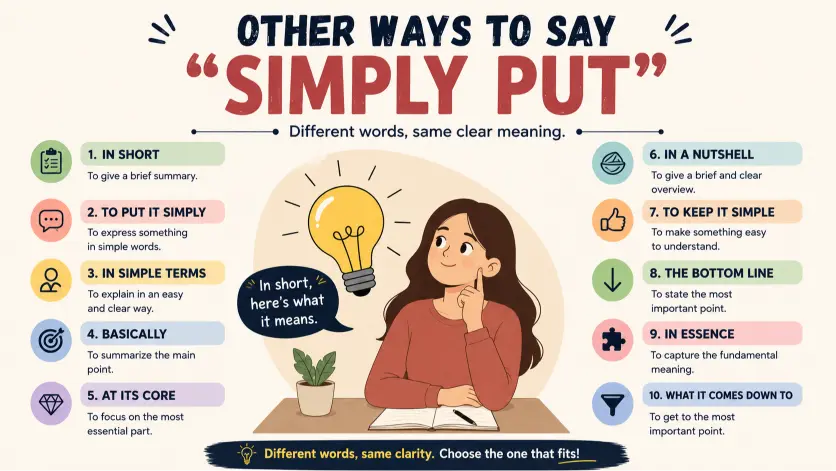
Ever feel like you use “simply put” too often when explaining an idea? Whether you are writing an email, preparing an academic assignment, giving a presentation, or having a professional conversation, knowing different ways to express the same meaning can make your English sound clearer and more natural.
“Simply put” is a useful phrase for introducing a straightforward explanation, but using alternatives can help you match your language to different situations and audiences. In this guide, you’ll discover practical alternatives ranging from casual expressions to polished phrases suitable for professional and academic communication. Each expression can add variety while helping you communicate ideas with greater precision. The examples are designed around real-world English usage and common communication contexts, making them useful for intermediate and advanced learners. By understanding the tone and context of each alternative, you can choose the right phrase confidently instead of relying on the same expression repeatedly
Quick Categories
Formal alternatives to “simply put”
- To put it plainly
- In straightforward terms
- In essence
- In practical terms
These expressions work well when explaining information clearly without sounding overly casual.
Pro Tip: In formal writing, choose a phrase that clarifies the idea without making your explanation sound conversational.
Casual alternatives
- Put simply
- In other words
- Basically
- To put it another way
These choices are natural in everyday conversations, discussions, and friendly explanations.
Pro Tip: Use casual alternatives when your audience already understands the general topic and you simply want to make one point clearer.
Professional alternatives
- In summary
- At its core
- The key point is
- In practical terms
These phrases are especially useful in presentations, reports, meetings, emails, and professional discussions.
Pro Tip: For workplace communication, select an expression that makes your main point obvious without sounding too informal.
Informal expressions
- Basically
- Long story short
- What it comes down to is
- The bottom line is
These informal expressions can make spoken English more conversational.
Pro Tip: Keep informal expressions for relaxed conversations unless your workplace culture specifically encourages conversational communication.
“Fluent English is not just knowing more words. It is knowing which words fit the situation.”
Common Mistakes When Using “Simply Put”
1. Using it before a complicated explanation
“Simply put” should normally introduce a simpler explanation rather than another complicated sentence.
Incorrect: Simply put, the multifaceted organizational restructuring necessitates comprehensive operational optimization.
Better: Simply put, the company needs to improve how it operates.
2. Repeating the phrase too often
Using the same expression repeatedly can make your writing sound repetitive.
Example: Simply put, sales are falling. Simply put, customers are leaving. Simply put, we need a new strategy.
Better: Sales are falling. In other words, customers are leaving, so we need a new strategy.
3. Using it when no simplification is needed
The expression works best when you are making an idea easier to understand.
Weak: Simply put, the meeting starts at nine.
Better: The meeting starts at nine.
4. Assuming it always means “in conclusion”
“Simply put” can summarize an idea, but it primarily signals simplification or clarification.
Example: Simply put, the product solves a common problem more efficiently.
5. Choosing an overly casual alternative in formal writing
Some alternatives can sound too conversational in reports or academic documents.
Example: Long story short, the project failed.
Better: In summary, the project did not achieve its objectives.
What Does “Simply Put” Mean?
“Simply put” means stated in a simple, clear, or uncomplicated way.
It is an introductory phrase used to simplify an explanation, summarize a complicated idea, or emphasize the central point.
Example:
Simply put, we need more time to complete the project.
Grammar Explanation
“Simply put” commonly appears at the beginning of a sentence and is followed by a comma.
Structure:
Simply put, + simplified explanation
For example:
Simply put, the plan is too expensive.
It can also appear after a longer explanation when you want to restate the main idea in simpler language.
When to Use “Simply Put”
You can use the expression in many situations, including:
- Explaining a complicated concept
- Summarizing a long explanation
- Clarifying technical information
- Presenting a central argument
- Making a business point easier to understand
- Restating information for an English learner
- Giving a concise conclusion
- Explaining cause and effect
Spoken English
“Simply put” sounds natural in presentations, conversations, interviews, lessons, and discussions.
Written English
It also works in articles, reports, explanatory content, emails, and professional documents.
Formal vs Informal
“Simply put” sits comfortably between casual and formal English. It is not slang, and it is not inherently unprofessional. However, highly formal academic or legal writing may sometimes benefit from a more precise expression such as “in essence” or “in summary.”
Is It Professional or Polite to Say “Simply Put”?
“Simply put” is generally polite and professionally acceptable. It can be especially effective when you need to simplify a complex explanation for colleagues, clients, students, or readers.
The important consideration is tone. If you use it respectfully, it does not imply that the other person is unintelligent.
Polite? ✔ Yes
Professional? ✔ Yes, in many professional contexts
Business example:
“Simply put, the proposed strategy will help us reduce operating costs while maintaining service quality.”
For very formal academic or legal writing, alternatives such as “in essence,” “in summary,” or “to summarize” may be preferable depending on the context.
“Professional communication becomes stronger when complicated ideas are made clear without being oversimplified.”
Pros and Cons of Using “Simply Put”
Pros
- Simple and natural: It is easy for most English speakers to understand.
- Friendly tone: It can make explanations feel accessible.
- Common usage: Native speakers frequently use it in speech and writing.
- Easy to understand: It immediately signals that a simpler explanation is coming.
Cons
- Can become repetitive: Frequent use may make writing predictable.
- Can oversimplify: Complex subjects sometimes require more precise wording.
- Limited emotional range: It primarily focuses on clarity rather than emotion.
- May not suit every formal context: Highly specialized writing may require more precise terminology.
Other Ways to Say “Simply Put” With Examples
These other ways to say simply put will help you sound more fluent, confident, and natural in different situations.
Use them according to tone, context, and audience to express excitement, admiration, approval, clarification, or a straightforward conclusion.
1. Phrase: In Simple Terms
Meaning: Explains something using easy and understandable language.
Explanation: This is one of the clearest choices when translating a complicated idea into accessible English.
Example Sentence: In simple terms, the software helps businesses organize their customer information.
Best Use: Clear explanations
Worst Use: Highly technical writing
Tone: Clear, neutral, educational
Context Variability: Casual conversation, professional presentations, educational writing
2. Phrase: Put Simply
Meaning: Introduces a simpler version of an idea.
Explanation: It has almost the same meaning as “simply put” and works naturally in speech and writing.
Example Sentence: Put simply, the company needs to spend less and save more.
Best Use: General communication
Worst Use: Repetitive writing
Tone: Natural, concise, neutral
Context Variability: Casual, professional, spoken
3. Phrase: In Other Words
Meaning: Restates something using different language.
Explanation: This is especially useful when the first explanation was difficult or unclear.
Example Sentence: In other words, you need to finish the first stage before moving to the next one.
Best Use: Clarifying ideas
Worst Use: Exact quotations
Tone: Natural, explanatory, flexible
Context Variability: Casual, professional, spoken
4. Phrase: To Put It Plainly
Meaning: States something directly and clearly.
Explanation: This expression emphasizes straightforward communication.
Example Sentence: To put it plainly, the proposal is too expensive for our current budget.
Best Use: Direct explanations
Worst Use: Sensitive criticism
Tone: Direct, clear, formal
Context Variability: Professional, written, spoken
5. Phrase: In Essence
Meaning: Describes the essential or most important part of something.
Explanation: It is particularly useful when summarizing the central idea of a complex subject.
Example Sentence: In essence, the policy is designed to protect consumers.
Best Use: Formal summaries
Worst Use: Casual chats
Tone: Formal, concise, analytical
Context Variability: Professional, academic, written
6. Phrase: In Short
Meaning: Gives a brief summary of a longer explanation.
Explanation: It helps you quickly communicate the main point without repeating every detail.
Example Sentence: In short, the project needs additional funding.
Best Use: Summaries
Worst Use: Detailed analysis
Tone: Concise, neutral, practical
Context Variability: Spoken, professional, written
7. Phrase: In Brief
Meaning: Provides a shortened version of information.
Explanation: This expression is especially useful in professional and written communication.
Example Sentence: In brief, the new policy will affect how employees request leave.
Best Use: Professional summaries
Worst Use: Casual storytelling
Tone: Formal, concise, professional
Context Variability: Professional, written, presentations
8. Phrase: To Summarize
Meaning: Presents the main points without unnecessary detail.
Explanation: It clearly signals that you are moving toward a concise summary.
Example Sentence: To summarize, our three priorities are quality, efficiency, and customer service.
Best Use: Formal summaries
Worst Use: Casual greetings
Tone: Formal, organized, informative
Context Variability: Professional, academic, spoken
9. Phrase: In Summary
Meaning: Gives the central points of an explanation.
Explanation: It is a strong option for reports, presentations, and other structured communication.
Example Sentence: In summary, the research supports the proposed approach.
Best Use: Reports and presentations
Worst Use: Casual conversation
Tone: Professional, formal, concise
Context Variability: Professional, written, spoken
10. Phrase: To Put It Another Way
Meaning: Expresses the same idea using different wording.
Explanation: Use it when you want to clarify an idea without changing its basic meaning.
Example Sentence: To put it another way, customers want convenience as well as quality.
Best Use: Clarification
Worst Use: Repetitive explanations
Tone: Neutral, explanatory, natural
Context Variability: Spoken, professional, educational
11. Phrase: At Its Core
Meaning: Refers to the most essential part of something.
Explanation: This phrase is useful when reducing a complex topic to its fundamental idea.
Example Sentence: At its core, the business is focused on solving a customer problem.
Best Use: Core ideas
Worst Use: Minor details
Tone: Professional, analytical, clear
Context Variability: Professional, spoken, written
12. Phrase: At the Most Basic Level
Meaning: Explains something from its simplest perspective.
Explanation: It works well when introducing a complicated concept to someone unfamiliar with it.
Example Sentence: At the most basic level, supply and demand determine how prices change.
Best Use: Educational explanations
Worst Use: Advanced analysis
Tone: Educational, neutral, explanatory
Context Variability: Academic, professional, spoken
13. Phrase: In Straightforward Terms
Meaning: Explains something directly and without unnecessary complexity.
Explanation: It emphasizes clarity and accessibility.
Example Sentence: In straightforward terms, the contract gives both parties more flexibility.
Best Use: Professional explanations
Worst Use: Creative writing
Tone: Clear, professional, direct
Context Variability: Professional, written, spoken
14. Phrase: The Key Point Is
Meaning: Introduces the most important idea.
Explanation: This phrase is useful when your audience needs to focus on one central message.
Example Sentence: The key point is that we need to respond before Friday.
Best Use: Important points
Worst Use: Every sentence
Tone: Direct, professional, focused
Context Variability: Meetings, presentations, emails
15. Phrase: The Main Idea Is
Meaning: Identifies the central message of something.
Explanation: It is especially accessible for learners and educational contexts.
Example Sentence: The main idea is that regular practice improves communication skills.
Best Use: Teaching and summaries
Worst Use: Highly formal reports
Tone: Simple, educational, neutral
Context Variability: Educational, spoken, written
16. Phrase: Essentially
Meaning: Indicates the fundamental nature of something.
Explanation: It allows you to summarize a complicated point in one concise word.
Example Sentence: Essentially, the two proposals offer the same solution.
Best Use: Concise summaries
Worst Use: Detailed evidence
Tone: Professional, concise, analytical
Context Variability: Professional, academic, spoken
17. Phrase: Basically
Meaning: Gives a simple or general explanation.
Explanation: It is common in conversational English but can sound less formal in professional writing.
Example Sentence: Basically, we need to change the way we manage the project.
Best Use: Casual explanations
Worst Use: Formal reports
Tone: Casual, natural, conversational
Context Variability: Casual, spoken, informal writing
18. Phrase: The Bottom Line Is
Meaning: Identifies the most important conclusion or practical result.
Explanation: It is particularly common in business and workplace conversations.
Example Sentence: The bottom line is that we need to increase customer retention.
Best Use: Business discussions
Worst Use: Academic essays
Tone: Direct, practical, businesslike
Context Variability: Professional, spoken, business writing
19. Phrase: What It Comes Down To Is
Meaning: Identifies the essential issue after considering several details.
Explanation: This phrase is useful when reducing a complicated discussion to one central factor.
Example Sentence: What it comes down to is whether the investment will create long term value.
Best Use: Decision discussions
Worst Use: Formal academic prose
Tone: Conversational, direct, practical
Context Variability: Spoken, professional, informal
20. Phrase: In Practical Terms
Meaning: Explains what something means in real world situations.
Explanation: It moves the discussion from theory toward practical consequences.
Example Sentence: In practical terms, the change means employees will have more flexible working hours.
Best Use: Workplace explanations
Worst Use: Pure definitions
Tone: Professional, practical, clear
Context Variability: Professional, spoken, written
21. Phrase: To Simplify
Meaning: Signals that you are reducing a complicated explanation.
Explanation: It clearly tells the audience that a simpler interpretation is coming.
Example Sentence: To simplify, the system automatically checks the information before submitting it.
Best Use: Technical explanations
Worst Use: Formal conclusions
Tone: Clear, instructional, neutral
Context Variability: Educational, professional, spoken
22. Phrase: To State It Simply
Meaning: Presents information in uncomplicated language.
Explanation: It is useful when you want to emphasize clarity.
Example Sentence: To state it simply, the company needs a more efficient process.
Best Use: Clear summaries
Worst Use: Casual greetings
Tone: Neutral, clear, professional
Context Variability: Professional, educational, written
23. Phrase: To Explain It Simply
Meaning: Introduces an easier explanation of a topic.
Explanation: This phrase is particularly useful when teaching or communicating with someone unfamiliar with the subject.
Example Sentence: To explain it simply, the program matches students with suitable courses.
Best Use: Teaching contexts
Worst Use: Formal conclusions
Tone: Educational, friendly, clear
Context Variability: Educational, spoken, professional
24. Phrase: In Layman’s Terms
Meaning: Explains specialized information using language that a general audience can understand.
Explanation: It is common when translating technical or professional concepts into accessible language.
Example Sentence: In layman’s terms, the device helps prevent the battery from overheating.
Best Use: Technical explanations
Worst Use: Specialized expert reports
Tone: Accessible, explanatory, informal
Context Variability: Educational, spoken, general audience
25. Phrase: To Break It Down
Meaning: Divides a complicated idea into easier parts.
Explanation: This is common in conversational and educational English.
Example Sentence: To break it down, there are three steps you need to follow.
Best Use: Step by step explanations
Worst Use: Formal reports
Tone: Conversational, friendly, instructional
Context Variability: Casual, spoken, educational
26. Phrase: To Make It Clear
Meaning: Introduces information intended to remove confusion.
Explanation: It works well when you want to emphasize a specific interpretation.
Example Sentence: To make it clear, the deadline applies to every department.
Best Use: Clarification
Worst Use: Repeated instructions
Tone: Direct, clear, professional
Context Variability: Spoken, professional, written
27. Phrase: To Be Clear
Meaning: Emphasizes that a statement should be understood in a particular way.
Explanation: It can clarify expectations, boundaries, or important information.
Example Sentence: To be clear, this offer is available only until the end of the month.
Best Use: Clarifying expectations
Worst Use: Casual storytelling
Tone: Direct, professional, firm
Context Variability: Professional, spoken, written
28. Phrase: The Short Version Is
Meaning: Introduces a brief summary of a longer explanation.
Explanation: It is especially natural in conversational English.
Example Sentence: The short version is that we found a better solution.
Best Use: Casual summaries
Worst Use: Formal reports
Tone: Conversational, concise, friendly
Context Variability: Casual, spoken, informal writing
29. Phrase: In a Nutshell
Meaning: Summarizes something in very few words.
Explanation: It is an idiomatic expression that works well in everyday and semi professional communication.
Example Sentence: In a nutshell, the project needs more time and resources.
Best Use: Quick summaries
Worst Use: Highly formal writing
Tone: Informal, concise, friendly
Context Variability: Casual, spoken, informal professional communication
30. Phrase: To Sum It Up
Meaning: Gives a concise statement of the main points.
Explanation: It is a natural way to close an explanation or discussion.
Example Sentence: To sum it up, the new strategy should improve both efficiency and customer satisfaction.
Best Use: Final summaries
Worst Use: Detailed analysis
Tone: Natural, concise, conversational
Context Variability: Spoken, casual, professional
“Choose your phrase based on the audience, not just the dictionary meaning.”
How to Choose the Right Alternative
The best alternative depends on your purpose.
For everyday conversations
Choose:
- Put simply
- In other words
- Basically
- To put it another way
- The short version is
These expressions sound natural when speaking with friends, classmates, or colleagues.
For professional communication
Choose:
- In practical terms
- In essence
- The key point is
- In summary
- At its core
These phrases can help you communicate ideas clearly during meetings, presentations, emails, and workplace discussions.
For academic or educational writing
Choose:
- In essence
- In summary
- To summarize
- In straightforward terms
- At the most basic level
These options can help explain concepts without making the writing unnecessarily complicated.
For technical explanations
Choose:
- In simple terms
- To simplify
- To break it down
- In layman’s terms
- In practical terms
The goal is to make specialized information accessible while preserving its important meaning.
Professional Reaction Phrases and Clear Communication
Clear explanation is an important part of professional English. When responding to information, you may need more than alternatives to “simply put.” You may also need professional reaction phrases that show understanding, agreement, concern, or interest.
For example:
- “That makes sense.”
- “I understand the main point.”
- “That is a useful perspective.”
- “I see how this affects the project.”
- “The key takeaway is clear.”
These expressions can make workplace communication more natural while keeping the tone respectful.
If you are learning informal expressions in English, remember that informal does not automatically mean incorrect. The important skill is knowing when an expression fits your audience and situation.
See Also
See also: Explore our guide to Other Ways to Say “In Other Words” for additional expressions that help you clarify and restate ideas.
See also: Check our Professional English Guide for practical expressions used in workplace conversations, meetings, emails, and presentations.
“Vocabulary gives you choices. Context tells you which choice to make.”
Mini Quiz and Self Check
1. You are presenting a complicated business strategy to your team. Which phrase is most suitable?
A. Long story short
B. In practical terms
C. Whatever
D. In a nutshell
Answer: B. In practical terms
2. Which phrase is most natural in a casual conversation?
A. In essence
B. To summarize
C. In other words
D. Pursuant to the foregoing
Answer: C. In other words
3. You want to identify the most important point during a meeting. Which expression works best?
A. The key point is
B. Basically, dude
C. Long story short
D. In a nutshell
Answer: A. The key point is
4. Which phrase is more appropriate for a formal report?
A. The short version is
B. In summary
C. Basically
D. To break it down
Answer: B. In summary
Comparison Table: Top Alternatives
| Phrase | Tone | Best Use |
| In simple terms | Neutral | Clear explanations |
| Put simply | Neutral | General communication |
| In other words | Flexible | Clarification |
| To put it plainly | Direct | Straightforward explanations |
| In essence | Formal | Formal summaries |
| In short | Neutral | Brief summaries |
| In brief | Formal | Professional writing |
| In summary | Professional | Reports and presentations |
| At its core | Professional | Central ideas |
| In practical terms | Professional | Workplace explanations |
FAQs
1. What is another way to say “simply put”?
Common alternatives include “in simple terms,” “put simply,” “in other words,” “in essence,” and “to put it plainly.”
2. Is “simply put” professional English?
Yes. “Simply put” is generally acceptable in professional communication, especially when you are clarifying or summarizing an idea.
3. What is a formal way to say “simply put”?
“In essence,” “in summary,” “in brief,” “to summarize,” and “in straightforward terms” are useful formal alternatives.
4. Is “in other words” the same as “simply put”?
They are similar, but not identical. “In other words” mainly signals a restatement, while “simply put” often signals that a complicated idea is being simplified.
5. What can I say instead of “simply put” in a business meeting?
Try “the key point is,” “in practical terms,” “at its core,” “in summary,” or “the bottom line is,” depending on the situation and desired tone.
Conclusion
Learning different alternatives to “simply put” gives you greater control over your English. Instead of repeating one expression, you can select a phrase that matches your audience, purpose, and level of formality. “In essence” may suit a formal presentation, while “in other words” may feel more natural during a conversation.
The best way to build this skill is through regular practice. Notice how native and proficient English speakers simplify ideas in conversations, meetings, articles, and presentations. Then practice replacing the same expression with two or three alternatives. With time, choosing between formal, professional, casual, and informal expressions will become more natural and automatic.









