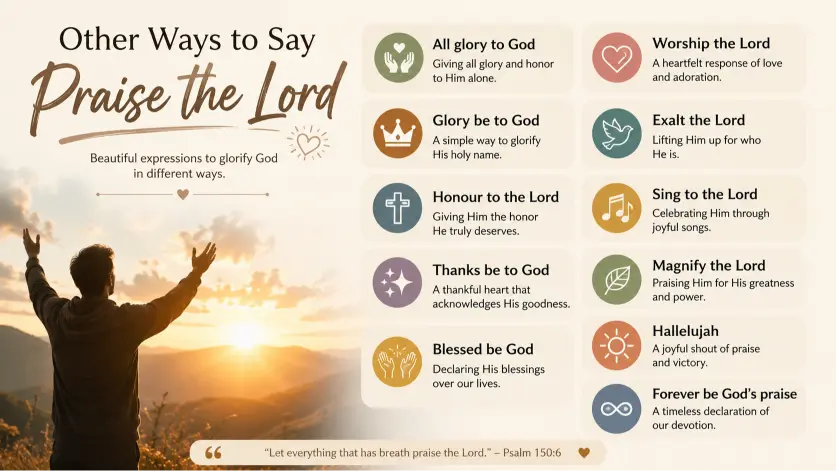
Finding the right words to express faith, gratitude, and happiness can make everyday conversations more meaningful. While “Praise the Lord” is a familiar and powerful expression among Christians, using different phrases can help you communicate your feelings in a fresh, heartfelt, and natural way. Whether you’re celebrating a blessing, sharing good news, expressing gratitude, or participating in a spiritual conversation, having alternative expressions can make your words more personal and impactful. From “Glory to God” and “Thank God” to “Hallelujah” and “Blessed be His name,” there are many beautiful ways to share your faith.
In this guide, we explore 30 other ways to say Praise the Lord, with practical examples to help you understand their meanings, tones, and appropriate contexts. Each expression is selected to support clear communication while respecting the spiritual significance of Christian language. As an English-learning resource, this article focuses on everyday usage, conversational differences, and meaningful alternatives rather than treating every phrase as an exact theological equivalent. For you’re an English learner, a writer, or someone looking for fresh ways to express gratitude and worship, these examples will help you find the right words for every occasion
Quick Categories of Alternatives
Formal alternatives to “Praise the Lord”
These expressions are suitable for religious writing, church announcements, formal prayers, and respectful conversations.
- May God’s name be glorified.
- All glory be to God.
- Blessed be the name of the Lord.
- Let us give thanks to God.
Pro Tip: Use complete, respectful expressions in formal religious settings. Traditional wording often feels more appropriate during worship and ceremonial occasions.
Casual alternatives
These phrases work well in everyday conversations when sharing good news or expressing gratitude.
- Thank God!
- God is good!
- What a blessing!
- I’m so grateful to God.
Pro Tip: Keep your response natural and sincere. A short expression can communicate genuine happiness without sounding overly formal.
Professional alternatives
These expressions are useful in respectful workplace conversations, particularly when discussing personal gratitude without assuming that everyone shares the same beliefs.
- I’m truly grateful.
- I’m thankful for this blessing.
- I’m deeply appreciative.
- I’m grateful things worked out.
Pro Tip: In professional environments, focus on gratitude and positive outcomes. Choose explicitly religious wording only when you know it suits the audience and setting.
Informal expressions
These informal expressions are common in friendly conversations, personal messages, and faith-based social interactions.
- Hallelujah!
- Amen!
- Glory to God!
- God be praised!
Pro Tip: Informal religious expressions are especially effective when responding to shared good news. Consider your listener’s beliefs before using them.
“The most meaningful expression is not always the most elaborate one. Sincerity and context matter more than complicated vocabulary.”
Common Mistakes When Using “Praise the Lord”
Even familiar religious expressions can be misunderstood when used in the wrong context. Here are five common mistakes to avoid.
1. Using religious expressions in every conversation
Mistake: Repeating “Praise the Lord” after every ordinary statement.
Better approach: Reserve it for moments when you genuinely want to express faith, gratitude, or celebration.
2. Confusing gratitude with celebration
Mistake: Using “Hallelujah” in every situation where someone simply says thank you.
Better approach: Use “Thank God” or “I’m grateful” when the main feeling is appreciation rather than celebration.
3. Ignoring the audience’s beliefs
Mistake: Assuming everyone is comfortable with explicitly religious expressions in a workplace discussion.
Better approach: Choose neutral expressions such as “That’s wonderful news” when speaking to a diverse audience.
4. Using formal expressions in casual conversations
Mistake: Saying “May God’s name be glorified” in a relaxed conversation where a simple response would sound more natural.
Better approach: Use expressions such as “God is good” or “Thank God” when appropriate.
5. Treating every alternative as an exact synonym
Mistake: Assuming “Amen,” “Thank God,” and “Hallelujah” have precisely the same meaning.
Better approach: Understand their individual meanings and use them according to the emotion and religious context.
What Does “Praise the Lord” Mean?
“Praise the Lord” is a religious expression that means to honor, glorify, or celebrate God for His goodness, greatness, love, and blessings.
The phrase is commonly associated with Christian worship and biblical language. It combines the verb “praise,” meaning to express admiration or approval, with “the Lord,” a title referring to God.
Example sentence: “Praise the Lord! Our family has finally received the good news we’ve been praying for.”
Grammatically, “Praise the Lord” is an imperative sentence. The verb “praise” is in its base form and expresses a call or encouragement to give praise.
When to Use “Praise the Lord”
The expression is appropriate in different situations, depending on your beliefs, audience, and communication goals.
- Church services: During worship, prayer meetings, and religious gatherings.
- Celebrating blessings: When sharing positive news or acknowledging a fortunate outcome.
- Personal prayers: When expressing devotion, admiration, and gratitude to God.
- Family conversations: When discussing meaningful events or moments of relief.
- Religious messages: In faith-based emails, greeting cards, captions, and personal messages.
- Spoken communication: When responding to encouraging news in a faith-friendly conversation.
- Written communication: In religious reflections, sermons, devotionals, and inspirational writing.
Spoken vs. written: In spoken English, the phrase can sound warm, joyful, and spontaneous. In writing, it is particularly suitable for prayers, religious reflections, and messages celebrating blessings.
Formal vs. informal: It can be used in both formal worship and informal conversations. The level of formality depends on the setting and the way the expression is delivered.
Is It Professional or Polite to Say “Praise the Lord”?
Polite? Yes, when used sincerely and respectfully in an appropriate setting.
Professional? No, in most cases where workplace communication needs to remain religiously neutral.
“Praise the Lord” is not inherently impolite or unprofessional. However, professional communication usually prioritizes inclusivity and audience awareness. In a workplace with people from different religious backgrounds, neutral expressions can be more suitable.
Business-style example:
“I’m very grateful that our team successfully completed the project ahead of schedule.”
This conveys appreciation and positivity without making assumptions about the audience’s religious beliefs.
“Professional communication is about choosing words that respect both your message and the people receiving it.”
Pros and Cons of Using “Praise the Lord”
Pros
- Simple and natural: Easy to say and understand in faith-based conversations.
- Friendly tone: Can communicate warmth, joy, and shared appreciation.
- Common usage: Familiar to many English-speaking Christian communities.
- Easy to understand: Clearly communicates religious admiration or gratitude in suitable contexts.
Cons
- Too religious for some workplaces: May not suit professional conversations with diverse audiences.
- Can become overused: Repeating it too often may reduce its impact.
- Limited emotional range: It does not communicate every kind of gratitude, relief, or excitement equally well.
- Not suitable for all formal writing: Neutral or more specific wording may be preferable in general business and academic documents.
Other Ways to Say “Praise the Lord” (With Examples)
These alternatives will help you sound more fluent, confident, and natural in different situations.
Use them according to tone, context, and audience to express excitement, admiration, or approval. Some are direct religious expressions, while others communicate gratitude in a more general way.
30 Meaningful Alternatives to “Praise the Lord”
1. Glory to God
Meaning: Give honor and recognition to God for His greatness.
Explanation: A traditional Christian expression used to celebrate blessings and acknowledge God’s power.
Example Sentence: “Glory to God! We finally found a solution to our problem.”
Best Use: Worship, celebration
Worst Use: Neutral business
Tone: Reverent, joyful
Context Variability: Casual: “Glory to God!” Professional: “I’m grateful for this blessing.” Spoken: “Glory to God, everything worked out!”
2. Thank God
Meaning: Express relief or gratitude to God.
Explanation: A common everyday expression used when something positive happens or a difficult situation improves.
Example Sentence: “Thank God, everyone arrived home safely.”
Best Use: Everyday conversation
Worst Use: Formal worship
Tone: Relieved, grateful
Context Variability: Casual: “Thank God!” Professional: “I’m thankful everything went smoothly.” Spoken: “Thank God we made it on time.”
3. Hallelujah
Meaning: An expression of joyful praise to God.
Explanation: Traditionally used in religious worship and celebrations to express happiness and devotion.
Example Sentence: “Hallelujah! Our prayers have finally been answered.”
Best Use: Religious celebration
Worst Use: Serious business
Tone: Exuberant, worshipful
Context Variability: Casual: “Hallelujah!” Professional: “I’m delighted by the positive result.” Spoken: “Hallelujah, we did it!”
4. All Glory Be to God
Meaning: Attribute all honor and praise to God.
Explanation: This expression emphasizes that success and blessings are ultimately credited to God.
Example Sentence: “All glory be to God for helping us achieve this milestone.”
Best Use: Testimonies, ceremonies
Worst Use: Casual introductions
Tone: Humble, reverent
Context Variability: Casual: “All glory to God!” Professional: “I’m grateful for this opportunity.” Spoken: “All glory be to God for this achievement.”
5. Blessed Be the Lord
Meaning: Express admiration and reverence for God.
Explanation: A traditional religious phrase that acknowledges God’s goodness and deserves a place in prayers and worship.
Example Sentence: “Blessed be the Lord for guiding our family through difficult times.”
Best Use: Prayers, devotionals
Worst Use: Casual workplace chat
Tone: Devotional, respectful
Context Variability: Casual: “Blessed be the Lord!” Professional: “I’m grateful for the support we received.” Spoken: “Blessed be the Lord for this wonderful day.”
6. God Is Good
Meaning: Recognize God’s goodness and kindness.
Explanation: A simple, widely recognized expression used to acknowledge positive experiences and blessings.
Example Sentence: “God is good! My family has received some wonderful news.”
Best Use: Friendly conversations
Worst Use: Religious neutrality
Tone: Warm, optimistic
Context Variability: Casual: “God is good!” Professional: “I’m thankful for this positive outcome.” Spoken: “God is good, and I’m grateful.”
7. Let Us Give Thanks to God
Meaning: Encourage people to express gratitude to God.
Explanation: This inclusive religious expression is especially appropriate when addressing a group during worship or a celebration.
Example Sentence: “Let us give thanks to God for bringing everyone together today.”
Best Use: Group prayers
Worst Use: Informal texting
Tone: Respectful, encouraging
Context Variability: Casual: “Let’s thank God!” Professional: “Let’s recognize everyone’s contributions.” Spoken: “Let us give thanks to God for this blessing.”
8. God Be Praised
Meaning: Declare that God deserves praise and honor.
Explanation: A concise religious expression that communicates gratitude, admiration, and celebration.
Example Sentence: “God be praised for the wonderful progress we’ve made.”
Best Use: Religious conversations
Worst Use: Neutral reports
Tone: Grateful, reverent
Context Variability: Casual: “God be praised!” Professional: “I’m pleased with our progress.” Spoken: “God be praised, everything is going well.”
9. Thank You, Lord
Meaning: Directly express gratitude to God.
Explanation: This personal expression is often used during prayer or after experiencing relief, support, or a blessing.
Example Sentence: “Thank You, Lord, for giving me the strength to keep going.”
Best Use: Personal prayer
Worst Use: Formal business writing
Tone: Personal, heartfelt
Context Variability: Casual: “Thank You, Lord!” Professional: “I’m sincerely grateful.” Spoken: “Thank You, Lord, for this opportunity.”
10. May God’s Name Be Glorified
Meaning: Express the desire that God’s name receive honor and praise.
Explanation: A formal and devotional expression suitable for religious speeches, ceremonies, and written reflections.
Example Sentence: “May God’s name be glorified through every good thing we accomplish.”
Best Use: Religious speeches
Worst Use: Casual conversation
Tone: Formal, devotional
Context Variability: Casual: “Glory to God!” Professional: “May our work make a positive difference.” Spoken: “May God’s name be glorified in all we do.”
11. What a Blessing
Meaning: Express happiness and appreciation for something positive.
Explanation: A warm expression that can refer to a blessing without explicitly mentioning God.
Example Sentence: “What a blessing to have such supportive friends.”
Best Use: Personal gratitude
Worst Use: Critical discussions
Tone: Appreciative, warm
Context Variability: Casual: “What a blessing!” Professional: “We’re fortunate to have this opportunity.” Spoken: “What a blessing this has been.”
12. I’m So Grateful to God
Meaning: Communicate deep personal gratitude to God.
Explanation: This phrase emphasizes the speaker’s personal feelings of thankfulness for a particular blessing.
Example Sentence: “I’m so grateful to God for helping me overcome this challenge.”
Best Use: Personal reflections
Worst Use: Impersonal reports
Tone: Sincere, emotional
Context Variability: Casual: “I’m grateful to God!” Professional: “I’m thankful for the opportunity.” Spoken: “I’m so grateful to God for everything.”
13. Praise Be to God
Meaning: Give praise and honor to God.
Explanation: A traditional expression used in religious settings to acknowledge God’s greatness or celebrate good news.
Example Sentence: “Praise be to God for the successful completion of our journey.”
Best Use: Religious gatherings
Worst Use: Casual business
Tone: Traditional, reverent
Context Variability: Casual: “Praise be to God!” Professional: “I’m grateful for the successful outcome.” Spoken: “Praise be to God, we’re safe.”
14. God Has Been So Good to Us
Meaning: Recognize God’s kindness and blessings over time.
Explanation: This expression is particularly useful when reflecting on a series of positive experiences or shared blessings.
Example Sentence: “God has been so good to us throughout this entire year.”
Best Use: Family gatherings
Worst Use: Formal business reports
Tone: Reflective, thankful
Context Variability: Casual: “God has been good!” Professional: “We’ve been fortunate this year.” Spoken: “God has been so good to our family.”
15. Glory Be to His Name
Meaning: Give honor and praise to God’s name.
Explanation: A traditional devotional expression that emphasizes reverence and recognition of God’s greatness.
Example Sentence: “Glory be to His name for the strength that carried us through.”
Best Use: Worship, devotionals
Worst Use: Casual workplace talk
Tone: Solemn, reverent
Context Variability: Casual: “Glory to His name!” Professional: “I’m grateful for the support.” Spoken: “Glory be to His name for this blessing.”
16. I’m Blessed
Meaning: Express appreciation for the good things in your life.
Explanation: A short, personal expression that can convey gratitude in both religious and general conversations.
Example Sentence: “I’m blessed to have people who believe in me.”
Best Use: Personal conversations
Worst Use: Formal announcements
Tone: Positive, humble
Context Variability: Casual: “Feeling blessed!” Professional: “I’m fortunate to be part of this team.” Spoken: “I’m truly blessed to have this opportunity.”
17. God Is Great
Meaning: Recognize God’s greatness and power.
Explanation: A simple expression of admiration that can be used when celebrating positive events or discussing faith.
Example Sentence: “God is great! We received the help we needed at the right time.”
Best Use: Faith-based conversations
Worst Use: Neutral business settings
Tone: Admiring, joyful
Context Variability: Casual: “God is great!” Professional: “I’m grateful things worked out.” Spoken: “God is great, and I’m thankful.”
18. My Heart Is Full of Gratitude
Meaning: Express deep and sincere appreciation.
Explanation: This emotional expression focuses on gratitude and can be used with or without an explicitly religious meaning.
Example Sentence: “My heart is full of gratitude for the blessings my family has received.”
Best Use: Personal messages
Worst Use: Technical reports
Tone: Heartfelt, emotional
Context Variability: Casual: “My heart is so grateful.” Professional: “I’m deeply appreciative of your support.” Spoken: “My heart is full of gratitude today.”
19. I’m Thankful for His Grace
Meaning: Express appreciation for God’s mercy, kindness, and grace.
Explanation: This Christian expression is especially suitable for reflecting on spiritual support and forgiveness.
Example Sentence: “I’m thankful for His grace during the most challenging moments of my life.”
Best Use: Spiritual reflections
Worst Use: Secular business writing
Tone: Spiritual, reflective
Context Variability: Casual: “Thankful for His grace!” Professional: “I’m grateful for the support I received.” Spoken: “I’m thankful for His grace every day.”
20. God Deserves All the Praise
Meaning: Recognize God as worthy of all admiration and honor.
Explanation: This phrase emphasizes humility by directing praise toward God rather than personal achievements.
Example Sentence: “God deserves all the praise for helping us through this difficult season.”
Best Use: Testimonies
Worst Use: Casual introductions
Tone: Humble, worshipful
Context Variability: Casual: “God deserves the praise!” Professional: “I’m grateful to everyone who contributed.” Spoken: “God deserves all the praise for this.”
21. What a Wonderful Blessing
Meaning: Express joy and appreciation for something valuable or fortunate.
Explanation: This phrase highlights the positive impact of a blessing and works in both religious and general contexts.
Example Sentence: “What a wonderful blessing to see everyone together again.”
Best Use: Celebrations
Worst Use: Serious complaints
Tone: Joyful, appreciative
Context Variability: Casual: “Such a wonderful blessing!” Professional: “This is a valuable opportunity.” Spoken: “What a wonderful blessing this is!”
22. Thanks Be to God
Meaning: Give thanks to God for a positive event or outcome.
Explanation: A traditional expression of gratitude often used when acknowledging relief, protection, or good news.
Example Sentence: “Thanks be to God, everyone is safe after the storm.”
Best Use: Religious conversations
Worst Use: Casual business emails
Tone: Grateful, traditional
Context Variability: Casual: “Thanks be to God!” Professional: “I’m relieved everyone is safe.” Spoken: “Thanks be to God, we made it through.”
23. I’m Filled With Joy
Meaning: Communicate strong happiness and emotional satisfaction.
Explanation: This expression focuses on your feelings and can be used when celebrating a blessing or a personal achievement.
Example Sentence: “I’m filled with joy because our family has finally reunited.”
Best Use: Personal celebrations
Worst Use: Formal technical writing
Tone: Joyful, expressive
Context Variability: Casual: “I’m so happy!” Professional: “I’m delighted with the outcome.” Spoken: “I’m filled with joy today.”
24. Let God’s Name Be Praised
Meaning: Encourage others to honor and praise God.
Explanation: A devotional expression that works well in group worship, prayers, and faith-based messages.
Example Sentence: “Let God’s name be praised for the kindness He has shown us.”
Best Use: Group worship
Worst Use: Informal office chat
Tone: Devotional, respectful
Context Variability: Casual: “Let’s praise God!” Professional: “Let’s appreciate this achievement.” Spoken: “Let God’s name be praised for this day.”
25. I’m Grateful for God’s Goodness
Meaning: Express appreciation for God’s kindness and positive influence.
Explanation: This phrase combines personal gratitude with an acknowledgment of God’s goodness.
Example Sentence: “I’m grateful for God’s goodness and the opportunities I’ve received.”
Best Use: Personal reflections
Worst Use: Neutral business presentations
Tone: Sincere, reflective
Context Variability: Casual: “Grateful for God’s goodness!” Professional: “I’m thankful for these opportunities.” Spoken: “I’m grateful for God’s goodness in my life.”
26. How Great Is Our God
Meaning: Express admiration for God’s greatness.
Explanation: This phrase is often used in worship and religious celebrations to emphasize God’s power and majesty.
Example Sentence: “How great is our God for giving us hope during difficult times!”
Best Use: Worship, praise
Worst Use: Business meetings
Tone: Celebratory, reverent
Context Variability: Casual: “How great is our God!” Professional: “I’m grateful for the positive outcome.” Spoken: “How great is our God, indeed!”
27. I Give God All the Credit
Meaning: Attribute success or a positive outcome to God.
Explanation: This expression emphasizes humility and gratitude instead of taking all the recognition for yourself.
Example Sentence: “I give God all the credit for helping me reach this goal.”
Best Use: Personal testimonies
Worst Use: Corporate reports
Tone: Humble, appreciative
Context Variability: Casual: “I give God the credit!” Professional: “I’m grateful to everyone who helped.” Spoken: “I give God all the credit for this success.”
28. God Has Answered Our Prayers
Meaning: Express gratitude because a hoped-for outcome has happened.
Explanation: This phrase is especially meaningful when sharing positive news after a period of prayer or uncertainty.
Example Sentence: “God has answered our prayers, and my father is finally recovering.”
Best Use: Personal celebrations
Worst Use: Unrelated discussions
Tone: Hopeful, emotional
Context Variability: Casual: “Our prayers were answered!” Professional: “We’re relieved to hear the good news.” Spoken: “God has answered our prayers!”
29. I’m Overwhelmed With Gratitude
Meaning: Express an exceptionally strong feeling of thankfulness.
Explanation: This phrase communicates deep emotion and works well when a blessing or kind gesture has had a significant impact.
Example Sentence: “I’m overwhelmed with gratitude for everyone who supported our family.”
Best Use: Heartfelt messages
Worst Use: Routine updates
Tone: Emotional, sincere
Context Variability: Casual: “I’m so grateful!” Professional: “I sincerely appreciate your generosity.” Spoken: “I’m overwhelmed with gratitude today.”
30. Let Everything Give Praise to the Lord
Meaning: Encourage all creation or everyone to honor God.
Explanation: This poetic, religious expression communicates universal praise and is suitable for devotional writing or worship.
Example Sentence: “Let everything give praise to the Lord for His endless goodness.”
Best Use: Devotional writing
Worst Use: Everyday office chat
Tone: Poetic, worshipful
Context Variability: Casual: “Let’s praise the Lord!” Professional: “Let’s recognize this wonderful achievement.” Spoken: “Let everything give praise to the Lord.”
Key takeaway: Expressions such as “Glory to God” and “Thanks be to God” are close religious alternatives, while “I’m grateful” and “What a blessing” offer more flexible ways to express appreciation.
Mini Quiz: Test Your Understanding
Check your knowledge of the meaning, tone, and appropriate use of these expressions.
1. Which expression is most suitable for a traditional Christian worship service?
That’s awesome
Blessed be the Lord
Sounds good
2. Which phrase is generally more suitable for a religiously diverse workplace?
I’m grateful for this opportunity
Hallelujah!
God be praised!
3. What does ‘Hallelujah’ primarily express?
An apology
A formal request
Joyful praise to God
4. Your friend shares wonderful news about a long-awaited blessing. Which response is natural in a faith-based conversation?
Glory to God!
Please be advised
I disagree
Check answers
Comparison Table: Top 10 Alternatives
Compare these popular expressions to choose the right wording for your situation.
| Phrase | Tone | Best Use |
| Glory to God | Reverent, joyful | Religious celebrations |
| Thank God | Casual, grateful | Everyday conversations |
| Hallelujah | Exuberant, worshipful | Worship and joyful news |
| All Glory Be to God | Humble, devotional | Religious speeches |
| Blessed Be the Lord | Traditional, respectful | Prayers and worship |
| God Is Good | Warm, optimistic | Friendly conversations |
| Thanks Be to God | Grateful, traditional | Sharing relief |
| God Be Praised | Reverent, appreciative | Faith-based discussions |
| What a Blessing | Warm, appreciative | Personal celebrations |
| I’m So Grateful to God | Sincere, emotional | Personal reflections |
FAQs
1. What are the best alternatives to “Praise the Lord”?
Some of the best alternatives include “Glory to God,” “Hallelujah,” “Thank God,” “God be praised,” and “All glory be to God.” Each phrase communicates praise or gratitude with a slightly different tone.
2. How can I say “Praise the Lord” in a more formal way?
You can say “May God’s name be glorified,” “Blessed be the name of the Lord,” or “Let us give thanks to God.” These expressions are suitable for formal prayers, worship services, and religious writing.
3. What is a simple way to express gratitude to God in English?
“Thank You, Lord,” “I’m grateful to God,” and “God is good” are simple, natural expressions. Choose one that reflects your feelings and the situation.
4. Is “Hallelujah” the same as “Praise the Lord”?
Both expressions communicate praise to God, but they are not identical. “Hallelujah” is traditionally an exclamation of joyful praise, while “Praise the Lord” is a direct call to honor God.
5. How can I express praise without using religious language?
You can use phrases such as “That’s wonderful news,” “I’m truly grateful,” “What a fantastic outcome,” or “I’m so happy things worked out.” These expressions communicate appreciation and excitement without explicitly referring to religion.
Conclusion
Learning different ways to express praise and gratitude makes your English more flexible, meaningful, and natural. Expressions such as “Glory to God,” “Hallelujah,” and “Thanks be to God” are excellent choices for religious conversations, while “I’m grateful” and “What a blessing” can work in a wider range of everyday situations. Understanding their meanings and emotional differences helps you communicate your feelings with greater confidence.
Make a habit of practicing a few expressions each day. Try using them in conversations, personal messages, or short writing exercises. Pay attention to your audience, the setting, and the tone you want to convey. The more familiar you become with these alternatives, the easier it will be to choose words that express genuine gratitude, admiration, and joy.
.









