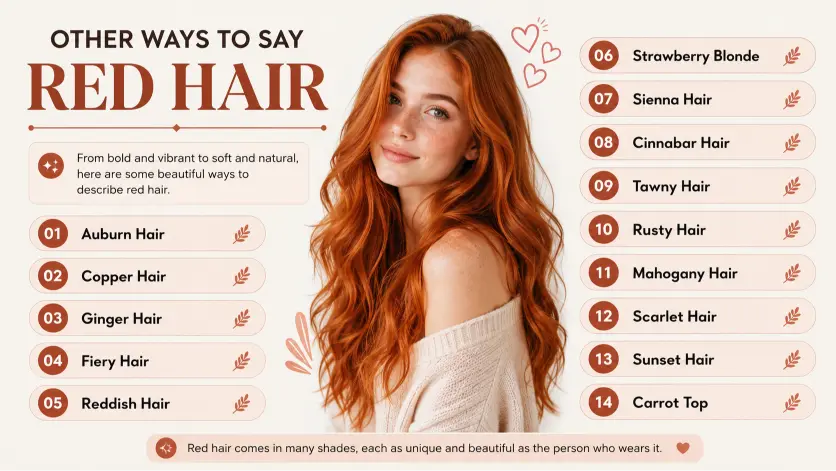
Red hair is more than just a hair color—it is a beautiful feature that can be described in countless creative, stylish, and expressive ways. For you’re writing a story, complimenting someone, improving your English vocabulary, or creating engaging social media captions, finding the right words can make your descriptions more memorable. Instead of repeatedly using the phrase “red hair,” you can explore alternatives like ginger hair, auburn locks, copper hair, fiery red tresses, and strawberry blonde. Each expression has its own meaning, tone, and visual appeal, helping you describe different shades and styles more accurately.
In this guide, we’ll explore 30+ other ways to say red hair, along with simple meanings, practical examples, and helpful usage tips. As an English vocabulary resource, this article focuses on natural expressions, clear explanations, and real-world language examples to help you choose the right phrase for different situations. Whether you’re an English learner, a writer, or simply looking for a fresh way to describe red hair, you’ll discover plenty of useful alternatives to make your vocabulary richer and your writing more engaging.
Quick Categories: Alternatives to Red Hair
Formal alternatives to “red hair”
- Auburn hair: A refined term for reddish-brown hair.
- Copper-colored hair: A precise description of warm, reddish-orange hair.
- Reddish-brown hair: A neutral and descriptive expression.
- Chestnut-red hair: A rich brown shade with noticeable red undertones.
Pro Tip: Use specific color descriptions in professional writing, fashion articles, and character profiles when accuracy matters.
Casual alternatives
- Ginger hair: A common, conversational expression for naturally orange-red hair.
- Red locks: A friendly and expressive way to describe red hair.
- Copper hair: A simple way to describe a warm, bright red shade.
- Flame-red hair: A vivid expression for striking red hair.
Pro Tip: Casual expressions work well in everyday conversations, but consider the person’s preferences before using labels about their appearance.
Professional alternatives
- Auburn-colored hair: A polished description for reddish-brown hair.
- Warm red hair: A neutral phrase for hair with warm red tones.
- Natural red hair: A clear description of naturally occurring red hair.
- Deep copper hair: A specific description suitable for beauty and fashion content.
Pro Tip: In professional communication, choose descriptive, neutral language instead of playful nicknames or assumptions about someone’s natural hair color.
Informal expressions
- Fiery red hair: A lively description of bright, eye-catching red hair.
- Ginger locks: An informal expression for orange-red hair.
- Bright red tresses: An expressive phrase for vivid red hair.
- Flaming red hair: A dramatic way to describe intense red hair.
Pro Tip: Informal expressions are especially useful in creative writing and friendly conversations. Avoid dramatic descriptions when a simple, respectful compliment is more appropriate.
The best hair-color description is not always the most colorful one. Choose the phrase that accurately reflects the shade and suits the situation.
Common Mistakes When Using Alternatives to Red Hair
Describing hair color seems simple, but some expressions can be confusing or inappropriate if used incorrectly. Here are five common mistakes to avoid.
1. Using auburn for every shade of red hair
Incorrect: Her bright orange hair is auburn.
Better: Her bright orange hair is copper-red.
2. Confusing strawberry blonde with ginger hair
Incorrect: His deep orange-red hair is strawberry blonde.
Better: His deep orange-red hair is ginger.
3. Using playful labels in formal settings
Incorrect: The ginger girl will lead the presentation.
Better: The woman with auburn hair will lead the presentation.
4. Assuming someone’s hair color is natural
Incorrect: She has naturally copper hair.
Better: She has copper-colored hair.
5. Using overly dramatic descriptions in everyday conversations
Incorrect: Her blazing, flaming crimson hair looks ordinary.
Better: Her red hair looks beautiful.
What Does “Red Hair” Mean?
Red hair refers to a hair color characterized by reddish, coppery, orange-red, or reddish-brown tones. It occurs naturally in a range of shades and can also be achieved through hair dye.
Grammatically, red is an adjective describing the noun hair. The word hair is generally an uncountable noun when referring to someone’s hair as a whole.
Example: Her red hair stands out beautifully against her dark blue jacket.
When describing individual strands, however, you can use the plural noun hairs.
When to Use “Red Hair”
The phrase is useful in several everyday and professional contexts:
- Everyday conversations: Describing someone’s appearance or discussing hair colors.
- Creative writing: Developing memorable characters through visual details.
- Fashion and beauty: Discussing hairstyles, hair dye, and color trends.
- Professional communication: Identifying a person when a description is genuinely necessary.
- Compliments: Appreciating someone’s distinctive hair color respectfully.
- Photography and art: Describing the colors, lighting, and visual details of a portrait.
Spoken vs. written usage
- Spoken: Use simple expressions such as red hair, ginger hair, and copper hair in everyday conversations.
- Written: Use more precise terms such as auburn, copper-red, and reddish-brown when writing detailed descriptions.
Formal vs. informal usage
- Formal: Prefer neutral descriptions such as auburn hair and reddish-brown hair.
- Informal: Expressions such as ginger locks and fiery red hair can add personality to a casual conversation.
Is It Professional or Polite to Say “Red Hair”?
Polite? Yes
Professional? Yes, when relevant and respectfully phrased.
The phrase red hair is neutral, widely understood, and appropriate in professional settings when someone’s hair color is relevant to the discussion. However, describing a person’s appearance unnecessarily may sound impersonal or distracting.
Business-style example:
The portrait features a professional model with natural auburn hair, wearing a navy business suit.
When communicating with colleagues, clients, or customers, prioritize relevant details and avoid making assumptions about someone’s appearance or identity.
Pros and Cons of Using “Red Hair”
Pros
- Simple and natural: Easy to understand and use in everyday English.
- Friendly tone: Neutral enough for casual descriptions and compliments.
- Common usage: Widely recognized across different English-speaking communities.
- Easy to understand: Clearly communicates a general hair-color category.
Cons
- Too informal for some work contexts: It may sound overly personal if the description is unnecessary.
- Overused: Repeating the same phrase can make descriptive writing less engaging.
- Limited emotional range: It does not communicate the exact shade or visual impression.
- Not suitable for every formal description: More precise terminology may be necessary in beauty, fashion, or technical writing.
Precise vocabulary helps readers visualize what you mean instead of simply recognizing a general color.
Other Ways to Say Red Hair (With Examples)
These 30 alternatives will help you sound more fluent, confident, and natural in different situations.
Use them according to tone, context, and audience to describe hair color, offer compliments, and create vivid descriptions.
30 Alternatives to Red Hair
1. Phrase: Auburn Hair
- Meaning: A rich reddish-brown hair color.
- Explanation: Auburn is an elegant term for hair that combines red and brown tones.
- Example Sentence: Her beautiful auburn hair looked stunning in the afternoon sunlight.
- Best Use: Formal descriptions
- Worst Use: Bright orange shades
- Tone: Elegant, natural, refined
- Context Variability: Casual: I love your auburn hair. Professional: The model has auburn hair. Spoken: Is your hair naturally auburn?
2. Phrase: Ginger Hair
- Meaning: Hair with a noticeable orange-red or reddish-orange shade.
- Explanation: Ginger is a familiar, informal term, particularly in British English.
- Example Sentence: He has bright ginger hair and a cheerful smile.
- Best Use: Casual conversations
- Worst Use: Sensitive introductions
- Tone: Friendly, informal, familiar
- Context Variability: Casual: Your ginger hair looks great. Professional: The character is depicted with ginger hair. Spoken: Have you always had ginger hair?
3. Phrase: Copper Hair
- Meaning: Hair with a warm, metallic-looking reddish-orange color.
- Explanation: Copper describes a vibrant shade resembling the reddish metal.
- Example Sentence: She dyed her hair copper for the summer.
- Best Use: Beauty descriptions
- Worst Use: Cool brown shades
- Tone: Stylish, vivid, descriptive
- Context Variability: Casual: I love your copper hair. Professional: The salon specializes in copper hair coloring. Spoken: Would copper hair suit me?
4. Phrase: Strawberry Blonde Hair
- Meaning: Blonde hair with noticeable reddish or pinkish undertones.
- Explanation: This phrase describes a light, warm hair color rather than deep red.
- Example Sentence: Her strawberry blonde hair glowed beautifully in the sunlight.
- Best Use: Light hair shades
- Worst Use: Deep red colors
- Tone: Soft, warm, delicate
- Context Variability: Casual: Your strawberry blonde hair is lovely. Professional: The stylist recommended a strawberry blonde shade. Spoken: Is that your natural strawberry blonde color?
5. Phrase: Fiery Red Hair
- Meaning: Bright, intense red hair that attracts attention.
- Explanation: Fiery adds energy and drama to an ordinary color description.
- Example Sentence: The actress looked unforgettable with her fiery red hair.
- Best Use: Creative descriptions
- Worst Use: Neutral reports
- Tone: Bold, energetic, dramatic
- Context Variability: Casual: Your fiery red hair looks amazing. Professional: The campaign features a model with fiery red hair. Spoken: I love that fiery red shade.
6. Phrase: Reddish-Brown Hair
- Meaning: Brown hair with visible red undertones.
- Explanation: This straightforward phrase is useful when the color is closer to brown than bright red.
- Example Sentence: He has reddish-brown hair that looks darker indoors.
- Best Use: Accurate descriptions
- Worst Use: Vivid orange shades
- Tone: Neutral, precise, natural
- Context Variability: Casual: I like your reddish-brown hair. Professional: The character has reddish-brown hair. Spoken: Would you call this shade reddish-brown?
7. Phrase: Red Locks
- Meaning: A descriptive expression for red-colored hair.
- Explanation: The word locks adds a slightly poetic touch to the description.
- Example Sentence: Her long red locks flowed gently in the breeze.
- Best Use: Creative writing
- Worst Use: Technical descriptions
- Tone: Expressive, warm, descriptive
- Context Variability: Casual: Your red locks look beautiful. Professional: The editorial features flowing red locks. Spoken: She has gorgeous red locks.
8. Phrase: Copper-Red Hair
- Meaning: Red hair with noticeable copper or orange undertones.
- Explanation: This combination communicates a specific, warm shade.
- Example Sentence: The stylist gave her a gorgeous copper-red hair color.
- Best Use: Salon consultations
- Worst Use: Ashy shades
- Tone: Specific, modern, stylish
- Context Variability: Casual: Copper-red hair would look great on you. Professional: The collection showcases copper-red hair colors. Spoken: Can you create a copper-red shade?
9. Phrase: Flame-Red Hair
- Meaning: Hair with a vivid, flame-like red appearance.
- Explanation: Flame-red creates a strong visual impression of bright, intense color.
- Example Sentence: The fantasy heroine had striking flame-red hair.
- Best Use: Fictional characters
- Worst Use: Formal identification
- Tone: Dramatic, imaginative, vivid
- Context Variability: Casual: That flame-red hair is incredible. Professional: The illustration features a character with flame-red hair. Spoken: I want a flame-red shade.
10. Phrase: Chestnut-Red Hair
- Meaning: Brown hair with warm, rich red undertones.
- Explanation: Chestnut-red combines the depth of chestnut brown with a reddish finish.
- Example Sentence: Her chestnut-red hair complemented her green eyes.
- Best Use: Detailed descriptions
- Worst Use: Bright orange hair
- Tone: Rich, elegant, natural
- Context Variability: Casual: Your chestnut-red hair suits you. Professional: The model wears a chestnut-red hairstyle. Spoken: I am considering a chestnut-red color.
11. Phrase: Mahogany Hair
- Meaning: Deep reddish-brown hair with rich, warm tones.
- Explanation: Mahogany is commonly used to describe dark red-brown hair colors.
- Example Sentence: She chose mahogany hair for a sophisticated new look.
- Best Use: Dark hair shades
- Worst Use: Pale blonde shades
- Tone: Sophisticated, rich, polished
- Context Variability: Casual: Your mahogany hair looks lovely. Professional: The stylist recommended mahogany hair color. Spoken: Would mahogany suit my complexion?
12. Phrase: Rust-Red Hair
- Meaning: Hair with a muted, earthy reddish-orange color.
- Explanation: Rust-red suggests the warm, slightly brownish shade of oxidized iron.
- Example Sentence: The character’s rust-red hair matched her autumn wardrobe.
- Best Use: Artistic descriptions
- Worst Use: Bright cherry shades
- Tone: Earthy, warm, distinctive
- Context Variability: Casual: I like that rust-red color. Professional: The designer selected a rust-red hair shade for the shoot. Spoken: Is rust-red close to this color?
13. Phrase: Crimson Hair
- Meaning: Hair with a deep, strong red appearance.
- Explanation: Crimson describes an intense red shade that may look more dramatic than natural red hair.
- Example Sentence: The performer appeared on stage with brilliant crimson hair.
- Best Use: Bold styling
- Worst Use: Natural shade matching
- Tone: Intense, striking, dramatic
- Context Variability: Casual: Your crimson hair is eye-catching. Professional: The artist created a portrait featuring crimson hair. Spoken: I want a rich crimson shade.
14. Phrase: Scarlet Hair
- Meaning: Hair colored a bright, vivid red.
- Explanation: Scarlet is a strong color term suited to striking or dyed red hair.
- Example Sentence: She surprised everyone with her new scarlet hair.
- Best Use: Vivid color descriptions
- Worst Use: Subtle natural tones
- Tone: Vivid, bold, attention-grabbing
- Context Variability: Casual: Your scarlet hair is stunning. Professional: The fashion shoot features scarlet hair. Spoken: Would scarlet hair be too bold?
15. Phrase: Auburn-Colored Hair
- Meaning: Hair with a combination of reddish and brown shades.
- Explanation: This descriptive phrase emphasizes the specific color rather than the general category.
- Example Sentence: The portrait showed a woman with beautiful auburn-colored hair.
- Best Use: Visual descriptions
- Worst Use: Simple casual remarks
- Tone: Refined, descriptive, neutral
- Context Variability: Casual: I love your auburn-colored hair. Professional: The advertisement features auburn-colored hair. Spoken: How do I maintain auburn-colored hair?
16. Phrase: Golden-Red Hair
- Meaning: Red hair with noticeable golden or yellowish highlights.
- Explanation: Golden-red describes a warm, luminous shade that sits between red and gold.
- Example Sentence: Her golden-red hair shimmered under the studio lights.
- Best Use: Warm color descriptions
- Worst Use: Dark burgundy shades
- Tone: Warm, luminous, appealing
- Context Variability: Casual: Your golden-red hair looks gorgeous. Professional: The stylist created a golden-red finish. Spoken: Can I add golden highlights to red hair?
17. Phrase: Burnt-Orange Hair
- Meaning: Hair with a deep orange shade that has slightly brown or red undertones.
- Explanation: This expression is suitable for describing earthy, intense orange-red hair colors.
- Example Sentence: The singer experimented with burnt-orange hair for her latest tour.
- Best Use: Fashion styling
- Worst Use: Cool red shades
- Tone: Earthy, creative, distinctive
- Context Variability: Casual: That burnt-orange hair is so unique. Professional: The collection includes burnt-orange hair colors. Spoken: Would burnt orange work with my skin tone?
18. Phrase: Cherry-Red Hair
- Meaning: Hair with a bright or deep red shade resembling ripe cherries.
- Explanation: Cherry-red usually suggests a vivid, slightly cool red, often achieved through coloring.
- Example Sentence: She transformed her appearance with glossy cherry-red hair.
- Best Use: Dyed hairstyles
- Worst Use: Natural hair descriptions
- Tone: Playful, vivid, modern
- Context Variability: Casual: Your cherry-red hair is fantastic. Professional: The salon offers cherry-red hair coloring. Spoken: I am thinking about trying cherry-red hair.
19. Phrase: Burgundy Hair
- Meaning: Dark red hair with purple or wine-colored undertones.
- Explanation: Burgundy is an excellent choice for describing a deep, rich red hairstyle.
- Example Sentence: Her burgundy hair added a dramatic touch to her look.
- Best Use: Dark red styles
- Worst Use: Light ginger shades
- Tone: Luxurious, deep, sophisticated
- Context Variability: Casual: I love your burgundy hair. Professional: The salon’s new collection features burgundy hair colors. Spoken: How can I maintain burgundy hair?
20. Phrase: Ruby-Red Hair
- Meaning: Hair with a rich, jewel-like red appearance.
- Explanation: Ruby-red conveys a vibrant and luxurious shade, particularly in creative descriptions.
- Example Sentence: The model’s ruby-red hair stood out against the neutral background.
- Best Use: Creative styling
- Worst Use: Everyday identification
- Tone: Rich, glamorous, expressive
- Context Variability: Casual: Your ruby-red hair looks incredible. Professional: The editorial highlights ruby-red hair. Spoken: Could I achieve a ruby-red shade?
21. Phrase: Ginger Locks
- Meaning: A casual expression for orange-red hair.
- Explanation: Combining ginger with locks creates a more expressive description of someone’s hairstyle.
- Example Sentence: Her ginger locks framed her face beautifully.
- Best Use: Friendly conversations
- Worst Use: Formal documents
- Tone: Casual, warm, expressive
- Context Variability: Casual: Your ginger locks are lovely. Professional: The character is styled with ginger locks. Spoken: She has naturally curly ginger locks.
22. Phrase: Red Tresses
- Meaning: A poetic expression for red hair, especially long or flowing hair.
- Explanation: Tresses is a literary word that gives a description a graceful quality.
- Example Sentence: Her red tresses moved gracefully in the evening breeze.
- Best Use: Literary writing
- Worst Use: Everyday business emails
- Tone: Poetic, elegant, romantic
- Context Variability: Casual: Your red tresses look beautiful. Professional: The magazine’s editorial showcases flowing red tresses. Spoken: She has long red tresses.
23. Phrase: Bright Red Hair
- Meaning: Hair with a highly visible and vibrant red color.
- Explanation: This straightforward phrase emphasizes brightness rather than a particular red undertone.
- Example Sentence: He dyed his hair bright red for the music festival.
- Best Use: Clear descriptions
- Worst Use: Subtle color analysis
- Tone: Direct, lively, simple
- Context Variability: Casual: Your bright red hair is amazing. Professional: The campaign features a model with bright red hair. Spoken: I want to try bright red hair.
24. Phrase: Warm Red Hair
- Meaning: Red hair with golden, orange, or copper undertones.
- Explanation: This expression is useful when the overall warmth of the shade matters more than its exact color name.
- Example Sentence: The stylist recommended warm red hair to complement her natural coloring.
- Best Use: Color consultations
- Worst Use: Cool red shades
- Tone: Neutral, descriptive, professional
- Context Variability: Casual: Warm red hair looks great on you. Professional: The salon specializes in warm red hair colors. Spoken: Does warm red hair suit my skin tone?
25. Phrase: Natural Red Hair
- Meaning: Red hair that occurs naturally rather than through coloring.
- Explanation: This expression distinguishes naturally occurring red hair from dyed shades.
- Example Sentence: The photographer wanted a model with natural red hair for the campaign.
- Best Use: Accurate identification
- Worst Use: Unverified assumptions
- Tone: Neutral, factual, clear
- Context Variability: Casual: Your natural red hair is beautiful. Professional: The casting brief requests models with natural red hair. Spoken: Is your red hair natural?
26. Phrase: Deep Copper Hair
- Meaning: Darker copper-colored hair with rich reddish-orange tones.
- Explanation: Deep copper is useful for describing a more intense version of traditional copper hair.
- Example Sentence: She chose deep copper hair for a richer autumn look.
- Best Use: Salon descriptions
- Worst Use: Pale red shades
- Tone: Rich, modern, polished
- Context Variability: Casual: Your deep copper hair looks stunning. Professional: The stylist created a deep copper finish. Spoken: Could you make the copper shade darker?
27. Phrase: Red-Orange Hair
- Meaning: Hair that combines strong red and orange tones.
- Explanation: This direct expression works well when the color falls between traditional red and orange.
- Example Sentence: The animated character had unmistakable red-orange hair.
- Best Use: Exact color descriptions
- Worst Use: Elegant literary prose
- Tone: Clear, descriptive, straightforward
- Context Variability: Casual: I love that red-orange shade. Professional: The design features a red-orange hairstyle. Spoken: Would you describe this as red-orange hair?
28. Phrase: Cinnamon-Red Hair
- Meaning: Warm reddish-brown hair with subtle cinnamon-like tones.
- Explanation: Cinnamon-red evokes a soft, spicy, earthy shade between brown and red.
- Example Sentence: Her cinnamon-red hair looked especially beautiful in the autumn light.
- Best Use: Warm hair shades
- Worst Use: Cool violet reds
- Tone: Cozy, warm, descriptive
- Context Variability: Casual: Your cinnamon-red hair is gorgeous. Professional: The stylist suggested a cinnamon-red color. Spoken: Can you give me a cinnamon-red shade?
29. Phrase: Rosy-Red Hair
- Meaning: Red hair with soft pink or rosy undertones.
- Explanation: This phrase communicates a softer, slightly pinkish red appearance.
- Example Sentence: The character’s rosy-red hair gave her a gentle appearance.
- Best Use: Soft color descriptions
- Worst Use: Dark brown shades
- Tone: Soft, delicate, expressive
- Context Variability: Casual: That rosy-red hair looks lovely. Professional: The beauty campaign features rosy-red hair. Spoken: Could a rosy-red shade work for me?
30. Phrase: Flaming Red Hair
- Meaning: Extremely bright or intense red hair that creates a dramatic impression.
- Explanation: Flaming adds emphasis and visual energy to the description of vivid red hair.
- Example Sentence: The lead character entered the room with flaming red hair and a confident smile.
- Best Use: Dramatic descriptions
- Worst Use: Neutral professional reports
- Tone: Bold, dramatic, energetic
- Context Variability: Casual: Your flaming red hair is unforgettable. Professional: The fantasy campaign features a character with flaming red hair. Spoken: I want a flaming red hairstyle for the event.
Writing tip: Color words such as auburn, copper, mahogany, and burgundy are especially useful when you want your descriptions to sound more precise and professional.
Mini Quiz: Test Your Understanding
Check how well you can choose the right expressions for different situations.
1. Which phrase best describes reddish-brown hair?
Strawberry blonde hair
Auburn hair
Cherry-red hair
Scarlet hair
2. Which phrase is most appropriate for a bright orange-red shade?
Ginger hair
Mahogany hair
Burgundy hair
Chestnut-red hair
3. Which phrase is best for a formal description of naturally occurring red hair?
Flaming red hair
Ginger locks
Natural red hair
Ruby-red hair
4. Which expression is most suitable for a dramatic fictional character?
Reddish-brown hair
Flaming red hair
Warm red hair
Auburn-colored hair
Check answers
Comparison Table: Top 10 Alternatives to Red Hair
Here is a quick comparison of the most useful expressions, their tones, and where they work best.
| Phrase | Tone | Best Use |
| Auburn hair | Elegant, refined | Formal descriptions |
| Ginger hair | Casual, friendly | Everyday conversations |
| Copper hair | Stylish, vivid | Beauty and fashion |
| Strawberry blonde hair | Soft, warm | Light hair shades |
| Fiery red hair | Bold, dramatic | Creative writing |
| Reddish-brown hair | Neutral, precise | Accurate descriptions |
| Mahogany hair | Rich, sophisticated | Dark hair shades |
| Burgundy hair | Luxurious, modern | Dyed hairstyles |
| Natural red hair | Clear, factual | Professional descriptions |
| Copper-red hair | Specific, stylish | Salon consultations |
FAQs About Other Ways to Say Red Hair
1. What is another word for red hair?
Auburn, ginger, copper, and reddish-brown are popular alternatives. The best choice depends on the exact shade and whether you want a casual or formal description.
2. What is a more elegant way to say red hair?
Auburn hair, copper tresses, and rich mahogany hair are elegant alternatives. They provide more detail and can make descriptions sound polished.
3. What is the difference between ginger hair and auburn hair?
Ginger hair usually has noticeable orange-red tones, while auburn hair combines red and brown shades. Ginger is generally more informal, whereas auburn sounds more refined.
4. How can I describe red hair professionally?
Use precise and neutral phrases such as natural red hair, auburn hair, copper-colored hair, or reddish-brown hair. Avoid unnecessary comments about someone’s appearance in professional communication.
5. What are some beautiful ways to describe red hair in writing?
Expressions such as fiery red locks, glowing copper tresses, rich auburn hair, and flame-red hair can make creative writing more vivid. Choose descriptions that fit the character and scene.
Conclusion
Learning different ways to describe red hair can make your English more expressive, precise, and natural. From elegant terms such as auburn hair and mahogany hair to casual expressions such as ginger hair and red locks, each alternative offers a slightly different meaning and tone. Choosing the right phrase helps you communicate more effectively in everyday conversations, creative writing, and professional descriptions.
Make vocabulary practice part of your daily routine by using a few of these expressions in sentences, short stories, or conversations. Pay attention to the difference between formal and informal language, and remember that accuracy matters more than complicated vocabulary. With consistent practice, you can develop a richer vocabulary and describe colors and appearances with greater confidence.









