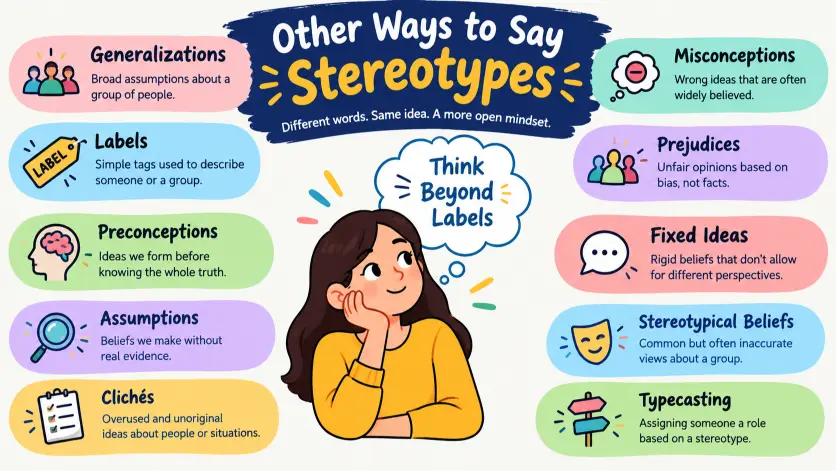
Words matter, especially when you are discussing ideas about people, cultures, groups, or society. While “stereotypes” is a common and useful word, repeating it in every conversation or piece of writing can make your language sound predictable. Choosing the right alternative can also help you communicate your meaning more precisely, whether you are writing an academic essay, preparing a professional report, participating in a discussion, or simply improving your everyday English.
Quick Categories
Formal alternatives to “stereotypes”
- Generalizations
- Preconceived notions
- Fixed assumptions
- Categorical assumptions
Pro Tip: Use these expressions when writing academic, analytical, or carefully worded professional content.
Casual alternatives
- Common beliefs
- General assumptions
- Typical ideas
- Fixed ideas
Pro Tip: These phrases work well in everyday discussions when you want to sound natural without being overly academic.
Professional alternatives
- Generalized perceptions
- Prevailing assumptions
- Conventional perceptions
- Simplified views
Pro Tip: In professional communication, choose language that describes the specific assumption rather than making a broad judgment about people.
Informal expressions
- Prejudged ideas
- One size fits all views
- Common labels
- Quick assumptions
Pro Tip: Informal expressions can make conversations more accessible, but avoid them when precision is important.
Professional English becomes stronger when you replace broad labels with precise descriptions.
Common Mistakes
1. Treating every generalization as a stereotype
A generalization may be based on an observed pattern, while a stereotype is usually an oversimplified belief about a group.
Example: “Every generalization is automatically a stereotype.”
2. Using “stereotype” when you mean “assumption”
An assumption can concern one person or situation, while a stereotype generally applies a simplified idea to a group.
Example: “I made a stereotype about his decision.”
3. Using the word in a positive context without considering the implication
Even seemingly positive generalizations can reduce individuals to a single characteristic.
Example: “All members of that group are naturally talented.”
4. Using formal alternatives in casual conversations unnecessarily
Words such as “categorical assumptions” can sound overly academic in an ordinary conversation.
Example: “Her categorical assumptions about the team were unnecessary.”
5. Using stereotypes as established facts
A stereotype represents a generalized belief, not reliable evidence about every individual.
Example: “People from that profession are always like that.”
What Does “Stereotypes” Mean?
Stereotypes are simplified and generalized beliefs about a particular group of people. They often assign the same characteristics, behavior, or expectations to members of a group without recognizing individual differences.
Grammatically, stereotypes is the plural noun form of stereotype. The verb stereotype means to make generalized assumptions about a group.
Example: “The article challenges common stereotypes about different professions.”
When to Use “Stereotypes”
You can use the word stereotypes in many contexts, including:
- Social discussions: When discussing beliefs about groups of people.
- Education: When analyzing cultural assumptions or social attitudes.
- Academic writing: When examining patterns of representation or perception.
- Media discussions: When discussing how groups are portrayed.
- Workplace communication: When discussing assumptions about employees or professions.
- Everyday conversation: When explaining a generalized belief.
Spoken vs Written
Spoken English: “That sounds like a common stereotype.”
Written English: “The study examines stereotypes associated with different professional groups.”
Formal vs Informal
For formal writing, consider generalized perceptions, preconceived notions, or prevailing assumptions when they accurately describe your meaning.
For casual conversation, common beliefs, fixed ideas, or general assumptions may sound more natural.
Is It Professional or Polite to Say “Stereotypes”?
Polite? ✔️ Yes
Professional? ✔️ Yes, when used accurately and objectively
The word itself is not impolite. However, the way you use it matters. In professional communication, explain the specific belief or assumption rather than simply labeling someone’s view.
Business style example:
“Our discussion should avoid stereotypes and focus on evidence based observations about customer preferences.”
Pros and Cons of Using “Stereotypes”
Pros
- Simple and natural: The word is widely understood.
- Clear meaning: It directly identifies generalized beliefs about groups.
- Common usage: It appears frequently in conversations, education, media, and professional discussions.
- Easy to understand: Most intermediate and advanced English learners can use it confidently.
Cons
- Can sound broad: It may not explain the exact assumption being discussed.
- Can be overused: Repeating the same word can make writing less varied.
- Limited emotional range: It may not communicate whether the belief is an assumption, misconception, or perception.
- Needs context: Readers may need additional information to understand the specific belief involved.
Clarity matters more than complexity. A precise alternative can make one sentence much more effective.
Other Ways to Say “Stereotypes” With Examples
These other ways to say stereotypes will help you sound more fluent, confident, and natural in different situations.
Use them according to tone, context, and audience to describe assumptions, perceptions, social beliefs, or simplified views. Some can also help you discuss professional reaction phrases and informal expressions in English more precisely.
1. Phrase: Generalizations
Meaning: Broad statements about a group or category.
Explanation: This is one of the most useful neutral alternatives when discussing broad beliefs.
Example Sentence: “The report warns against making generalizations about younger employees.”
Best Use: Academic discussion
Worst Use: Exact evidence
Tone: Neutral, analytical
Context Variability: Casual: “That is a generalization.” Professional: “The conclusion may rely on broad generalizations.” Spoken: “I think that is a generalization.”
2. Phrase: Preconceived Notions
Meaning: Ideas formed before someone has enough information.
Explanation: This phrase emphasizes assumptions that exist before direct experience or evidence.
Example Sentence: “The training session helped employees reconsider their preconceived notions.”
Best Use: Professional discussion
Worst Use: Casual banter
Tone: Formal, thoughtful
Context Variability: Casual: “Try not to have preconceived notions.” Professional: “The research challenges preconceived notions.” Spoken: “I had a preconceived notion about it.”
3. Phrase: Fixed Ideas
Meaning: Beliefs that are strongly established and difficult to change.
Explanation: It is useful when you want to emphasize rigidity rather than simply generalization.
Example Sentence: “Education can help people question fixed ideas about success.”
Best Use: Everyday discussion
Worst Use: Technical analysis
Tone: Neutral, accessible
Context Variability: Casual: “He has some fixed ideas.” Professional: “The policy challenges fixed ideas about productivity.” Spoken: “People can have fixed ideas.”
4. Phrase: Assumptions
Meaning: Beliefs accepted without complete evidence or proof.
Explanation: This is a broad and highly flexible alternative when the belief may concern individuals or groups.
Example Sentence: “We should test our assumptions before making a decision.”
Best Use: Professional communication
Worst Use: Precise social analysis
Tone: Neutral, professional
Context Variability: Casual: “That is just an assumption.” Professional: “Our assumptions should be supported by data.” Spoken: “I think we are making assumptions.”
5. Phrase: Generalized Perceptions
Meaning: Broad ways of viewing a group or situation.
Explanation: This phrase sounds objective and works well in professional and academic contexts.
Example Sentence: “The survey examined generalized perceptions of remote workers.”
Best Use: Formal writing
Worst Use: Casual conversation
Tone: Formal, objective
Context Variability: Casual: Limited use. Professional: “The research identified generalized perceptions.” Spoken: “The discussion focused on generalized perceptions.”
6. Phrase: Prejudgments
Meaning: Opinions formed before sufficient knowledge or consideration.
Explanation: This word focuses on forming an opinion too early.
Example Sentence: “Good interviewers avoid prejudgments about candidates.”
Best Use: Professional training
Worst Use: Friendly conversation
Tone: Formal, serious
Context Variability: Casual: “Try not to prejudge people.” Professional: “Prejudgments can affect hiring decisions.” Spoken: “We should avoid prejudgments.”
7. Phrase: Common Beliefs
Meaning: Ideas widely held by many people.
Explanation: This phrase is neutral and does not necessarily imply that the belief is wrong.
Example Sentence: “The documentary examines common beliefs about career success.”
Best Use: General discussion
Worst Use: Strong criticism
Tone: Neutral, accessible
Context Variability: Casual: “That is a common belief.” Professional: “The survey explored common beliefs.” Spoken: “It is a common belief.”
8. Phrase: Prevailing Assumptions
Meaning: Assumptions that are widely accepted within a particular group or context.
Explanation: This is especially useful for formal and professional writing.
Example Sentence: “The research challenges prevailing assumptions about workplace communication.”
Best Use: Formal writing
Worst Use: Casual chat
Tone: Formal, analytical
Context Variability: Casual: Limited use. Professional: “The study challenges prevailing assumptions.” Spoken: “The prevailing assumption was different.”
9. Phrase: Conventional Perceptions
Meaning: Commonly accepted ways of viewing something.
Explanation: It highlights established perceptions rather than individual opinions.
Example Sentence: “The campaign challenges conventional perceptions of leadership.”
Best Use: Professional writing
Worst Use: Informal chat
Tone: Formal, polished
Context Variability: Casual: Limited use. Professional: “The campaign questions conventional perceptions.” Spoken: “That differs from conventional perceptions.”
10. Phrase: Simplified Views
Meaning: Opinions that reduce a complex issue to a simple explanation.
Explanation: This expression is useful when the problem is oversimplification.
Example Sentence: “Complex social issues cannot be explained through simplified views.”
Best Use: Analytical writing
Worst Use: Personal compliment
Tone: Neutral, analytical
Context Variability: Casual: “That is a simplified view.” Professional: “The report avoids simplified views.” Spoken: “That seems like a simplified view.”
11. Phrase: Fixed Assumptions
Meaning: Beliefs that are firmly established and rarely questioned.
Explanation: It emphasizes rigidity and resistance to reconsideration.
Example Sentence: “The workshop encourages employees to question fixed assumptions.”
Best Use: Workplace training
Worst Use: Casual greeting
Tone: Professional, direct
Context Variability: Casual: “Those are fixed assumptions.” Professional: “We need to examine fixed assumptions.” Spoken: “Try not to rely on fixed assumptions.”
12. Phrase: Broad Assumptions
Meaning: General beliefs applied across many people or situations.
Explanation: This phrase clearly emphasizes the wide scope of an assumption.
Example Sentence: “Broad assumptions can lead to inaccurate conclusions.”
Best Use: Professional analysis
Worst Use: Personal praise
Tone: Neutral, analytical
Context Variability: Casual: “That is a broad assumption.” Professional: “Broad assumptions should be tested.” Spoken: “We are making broad assumptions.”
13. Phrase: Common Misconceptions
Meaning: Widely held ideas that are incorrect or misleading.
Explanation: Use this phrase only when there is evidence that the belief is inaccurate.
Example Sentence: “The workshop addresses common misconceptions about language learning.”
Best Use: Educational content
Worst Use: Unverified criticism
Tone: Educational, objective
Context Variability: Casual: “That is a common misconception.” Professional: “The study addresses common misconceptions.” Spoken: “Many people have that misconception.”
14. Phrase: Social Labels
Meaning: Simplified names or categories applied to people or groups.
Explanation: This phrase is useful when discussing how society categorizes people.
Example Sentence: “People should not be reduced to social labels.”
Best Use: Social discussion
Worst Use: Technical report
Tone: Neutral, thoughtful
Context Variability: Casual: “People use social labels.” Professional: “The campaign challenges social labels.” Spoken: “We should question those labels.”
15. Phrase: Cultural Assumptions
Meaning: Beliefs shaped by expectations associated with a culture.
Explanation: This phrase is useful when discussing differences in cultural expectations.
Example Sentence: “International teams need to recognize cultural assumptions.”
Best Use: Global workplace
Worst Use: Unrelated topics
Tone: Professional, respectful
Context Variability: Casual: “That may be a cultural assumption.” Professional: “Cultural assumptions can affect communication.” Spoken: “We may have different cultural assumptions.”
16. Phrase: Social Generalizations
Meaning: Broad statements or beliefs about social groups.
Explanation: This phrase specifically connects generalization with society or social categories.
Example Sentence: “The article examines social generalizations about education.”
Best Use: Academic writing
Worst Use: Casual conversation
Tone: Formal, analytical
Context Variability: Casual: Limited use. Professional: “The research analyzes social generalizations.” Spoken: “That sounds like a social generalization.”
17. Phrase: Popular Beliefs
Meaning: Ideas that many people commonly accept.
Explanation: It is useful when discussing widely held ideas without automatically saying they are wrong.
Example Sentence: “The study questions several popular beliefs about productivity.”
Best Use: General writing
Worst Use: Precise criticism
Tone: Neutral, accessible
Context Variability: Casual: “That is a popular belief.” Professional: “The research examines popular beliefs.” Spoken: “It is a popular belief.”
18. Phrase: Conventional Wisdom
Meaning: Ideas generally accepted as true within a society or group.
Explanation: This phrase is useful when discussing widely accepted opinions that may deserve closer examination.
Example Sentence: “The findings challenge conventional wisdom about workplace motivation.”
Best Use: Professional analysis
Worst Use: Basic definition
Tone: Formal, intelligent
Context Variability: Casual: “That goes against conventional wisdom.” Professional: “The evidence challenges conventional wisdom.” Spoken: “That is the conventional wisdom.”
19. Phrase: Group Based Assumptions
Meaning: Beliefs formed about people because they belong to a particular group.
Explanation: This expression clearly identifies the basis of the assumption.
Example Sentence: “Hiring decisions should not rely on group based assumptions.”
Best Use: Workplace communication
Worst Use: Casual storytelling
Tone: Professional, precise
Context Variability: Casual: Limited use. Professional: “Avoid group based assumptions.” Spoken: “That sounds like a group based assumption.”
20. Phrase: Collective Perceptions
Meaning: Shared ways of viewing a person, group, issue, or situation.
Explanation: This phrase emphasizes perceptions held across a community or organization.
Example Sentence: “Media coverage can influence collective perceptions.”
Best Use: Research writing
Worst Use: Casual conversation
Tone: Formal, analytical
Context Variability: Casual: Limited use. Professional: “Collective perceptions can change over time.” Spoken: “The campaign changed collective perceptions.”
21. Phrase: Mental Shortcuts
Meaning: Simplified ways of processing information quickly.
Explanation: This phrase can explain why people sometimes rely on broad categories instead of examining individual differences.
Example Sentence: “Mental shortcuts can influence how people interpret unfamiliar situations.”
Best Use: Psychology discussion
Worst Use: Formal definition
Tone: Accessible, educational
Context Variability: Casual: “We all use mental shortcuts.” Professional: “Mental shortcuts can influence judgment.” Spoken: “That may be a mental shortcut.”
22. Phrase: One Dimensional Views
Meaning: Opinions that consider only one aspect of a person or issue.
Explanation: This phrase is useful when criticizing an overly narrow perspective.
Example Sentence: “The article avoids one dimensional views of leadership.”
Best Use: Critical analysis
Worst Use: Friendly chat
Tone: Analytical, direct
Context Variability: Casual: “That is a one dimensional view.” Professional: “The report challenges one dimensional views.” Spoken: “That feels one dimensional.”
23. Phrase: Oversimplified Beliefs
Meaning: Beliefs that make a complex subject seem simpler than it really is.
Explanation: Use this phrase when complexity has been reduced too much.
Example Sentence: “The course helps students move beyond oversimplified beliefs.”
Best Use: Education
Worst Use: Casual praise
Tone: Educational, analytical
Context Variability: Casual: “That is an oversimplified belief.” Professional: “The research challenges oversimplified beliefs.” Spoken: “That belief seems oversimplified.”
24. Phrase: Assumed Characteristics
Meaning: Qualities people believe a person or group has without sufficient evidence.
Explanation: This phrase focuses specifically on characteristics assigned to others.
Example Sentence: “Recruiters should avoid relying on assumed characteristics.”
Best Use: Workplace context
Worst Use: Casual conversation
Tone: Formal, precise
Context Variability: Casual: Limited use. Professional: “Avoid assumed characteristics in evaluations.” Spoken: “Those are assumed characteristics.”
25. Phrase: Social Expectations
Meaning: Beliefs about how people are expected to behave.
Explanation: This phrase is useful when the issue concerns expected roles or behavior rather than beliefs alone.
Example Sentence: “Young professionals may face different social expectations.”
Best Use: Social discussion
Worst Use: Exact synonym
Tone: Neutral, respectful
Context Variability: Casual: “Those are social expectations.” Professional: “Social expectations can influence workplace behavior.” Spoken: “People experience different social expectations.”
26. Phrase: Established Beliefs
Meaning: Ideas that have existed and been accepted for a long time.
Explanation: This expression highlights the persistence of an idea.
Example Sentence: “The new evidence challenges established beliefs about learning.”
Best Use: Academic writing
Worst Use: Casual chat
Tone: Formal, neutral
Context Variability: Casual: “That is an established belief.” Professional: “The evidence challenges established beliefs.” Spoken: “People have established beliefs about it.”
27. Phrase: Common Labels
Meaning: Familiar categories or descriptions applied broadly to people or things.
Explanation: This is a simple conversational option when discussing categorization.
Example Sentence: “Common labels do not always describe individual experiences accurately.”
Best Use: Everyday discussion
Worst Use: Formal research
Tone: Casual, accessible
Context Variability: Casual: “Those are common labels.” Professional: “Common labels may oversimplify the issue.” Spoken: “People use common labels.”
28. Phrase: Prejudged Ideas
Meaning: Ideas formed before examining the facts or situation carefully.
Explanation: This expression emphasizes judgment made too early.
Example Sentence: “Good communication requires us to question prejudged ideas.”
Best Use: General discussion
Worst Use: Academic terminology
Tone: Direct, accessible
Context Variability: Casual: “Do not rely on prejudged ideas.” Professional: “The training challenges prejudged ideas.” Spoken: “We should reconsider those ideas.”
29. Phrase: Broad Social Views
Meaning: General perspectives about society or groups of people.
Explanation: This phrase works when discussing broad societal perceptions without making the wording overly technical.
Example Sentence: “The documentary explores broad social views about success.”
Best Use: General analysis
Worst Use: Precise research
Tone: Neutral, accessible
Context Variability: Casual: “Those are broad social views.” Professional: “The report examines broad social views.” Spoken: “That reflects a broad social view.”
30. Phrase: Simplistic Assumptions
Meaning: Assumptions that explain a complex situation in an excessively simple way.
Explanation: This is a strong choice when you want to emphasize that an assumption lacks necessary complexity or nuance.
Example Sentence: “Effective leadership cannot be understood through simplistic assumptions.”
Best Use: Professional analysis
Worst Use: Casual greeting
Tone: Formal, critical
Context Variability: Casual: “That sounds like a simplistic assumption.” Professional: “The report avoids simplistic assumptions.” Spoken: “We should question that simplistic assumption.”
Use “generalizations” for breadth, “preconceived notions” for prior beliefs, and “simplistic assumptions” when the main problem is oversimplification.
See Also
- See also: Other Ways to Say “I Agree” for natural agreement and response expressions.
- See also: Professional English Guide for clearer workplace communication, formal vocabulary, and confident professional expressions.
Mini Quiz and Self Check
1. Which phrase is most suitable for formal academic writing?
A. Common labels
B. Preconceived notions
C. Typical ideas
D. Quick assumptions
Answer: B. Preconceived notions
2. You want to describe an idea that is widely accepted but may not be accurate. Which phrase fits best?
A. Common misconception
B. Friendly opinion
C. Personal greeting
D. Exact fact
Answer: A. Common misconception
3. Which sentence sounds most appropriate in a professional setting?
A. “Everyone from that group is exactly the same.”
B. “We should examine the assumptions behind this conclusion.”
C. “Those people are always like that.”
D. “That label tells us everything.”
Answer: B. “We should examine the assumptions behind this conclusion.”
4. Which phrase focuses most strongly on oversimplification?
A. Common beliefs
B. Social expectations
C. Simplistic assumptions
D. Popular beliefs
Answer: C. Simplistic assumptions
Comparison Table: Top Alternatives
| Phrase | Tone | Best Use |
| Generalizations | Neutral | Academic discussion |
| Preconceived notions | Formal | Professional writing |
| Fixed ideas | Accessible | Everyday discussion |
| Assumptions | Neutral | Workplace communication |
| Generalized perceptions | Formal | Research writing |
| Common misconceptions | Educational | Teaching and explanations |
| Prevailing assumptions | Formal | Business and academic writing |
| Simplified views | Analytical | Critical discussion |
| Cultural assumptions | Professional | Global communication |
| Social generalizations | Formal | Social analysis |
FAQs
What are the best alternatives to stereotypes?
Useful alternatives include generalizations, preconceived notions, assumptions, fixed ideas, generalized perceptions, and common misconceptions. The best choice depends on whether you are describing a belief, perception, or inaccurate idea.
What is a professional way to say stereotypes?
In professional writing, generalized perceptions, prevailing assumptions, preconceived notions, and simplistic assumptions can work well when they accurately describe the intended meaning.
Are stereotypes and generalizations the same?
Not always. A generalization is a broad statement or observation, while a stereotype usually involves an oversimplified belief about members of a group.
Can I use stereotypes in formal writing?
Yes. The word is appropriate in formal writing when it accurately describes the subject. Academic and professional writing should provide enough context to explain the specific stereotype being discussed.
What is a polite way to discuss stereotypes?
You can use neutral expressions such as general assumptions, generalized perceptions, or preconceived notions when appropriate. Focus on describing the belief rather than labeling individuals.
Conclusion
Learning other ways to say stereotypes gives English learners more flexibility when discussing social beliefs, assumptions, perceptions, and generalizations. Instead of repeating one word, you can select a language that communicates your exact meaning and fits the context.
For everyday conversations, simpler phrases such as common beliefs and fixed ideas can sound natural. For professional and academic communication, expressions such as preconceived notions, generalized perceptions, and prevailing assumptions can provide greater precision. Practice using these alternatives in short sentences each day, and always consider your audience, purpose, and tone before choosing an expression.









