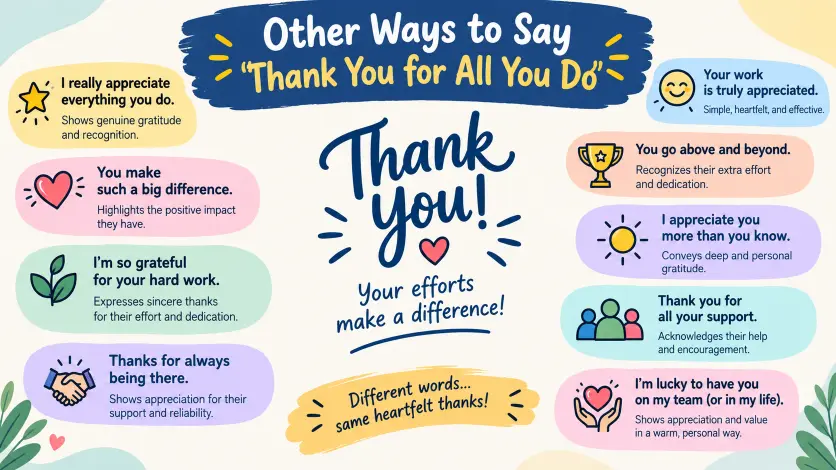
Sometimes, a simple “thank you” doesn’t feel strong enough to express how much someone’s effort, kindness, or support truly means to you. fo you’re thanking a supportive colleague, a caring friend, a dedicated teacher, a helpful family member, or someone who consistently goes the extra mile, choosing the right words can make your appreciation feel more genuine and memorable.
In this guide, you’ll discover 30+ practical and natural other ways to say “thank you for all you do”, including heartfelt, professional, polite, and casual expressions. These alternatives are selected with English learners and everyday communicators in mind, so you can understand not only what each phrase means but also when it sounds most appropriate. From workplace messages and emails to personal conversations and thoughtful notes, these expressions can help you communicate appreciation with greater confidence, clarity, and warmth. By understanding differences in tone and context, you can choose an expression that sounds natural rather than simply repeating the same phrase.
Quick Categories
Formal alternatives to “Thank You for All You Do”
- I sincerely appreciate everything you do.
- I am deeply grateful for your continued support.
- Please accept my sincere appreciation for your efforts.
Pro Tip: Use these expressions in formal letters, appreciation messages, ceremonies, and respectful professional communication.
Casual alternatives
- Thanks for everything you do.
- I really appreciate everything you do.
- Thanks for always being there.
Pro Tip: Choose warm, straightforward wording when speaking with friends, relatives, or people you know well.
Professional alternatives
- I greatly appreciate your continued efforts.
- Thank you for your ongoing support and dedication.
- Your contributions are greatly appreciated.
Pro Tip: In professional settings, mention a specific contribution whenever possible to make your appreciation more meaningful.
Informal expressions
- I appreciate you so much.
- Thanks for everything.
- You do so much, and I really appreciate it.
Pro Tip: Informal expressions in English work best when the relationship is familiar and the situation is relaxed.
“Specific appreciation sounds more genuine than generic praise.”
Common Mistakes
1. Using overly casual language in a formal email
Mistake: “Thanks a bunch for everything!”
Better: “I sincerely appreciate all your support.”
2. Repeating “thank you” without adding meaning
Mistake: “Thank you for everything. Thank you for all you do. Thank you so much.”
Better: “I truly appreciate your continued support and dedication.”
3. Choosing a phrase that is too emotional for a professional context
Mistake: “You mean absolutely everything to me.”
Better: “Your support has made a significant difference.”
4. Using “everything” when you mean one specific action
Mistake: “Thank you for everything” after someone only helped with a report.
Better: “Thank you for your help with the report.”
5. Forgetting the audience
Mistake: Using “I appreciate you so much!” in a formal business letter.
Better: “I greatly appreciate your assistance.”
What Does “Thank You for All You Do” Mean?
“Thank you for all you do” expresses appreciation for the many things someone does, especially their ongoing effort, support, kindness, or contribution.
Grammatically, “thank you” is a fixed expression of gratitude, while “for all you do” explains what the speaker appreciates. The phrase can refer to one person’s repeated actions rather than a single event.
Example: “Thank you for all you do to support our team.”
The expression is broad, positive, and flexible, but the exact meaning depends on context.
When to Use “Thank You for All You Do”
You can use the phrase in many situations, including:
- Showing appreciation to a colleague
- Thanking a manager or mentor
- Recognizing a teacher’s efforts
- Appreciating a parent or family member
- Thanking a friend for ongoing support
- Recognizing volunteers or community workers
- Expressing appreciation after a successful project
- Writing an appreciation card or message
Spoken vs. Written
Spoken: “Thanks for all you do. I really appreciate it.”
Written: “Thank you for all you do to support our team and our continued progress.”
Formal vs. Informal
Formal: “I sincerely appreciate your continued efforts and support.”
Informal: “Thanks for everything you do!”
“The same gratitude can sound formal, friendly, heartfelt, or professional depending on your word choice.”
Is It Professional or Polite to Say “Thank You for All You Do”?
The phrase is polite and appreciative, but it is not necessarily the most professional choice in every workplace situation.
It is appropriate when you want to recognize someone’s ongoing contribution. However, in formal business communication, a more specific expression can sound clearer and more purposeful.
Polite? ✔️ Yes
Professional? ❌ No, in most formal business situations
Business-style example:
“I greatly appreciate your continued support and the effort you have contributed to this project.”
Pros and Cons of Using “Thank You for All You Do”
Pros
- Simple and natural
- Friendly tone
- Common usage
- Easy to understand
Cons
- Too informal for some work situations
- Can become overused
- Has limited emotional range
- Not suitable for some formal writing
Other Ways to Say “Thank You for All You Do” With Examples
These alternatives will help you sound more fluent, confident, and natural in different situations.
Use them according to tone, context, and audience to express appreciation, admiration, or approval.
1. Phrase: I truly appreciate everything you do.
Meaning: This expresses sincere gratitude for someone’s ongoing efforts.
Explanation: It sounds warm while remaining appropriate for many professional and personal situations.
Example Sentence: “I truly appreciate everything you do to keep the project moving forward.”
Best Use: Personal appreciation
Worst Use: Highly formal letter
Tone: Warm, sincere, appreciative
Context Variability: Casual, professional, spoken
2. Phrase: Thank you for everything you do.
Meaning: This thanks someone for their overall efforts and support.
Explanation: It is a direct and natural variation of the original expression.
Example Sentence: “Thank you for everything you do for our team.”
Best Use: General gratitude
Worst Use: Specific recognition
Tone: Warm, friendly, sincere
Context Variability: Casual, professional, spoken
3. Phrase: I really appreciate all your help.
Meaning: This shows gratitude for someone’s assistance.
Explanation: It works especially well when the person has actively helped you.
Example Sentence: “I really appreciate all your help with preparing the presentation.”
Best Use: Helpful support
Worst Use: Formal ceremony
Tone: Friendly, grateful, natural
Context Variability: Casual, professional, spoken
4. Phrase: I sincerely appreciate your efforts.
Meaning: This formally recognizes someone’s work.
Explanation: It is suitable when you want to sound respectful and professional.
Example Sentence: “I sincerely appreciate your efforts in completing this project on time.”
Best Use: Formal appreciation
Worst Use: Close friendship
Tone: Formal, respectful, sincere
Context Variability: Professional, written, formal
5. Phrase: Your efforts mean a lot to me.
Meaning: This communicates that someone’s work has personal value.
Explanation: It adds an emotional element to a simple expression of gratitude.
Example Sentence: “Your efforts mean a lot to me, especially during such a demanding period.”
Best Use: Personal gratitude
Worst Use: Corporate memo
Tone: Heartfelt, warm, personal
Context Variability: Casual, spoken, personal
6. Phrase: I’m grateful for everything you do.
Meaning: This expresses deep appreciation for someone’s ongoing actions.
Explanation: “Grateful” can sound slightly more heartfelt than “thankful.”
Example Sentence: “I’m grateful for everything you do to support the team.”
Best Use: Genuine gratitude
Worst Use: Routine memo
Tone: Warm, sincere, heartfelt
Context Variability: Casual, professional, spoken
7. Phrase: I appreciate your continued support.
Meaning: This thanks someone for providing consistent assistance.
Explanation: It is especially useful in professional communication.
Example Sentence: “I appreciate your continued support throughout this transition.”
Best Use: Ongoing support
Worst Use: One-time favor
Tone: Professional, courteous, appreciative
Context Variability: Professional, written, spoken
8. Phrase: Thank you for your ongoing support.
Meaning: This recognizes someone’s continuing help or encouragement.
Explanation: It emphasizes that the support has continued over time.
Example Sentence: “Thank you for your ongoing support as we work toward our goals.”
Best Use: Long-term support
Worst Use: Casual joke
Tone: Professional, respectful, positive
Context Variability: Professional, written, spoken
9. Phrase: I’m thankful for your dedication.
Meaning: This expresses appreciation for someone’s commitment.
Explanation: It focuses more specifically on dedication than on general effort.
Example Sentence: “I’m thankful for your dedication to helping our students succeed.”
Best Use: Recognizing commitment
Worst Use: Quick favor
Tone: Warm, respectful, sincere
Context Variability: Professional, personal, written
10. Phrase: Your support is greatly appreciated.
Meaning: This formally acknowledges valuable assistance.
Explanation: Its passive structure makes it particularly common in professional writing.
Example Sentence: “Your support is greatly appreciated as we complete this important initiative.”
Best Use: Business communication
Worst Use: Intimate conversation
Tone: Formal, courteous, professional
Context Variability: Professional, written, formal
11. Phrase: I’m grateful for your help.
Meaning: This directly communicates appreciation for someone’s assistance.
Explanation: It is simple enough for everyday conversation but still respectful.
Example Sentence: “I’m grateful for your help during the transition.”
Best Use: Direct assistance
Worst Use: Group announcement
Tone: Warm, sincere, natural
Context Variability: Casual, professional, spoken
12. Phrase: Thank you for your dedication.
Meaning: This recognizes someone’s commitment and hard work.
Explanation: It is useful when someone has consistently invested time or energy.
Example Sentence: “Thank you for your dedication to improving our customer service.”
Best Use: Recognizing commitment
Worst Use: Minor favor
Tone: Professional, appreciative, respectful
Context Variability: Professional, written, spoken
13. Phrase: I appreciate all your hard work.
Meaning: This recognizes the effort someone has put into a task.
Explanation: It is particularly natural after completing a demanding project.
Example Sentence: “I appreciate all your hard work in getting this launch ready.”
Best Use: Work recognition
Worst Use: Formal legal document
Tone: Friendly, appreciative, professional
Context Variability: Casual, professional, spoken
14. Phrase: Thank you for your commitment.
Meaning: This expresses appreciation for someone’s dedication to a goal.
Explanation: It is useful when recognizing sustained responsibility or loyalty.
Example Sentence: “Thank you for your commitment to delivering high-quality work.”
Best Use: Professional recognition
Worst Use: Small favor
Tone: Formal, respectful, appreciative
Context Variability: Professional, written, spoken
15. Phrase: I deeply appreciate your support.
Meaning: This communicates strong and sincere gratitude.
Explanation: “Deeply” adds emotional emphasis without becoming excessively informal.
Example Sentence: “I deeply appreciate your support during this challenging project.”
Best Use: Sincere gratitude
Worst Use: Routine transaction
Tone: Heartfelt, sincere, respectful
Context Variability: Personal, professional, written
16. Phrase: Your kindness means so much to me.
Meaning: This thanks someone for a kind or caring action.
Explanation: It focuses on personal kindness rather than professional performance.
Example Sentence: “Your kindness means so much to me during this difficult time.”
Best Use: Personal support
Worst Use: Business report
Tone: Heartfelt, personal, warm
Context Variability: Personal, casual, spoken
17. Phrase: I’m incredibly grateful for your support.
Meaning: This expresses strong appreciation for someone’s assistance.
Explanation: “Incredibly” intensifies the gratitude and works best when the support has been significant.
Example Sentence: “I’m incredibly grateful for your support throughout this process.”
Best Use: Strong appreciation
Worst Use: Routine email
Tone: Warm, emphatic, sincere
Context Variability: Personal, professional, spoken
18. Phrase: I can’t thank you enough.
Meaning: This emphasizes that ordinary thanks do not feel sufficient.
Explanation: It is common when someone has provided especially meaningful help.
Example Sentence: “I can’t thank you enough for staying late to help me finish the presentation.”
Best Use: Major assistance
Worst Use: Formal report
Tone: Grateful, emphatic, warm
Context Variability: Casual, personal, spoken
19. Phrase: I’m so appreciative of everything you do.
Meaning: This expresses strong appreciation for someone’s ongoing actions.
Explanation: It has a warm and conversational quality.
Example Sentence: “I’m so appreciative of everything you do to make the team feel supported.”
Best Use: Personal appreciation
Worst Use: Formal notice
Tone: Warm, conversational, sincere
Context Variability: Casual, spoken, personal
20. Phrase: Thank you for making such a difference.
Meaning: This recognizes that someone’s actions have had a positive impact.
Explanation: It is more specific and emotionally meaningful than a general thank-you.
Example Sentence: “Thank you for making such a difference in our students’ lives.”
Best Use: Meaningful impact
Worst Use: Routine request
Tone: Warm, appreciative, positive
Context Variability: Personal, professional, spoken
21. Phrase: Your contribution is greatly valued.
Meaning: This formally recognizes the importance of someone’s contribution.
Explanation: It works well in professional and organizational settings.
Example Sentence: “Your contribution is greatly valued by everyone on the team.”
Best Use: Workplace recognition
Worst Use: Close friend
Tone: Formal, professional, respectful
Context Variability: Professional, written, formal
22. Phrase: I’m grateful for your continued efforts.
Meaning: This recognizes someone’s sustained work and commitment.
Explanation: It is useful when appreciation is connected to an ongoing project or responsibility.
Example Sentence: “I’m grateful for your continued efforts to improve the process.”
Best Use: Ongoing work
Worst Use: One-time favor
Tone: Professional, sincere, appreciative
Context Variability: Professional, written, spoken
23. Phrase: Thank you for going above and beyond.
Meaning: This recognizes effort that exceeds normal expectations.
Explanation: It is especially effective when someone has made an exceptional contribution.
Example Sentence: “Thank you for going above and beyond to ensure the event was successful.”
Best Use: Exceptional effort
Worst Use: Ordinary task
Tone: Appreciative, positive, professional
Context Variability: Professional, casual, spoken
24. Phrase: I value everything you contribute.
Meaning: This communicates that someone’s contributions are important.
Explanation: It emphasizes the value of the person’s actions rather than simply thanking them.
Example Sentence: “I value everything you contribute to our team.”
Best Use: Team appreciation
Worst Use: Casual favor
Tone: Professional, respectful, sincere
Context Variability: Professional, written, spoken
25. Phrase: I’m thankful for your continued dedication.
Meaning: This recognizes sustained commitment.
Explanation: It combines gratitude with recognition of long-term dedication.
Example Sentence: “I’m thankful for your continued dedication to our organization.”
Best Use: Long-term service
Worst Use: Quick assistance
Tone: Respectful, sincere, formal
Context Variability: Professional, written, formal
26. Phrase: Your hard work does not go unnoticed.
Meaning: This assures someone that their effort is recognized.
Explanation: It is useful when someone has worked consistently without receiving much acknowledgment.
Example Sentence: “Your hard work does not go unnoticed, and we truly appreciate your contribution.”
Best Use: Effort recognition
Worst Use: Casual greeting
Tone: Encouraging, appreciative, professional
Context Variability: Professional, written, spoken
27. Phrase: I’m grateful for all your efforts.
Meaning: This expresses appreciation for the work someone has done.
Explanation: It is a flexible option for both personal and professional situations.
Example Sentence: “I’m grateful for all your efforts in helping us meet the deadline.”
Best Use: General appreciation
Worst Use: Highly intimate message
Tone: Sincere, respectful, warm
Context Variability: Professional, personal, spoken
28. Phrase: Thank you for being so supportive.
Meaning: This thanks someone for providing encouragement or assistance.
Explanation: It focuses specifically on the person’s supportive behavior.
Example Sentence: “Thank you for being so supportive while I learned the new system.”
Best Use: Emotional support
Worst Use: Formal report
Tone: Warm, friendly, sincere
Context Variability: Casual, personal, spoken
29. Phrase: I appreciate everything you bring to the table.
Meaning: This recognizes the skills, ideas, and value someone contributes.
Explanation: It is particularly useful in team and workplace conversations.
Example Sentence: “I appreciate everything you bring to the table during our strategy meetings.”
Best Use: Team contribution
Worst Use: Formal letter
Tone: Professional, positive, conversational
Context Variability: Professional, spoken, casual
30. Phrase: Thank you for all your time and effort.
Meaning: This specifically acknowledges the time and work someone has invested.
Explanation: It is a clear alternative when a person’s contribution required significant effort.
Example Sentence: “Thank you for all your time and effort in preparing the training materials.”
Best Use: Effort recognition
Worst Use: Simple greeting
Tone: Professional, appreciative, courteous
Context Variability: Professional, written, spoken
“When you want your gratitude to feel genuine, name the effort, impact, or support you are appreciating.”
Professional English Tip
In workplace communication, replacing a broad expression with a specific one can make your message stronger.
Instead of:
“Thank you for all you do.”
Try:
“I appreciate your continued effort in keeping the project on schedule.”
The second version identifies exactly what you appreciate, making it more informative and professional.
See also: Explore our guide to other ways to say “thank you” in English for more natural expressions of gratitude.
See also: Check out our Professional English guide for useful expressions for workplace conversations, emails, and meetings.
Professional Reaction Phrases for Appreciation
When responding to someone’s work, these professional reaction phrases can help you sound polished:
- I greatly appreciate your contribution.
- Your efforts have made a significant difference.
- Thank you for your continued commitment.
- Your support has been invaluable.
- We truly value your contribution.
These phrases are especially useful in emails, meetings, performance recognition, presentations, and team communication.
Mini Quiz / Self-Check
1. Which phrase is most appropriate for a formal business email?
A. Thanks a bunch for everything!
B. I sincerely appreciate your continued efforts.
C. You’re the best!
D. Thanks for always having my back.
Answer: B
2. Your colleague worked late to finish an important presentation. Which phrase fits best?
A. Thank you for going above and beyond.
B. Good morning.
C. Please accept this notification.
D. I acknowledge your existence.
Answer: A
3. Which expression sounds most personal and heartfelt?
A. Your contribution is greatly valued.
B. I’m grateful for everything you do.
C. Your kindness means so much to me.
D. Your support is appreciated.
Answer: C
4. You want to thank a coworker for helping you meet a deadline. Which option is most natural?
A. I really appreciate all your help.
B. Thanks for everything in the universe.
C. Your kindness is formally received.
D. I express acknowledgment.
Answer: A
Comparison Table: Top Alternatives
| Phrase | Tone | Best Use |
| I truly appreciate everything you do. | Warm, sincere | General appreciation |
| Thank you for everything you do. | Friendly, natural | Everyday gratitude |
| I sincerely appreciate your efforts. | Formal, respectful | Business writing |
| I appreciate your continued support. | Professional, courteous | Workplace communication |
| Thank you for your dedication. | Respectful, appreciative | Recognizing commitment |
| Your support is greatly appreciated. | Formal, professional | Business messages |
| I appreciate all your hard work. | Friendly, professional | Team recognition |
| Thank you for going above and beyond. | Positive, appreciative | Exceptional effort |
| Your efforts mean a lot to me. | Personal, heartfelt | Personal gratitude |
| Thank you for making such a difference. | Warm, meaningful | Recognizing impact |
FAQs
1. What are the best alternatives to “thank you for all you do”?
Some natural options include “I truly appreciate everything you do,” “I sincerely appreciate your efforts,” “I’m grateful for your continued support,” and “Thank you for your dedication.”
2. How can I say “thank you for all you do” professionally?
For professional communication, try “I greatly appreciate your continued efforts,” “Thank you for your ongoing support,” or “Your contribution is greatly valued.”
3. Is “thank you for all you do” formal or informal?
It is polite and broadly appropriate, but it has a warm, general tone. More specific phrases such as “I sincerely appreciate your efforts” may be better for highly formal communication.
4. What is a heartfelt way to say “thank you for all you do”?
“I’m grateful for everything you do,” “Your efforts mean a lot to me,” and “Your kindness means so much to me” are heartfelt alternatives.
5. How can I avoid repeating “thank you for all you do”?
Choose an expression based on what you appreciate. For example, use “I appreciate your dedication” for commitment, “I appreciate all your hard work” for effort, or “Thank you for making such a difference” for impact.
Conclusion
Learning different other ways to say thank you for all you do gives you more flexibility when expressing appreciation. Instead of relying on one familiar phrase, you can choose language that reflects the relationship, situation, and level of formality. From professional expressions such as “I sincerely appreciate your efforts” to heartfelt options such as “Your efforts mean a lot to me,” each phrase communicates gratitude with a slightly different emphasis.
Practice these alternatives in emails, conversations, appreciation messages, and workplace situations. Pay attention to tone and context, because the most effective expression is not always the most formal one. Choose words that accurately communicate what you appreciate, and your English will sound more natural, confident, and precise.









