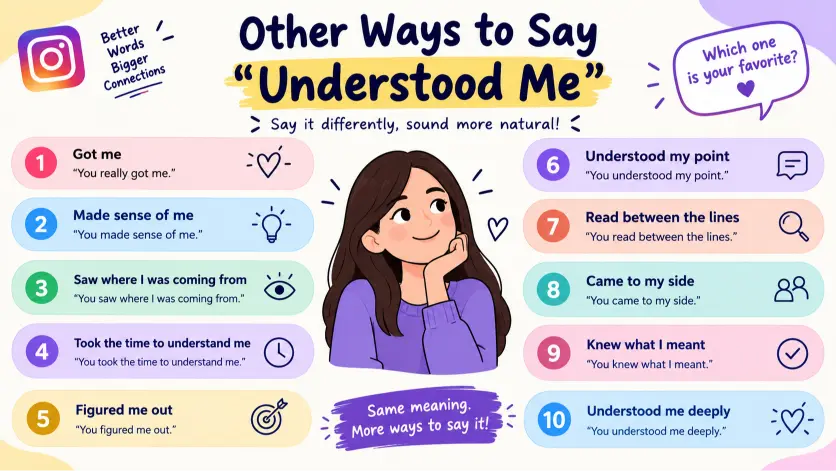
Have you ever replied with “understood” and wondered if there was a more natural, polite, or professional way to respond? The good news is that English offers many alternatives, and the best expression depends on the situation, relationship, and tone. From simple phrases like “I understand” to professional responses such as “Noted” or “I’ll take care of it,” choosing the right words can make your communication clearer and more confident.
In this guide, you’ll discover useful other ways to say understood for everyday conversations, workplace messages, emails, customer service, and formal communication. The alternatives are organized by tone and context so English learners and professionals can quickly find an expression that fits. As an English-focused language resource, this guide emphasizes natural usage, practical examples, and distinctions between formal and informal expressions. By learning these alternatives, you can avoid repetitive responses and communicate your understanding more effectively.
Quick Categories
Formal alternatives to “understood”
- I acknowledge that.
- I understand your point.
- Your instructions are clear.
- I have taken note of that.
These phrases work well when communicating respectfully in formal settings, written correspondence, meetings, or official discussions.
Pro Tip: In formal communication, choose phrases that clearly show attention without sounding unnecessarily emotional or casual.
Casual alternatives
- Got it.
- I see.
- Makes sense.
- Okay, I get it.
These responses are common in friendly conversations, messages, classroom discussions, and relaxed workplace interactions.
Pro Tip: Use shorter expressions when the conversation is informal and the meaning is already obvious from context.
Professional alternatives
- I understand.
- Noted.
- Understood and noted.
- I will keep that in mind.
Professional communication benefits from responses that show attention and responsibility without sounding too stiff.
Pro Tip: When responding to instructions at work, choose a phrase that confirms both understanding and your intended action when appropriate.
Informal expressions
- Gotcha.
- I get you.
- Right, I see.
- Okay, I’m with you.
These informal expressions in English are best for people you know well and situations where relaxed language is appropriate.
Pro Tip: Avoid very informal responses when speaking with senior colleagues, clients, customers, or people you have just met.
“Tone changes the meaning of a response. A simple ‘got it’ can sound friendly, while ‘I acknowledge that’ sounds more formal.”
Common Mistakes
1. Using “Got it” in every situation
“Got it” is natural, but it may sound too casual in highly formal communication.
Example: “Got it, Director. I will follow the procedure.”
A more formal option would be: “I understand the procedure and will follow it.”
2. Saying “Understood” when you actually disagree
“Understood” normally confirms comprehension, not necessarily agreement.
Example: “Understood, but I have a different recommendation.”
This makes the distinction between understanding and agreement clear.
3. Using “I understand” without understanding
Saying “I understand” simply to end a conversation can create confusion if you still need clarification.
Example: “I understand, but could you explain the final step again?”
4. Using informal expressions with clients
Expressions such as “Gotcha” can sound too relaxed in formal customer communication.
Example: “Gotcha, I’ll handle it.”
For a client, “I understand. I will take care of this” is usually more appropriate.
5. Confusing acknowledgment with emotional agreement
A response can acknowledge information without showing personal approval.
Example: “I acknowledge your concerns, although we may need to review the proposal again.”
What Does “Understood” Mean?
“Understood” means that something has been heard, read, or comprehended clearly. It can also communicate that someone has accepted an instruction or recognizes what is expected.
Grammatically, understood is the past participle of the verb understand. When used alone as a response, it functions as a concise elliptical statement meaning something like “I have understood” or “Your message is understood.”
Example: “Understood. I’ll send the revised document this afternoon.”
The word can therefore communicate comprehension, acknowledgment, or acceptance depending on the context.
When to Use “Understood”
You can use “understood” in several common situations:
- When confirming that you received instructions
- When acknowledging an explanation
- When confirming that expectations are clear
- When responding to workplace directions
- When accepting a request
- When showing that you have listened carefully
- When confirming information during a meeting
- When responding to a teacher or supervisor
- When acknowledging a rule or requirement
- When confirming an action you need to take
Spoken vs Written
In spoken English, “Understood,” “Got it,” and “I see” are common responses.
In written English, “I understand,” “Noted,” and “I acknowledge your message” can provide clearer professional communication.
Formal vs Informal
Formal: “I acknowledge your instructions.”
Professional: “I understand. I will proceed accordingly.”
Neutral: “I understand.”
Casual: “Got it.”
Informal: “Gotcha.”
The appropriate choice depends on your relationship with the listener, the subject matter, and the communication channel.
“Do not choose an alternative only because it sounds sophisticated. Choose the phrase that matches your audience and purpose.”
Is It Professional or Polite to Say “Understood”?
“Understood” is generally polite, but its level of professionalism depends on context.
It can sound professional when used to acknowledge instructions, expectations, or information. However, in some workplace situations, a fuller response such as “I understand and will take care of this” may sound more cooperative and informative.
Polite? ✔ Yes
Professional? ✔ Yes, depending on context
Business style example:
“Understood. I will review the report and provide the requested updates by Friday.”
For highly formal written communication, a complete sentence may be preferable to a one word response.
Pros and Cons of Using “Understood”
Pros
- Simple and natural: It communicates comprehension quickly.
- Friendly tone: Depending on delivery, it can sound respectful and cooperative.
- Common usage: Most English speakers understand it immediately.
- Easy to understand: There is little ambiguity when the context is clear.
Cons
- Can sound too brief at work: A one word response may not show what you plan to do next.
- Can become overused: Repeating it may make conversations feel mechanical.
- Limited emotional range: It does not always communicate enthusiasm, empathy, agreement, or appreciation.
- Not always suitable for formal writing: A complete sentence can be more effective in important professional correspondence.
“A stronger response does more than confirm comprehension. When necessary, it also communicates your next action.”
Other Ways to Say “Understood” With Examples
These alternatives will help you sound more fluent, confident, and natural in different situations.
Use them according to tone, context, and audience to express excitement, admiration, approval, acknowledgment, or simple comprehension.
1. Phrase: I understand
Meaning: You clearly comprehend what someone has said.
Explanation: This is one of the safest neutral alternatives for everyday and professional communication.
Example Sentence: “I understand your concerns, and I will review the proposal again.”
Best Use: Professional conversations
Worst Use: Very casual banter
Tone: Neutral, polite, clear
Context Variability: Casual: “I understand.” Professional: “I understand your concerns.” Spoken: “Yes, I understand.”
2. Phrase: Got it
Meaning: You have understood the information or instruction.
Explanation: “Got it” is concise and very common in conversational English.
Example Sentence: “Got it. I’ll bring the documents to the meeting.”
Best Use: Everyday conversations
Worst Use: Formal letters
Tone: Casual, friendly, natural
Context Variability: Casual: “Got it.” Professional: “Got it, I’ll take care of that.” Spoken: “Got it.”
3. Phrase: I see
Meaning: You now understand the situation or explanation.
Explanation: “I see” often shows that new information has clarified something for you.
Example Sentence: “I see why you changed the schedule.”
Best Use: Explanations and discussions
Worst Use: Formal confirmation
Tone: Neutral, thoughtful, receptive
Context Variability: Casual: “Oh, I see.” Professional: “I see your reasoning.” Spoken: “I see.”
4. Phrase: That makes sense
Meaning: The information is logical or understandable.
Explanation: This phrase can communicate both comprehension and recognition that an explanation is reasonable.
Example Sentence: “That makes sense. We should review the figures before making a decision.”
Best Use: Discussions and explanations
Worst Use: Strict instructions
Tone: Friendly, positive, conversational
Context Variability: Casual: “That makes sense.” Professional: “That makes sense given the current data.” Spoken: “Yes, that makes sense.”
5. Phrase: Noted
Meaning: You have recorded or acknowledged the information.
Explanation: “Noted” is especially common in workplace communication.
Example Sentence: “Noted. I’ll include the updated figures in the report.”
Best Use: Workplace messages
Worst Use: Emotional conversations
Tone: Concise, professional, direct
Context Variability: Casual: “Noted.” Professional: “Noted. I’ll make the changes.” Spoken: “Noted.”
6. Phrase: I acknowledge that
Meaning: You recognize or accept the information that was presented.
Explanation: This phrase is more formal and is useful when you want to sound precise and respectful.
Example Sentence: “I acknowledge that the deadline has been moved to Monday.”
Best Use: Formal communication
Worst Use: Friendly chats
Tone: Formal, respectful, precise
Context Variability: Casual: Rarely used. Professional: “I acknowledge your request.” Spoken: “I acknowledge that.”
7. Phrase: I follow you
Meaning: You understand someone’s explanation or reasoning.
Explanation: It indicates that you are following the speaker’s ideas or argument.
Example Sentence: “I follow you. Your main concern is the project timeline.”
Best Use: Detailed discussions
Worst Use: Formal notices
Tone: Conversational, attentive, supportive
Context Variability: Casual: “I follow you.” Professional: “I follow your reasoning.” Spoken: “Yes, I follow you.”
8. Phrase: I get it
Meaning: You understand the point or situation.
Explanation: This is a natural conversational alternative that works best in relaxed settings.
Example Sentence: “I get it. You need more time to finish the presentation.”
Best Use: Casual conversation
Worst Use: Formal reports
Tone: Casual, direct, friendly
Context Variability: Casual: “I get it.” Professional: Use sparingly. Spoken: “Yes, I get it now.”
9. Phrase: I’m with you
Meaning: You understand what someone is saying or explaining.
Explanation: It signals that you are following the speaker’s thought process.
Example Sentence: “I’m with you so far, but could you explain the final step?”
Best Use: Collaborative discussions
Worst Use: Formal correspondence
Tone: Friendly, conversational, engaged
Context Variability: Casual: “I’m with you.” Professional: “I’m with you on the main point.” Spoken: “I’m with you.”
10. Phrase: Clear
Meaning: The information or instruction is understood.
Explanation: “Clear” is a brief response often used when acknowledging straightforward instructions.
Example Sentence: “Clear. I’ll submit the application before noon.”
Best Use: Direct instructions
Worst Use: Formal emails
Tone: Brief, direct, confident
Context Variability: Casual: “Clear.” Professional: “The requirements are clear.” Spoken: “Clear.”
11. Phrase: Crystal clear
Meaning: Completely understandable.
Explanation: This emphasizes that there is no confusion about the information.
Example Sentence: “Your explanation was crystal clear.”
Best Use: Positive feedback
Worst Use: Formal documentation
Tone: Emphatic, positive, confident
Context Variability: Casual: “Crystal clear.” Professional: “The instructions are crystal clear.” Spoken: “Yes, crystal clear.”
12. Phrase: I’ve got it
Meaning: You understand what needs to be done.
Explanation: It can also imply that you are ready to handle the task.
Example Sentence: “I’ve got it. I’ll update the spreadsheet before the meeting.”
Best Use: Task confirmation
Worst Use: Formal letters
Tone: Confident, casual, reassuring
Context Variability: Casual: “I’ve got it.” Professional: “I’ve got it and will handle the update.” Spoken: “I’ve got it.”
13. Phrase: I hear you
Meaning: You recognize and understand what someone is communicating.
Explanation: This expression is particularly useful when acknowledging someone’s concerns or feelings.
Example Sentence: “I hear you, and I understand why the delay is frustrating.”
Best Use: Sensitive discussions
Worst Use: Routine instructions
Tone: Empathetic, supportive, conversational
Context Variability: Casual: “I hear you.” Professional: “I hear your concerns.” Spoken: “I hear you.”
14. Phrase: I take your point
Meaning: You understand the argument or perspective someone has presented.
Explanation: This phrase is useful when acknowledging someone’s reasoning without necessarily agreeing with it.
Example Sentence: “I take your point, but we should consider the budget as well.”
Best Use: Professional discussions
Worst Use: Simple instructions
Tone: Thoughtful, respectful, professional
Context Variability: Casual: “I take your point.” Professional: “I take your point regarding the deadline.” Spoken: “I take your point.”
15. Phrase: Your point is clear
Meaning: You understand the main idea someone has expressed.
Explanation: This phrase works well when acknowledging an argument or explanation.
Example Sentence: “Your point is clear, and I understand the concern.”
Best Use: Meetings and discussions
Worst Use: Casual texting
Tone: Professional, neutral, respectful
Context Variability: Casual: “Your point is clear.” Professional: “Your point is clear to the team.” Spoken: “Your point is clear.”
16. Phrase: I understand completely
Meaning: You have a full understanding of what was communicated.
Explanation: The word “completely” strengthens the confirmation of understanding.
Example Sentence: “I understand completely and will follow the revised procedure.”
Best Use: Important instructions
Worst Use: Very casual chats
Tone: Reassuring, clear, professional
Context Variability: Casual: “I understand completely.” Professional: “I understand completely and will proceed.” Spoken: “I understand completely.”
17. Phrase: I have taken note of that
Meaning: You have paid attention to and recorded the information mentally or practically.
Explanation: This formal expression works particularly well in professional writing.
Example Sentence: “I have taken note of your recommendations and will discuss them with the team.”
Best Use: Formal correspondence
Worst Use: Friendly texting
Tone: Formal, polished, respectful
Context Variability: Casual: Rarely used. Professional: Highly suitable. Spoken: Suitable in formal meetings.
18. Phrase: I’ll keep that in mind
Meaning: You will remember the information when making future decisions or taking action.
Explanation: This response confirms that the information will influence your future actions.
Example Sentence: “I’ll keep that in mind when preparing the next presentation.”
Best Use: Advice and feedback
Worst Use: Immediate instructions
Tone: Polite, thoughtful, cooperative
Context Variability: Casual: “I’ll keep that in mind.” Professional: “I’ll keep your feedback in mind.” Spoken: “Sure, I’ll keep that in mind.”
19. Phrase: I’ve noted that
Meaning: You have acknowledged and recorded the information.
Explanation: This phrase is concise and useful in workplace communication.
Example Sentence: “I’ve noted that the meeting has been moved to Thursday.”
Best Use: Workplace communication
Worst Use: Emotional support
Tone: Professional, concise, neutral
Context Variability: Casual: “I’ve noted that.” Professional: “I’ve noted the change.” Spoken: “I’ve noted that.”
20. Phrase: I acknowledge your point
Meaning: You recognize what someone has said or argued.
Explanation: It is useful when you want to recognize another person’s perspective without necessarily agreeing.
Example Sentence: “I acknowledge your point and will consider it before making a final decision.”
Best Use: Formal discussions
Worst Use: Friendly conversation
Tone: Formal, respectful, measured
Context Variability: Casual: Uncommon. Professional: Very suitable. Spoken: Suitable for meetings.
21. Phrase: I’m aware of that
Meaning: You already know or recognize the information.
Explanation: This response is useful when someone tells you something that you already understand.
Example Sentence: “I’m aware of that requirement and have already updated the application.”
Best Use: Existing knowledge
Worst Use: New explanations
Tone: Neutral, confident, direct
Context Variability: Casual: “I’m aware of that.” Professional: “I’m aware of the requirement.” Spoken: “Yes, I’m aware.”
22. Phrase: That’s clear to me
Meaning: You have no difficulty understanding the information.
Explanation: This phrase directly communicates that something is understandable.
Example Sentence: “That’s clear to me now, so I can proceed with the next step.”
Best Use: Clarification
Worst Use: Formal reports
Tone: Neutral, confident, reassuring
Context Variability: Casual: “That’s clear to me.” Professional: “The procedure is clear to me.” Spoken: “Yes, that’s clear.”
23. Phrase: I comprehend
Meaning: You understand something fully.
Explanation: Although grammatically correct, this phrase sounds more formal and less natural in everyday conversation.
Example Sentence: “I comprehend the requirements outlined in the document.”
Best Use: Academic contexts
Worst Use: Casual conversation
Tone: Formal, academic, serious
Context Variability: Casual: Unnatural. Professional: Possible but formal. Spoken: More common in academic settings.
24. Phrase: I recognize that
Meaning: You acknowledge that something is true or important.
Explanation: This expression is useful when recognizing a fact, concern, or position.
Example Sentence: “I recognize that the current process creates additional work for the team.”
Best Use: Professional discussions
Worst Use: Simple instructions
Tone: Formal, thoughtful, measured
Context Variability: Casual: Less common. Professional: Highly useful. Spoken: Suitable for meetings.
25. Phrase: I understand the situation
Meaning: You comprehend the circumstances surrounding an issue.
Explanation: This response is particularly useful when someone explains a problem or difficult circumstance.
Example Sentence: “I understand the situation and appreciate you explaining the issue.”
Best Use: Problem discussions
Worst Use: Simple confirmations
Tone: Empathetic, professional, calm
Context Variability: Casual: “I understand the situation.” Professional: “We understand the situation.” Spoken: “I understand the situation.”
26. Phrase: I’m aware
Meaning: You know about or recognize something.
Explanation: This is a short response that confirms existing awareness rather than new understanding.
Example Sentence: “I’m aware of the change and have informed the rest of the team.”
Best Use: Existing information
Worst Use: Detailed explanations
Tone: Brief, neutral, confident
Context Variability: Casual: “I’m aware.” Professional: “I’m aware of the issue.” Spoken: “Yes, I’m aware.”
27. Phrase: I acknowledge your instructions
Meaning: You confirm that you have received and recognized the instructions.
Explanation: This is a formal option that clearly communicates acknowledgment.
Example Sentence: “I acknowledge your instructions and will complete the task as requested.”
Best Use: Formal workplace settings
Worst Use: Friendly chats
Tone: Formal, respectful, precise
Context Variability: Casual: Rarely appropriate. Professional: Excellent fit. Spoken: Suitable for formal meetings.
28. Phrase: I understand what you mean
Meaning: You comprehend the speaker’s intended message.
Explanation: This phrase is useful when someone has explained an idea that initially seemed unclear.
Example Sentence: “I understand what you mean now, and your suggestion makes sense.”
Best Use: Clarifying conversations
Worst Use: Formal notices
Tone: Natural, empathetic, conversational
Context Variability: Casual: Very natural. Professional: Appropriate. Spoken: Extremely common.
29. Phrase: I’m following you
Meaning: You are successfully understanding the explanation or argument.
Explanation: This phrase is useful during longer explanations when you want to reassure the speaker that you are keeping up.
Example Sentence: “I’m following you. Please continue with the next part.”
Best Use: Detailed explanations
Worst Use: Formal emails
Tone: Conversational, attentive, friendly
Context Variability: Casual: “I’m following you.” Professional: “I’m following your explanation.” Spoken: Very natural.
30. Phrase: I’ve understood
Meaning: You have successfully comprehended the information.
Explanation: This grammatically correct expression emphasizes that understanding has taken place, although “I understand” is usually more natural in modern everyday English.
Example Sentence: “I’ve understood the procedure and can now complete the form.”
Best Use: Learning contexts
Worst Use: Casual responses
Tone: Formal, careful, precise
Context Variability: Casual: Less natural. Professional: Possible. Spoken: More common when emphasizing completed understanding.
“Knowing 30 alternatives is useful, but knowing when to use each one is what creates confident communication.”
See Also
See also: Explore Other Ways to Say Nice to Meet You Too for natural alternatives when responding to introductions.
See also: Read a Professional English Guide to build stronger vocabulary and more confident workplace communication.
Mini Quiz: Test Your Understanding
1. You are replying to a close friend who has explained where to meet. Which response sounds most natural?
A. I acknowledge your instructions.
B. Got it.
C. I hereby recognize your instructions.
D. I comprehend.
Answer: B. Got it.
2. Your manager gives you important workplace instruction. Which response is professional and clear?
A. Gotcha.
B. I get you.
C. I understand. I’ll take care of it.
D. Cool, whatever.
Answer: C. I understand. I’ll take care of it.
3. Someone presents an argument that you understand but do not necessarily agree with. Which phrase works well?
A. I take your point.
B. I completely agree.
C. Gotcha.
D. I’m aware.
Answer: A. I take your point.
4. Someone gives you useful advice for a future situation. Which response is appropriate?
A. I’ll keep that in mind.
B. I acknowledge your instructions.
C. I comprehend the advice.
D. Clear.
Answer: A. I’ll keep that in mind.
Comparison Table: Top Alternatives
| Phrase | Tone | Best Use |
| I understand | Neutral, professional | Work and everyday communication |
| Got it | Casual, friendly | Everyday conversations |
| I see | Neutral, receptive | Explanations |
| That makes sense | Positive, conversational | Discussions |
| Noted | Concise, professional | Workplace messages |
| I take your point | Thoughtful, professional | Arguments and meetings |
| I hear you | Empathetic, supportive | Concerns and sensitive topics |
| I’ll keep that in mind | Polite, thoughtful | Advice and feedback |
| I acknowledge that | Formal, precise | Formal communication |
| I understand what you mean | Natural, empathetic | Clarifying conversations |
Professional Reaction Phrases You Can Use
Professional reaction phrases allow you to show attention without relying on the same response repeatedly. Instead of using “understood” in every workplace conversation, consider what you actually want to communicate.
To confirm comprehension:
“I understand.”
“That’s clear.”
“I understand what you mean.”
To confirm instructions:
“Noted.”
“I acknowledge your instructions.”
“I’ll take care of it.”
To recognize an argument:
“I take your point.”
“I understand your perspective.”
“Your point is clear.”
To respond to feedback:
“I’ll keep that in mind.”
“I appreciate the feedback.”
“I understand your concern.”
This distinction makes your communication more precise because your response communicates the specific type of reaction you intend.
Choosing the Right Alternative
The best alternative depends on four main factors.
Consider your relationship
A close friend may expect “Got it” or “I get it,” while a client may expect “I understand” or “Noted.”
Consider the communication channel
Short responses can work well in instant messages. Emails and formal documents often benefit from complete sentences.
Consider your purpose
If you simply want to confirm comprehension, “I understand” works well. If you want to acknowledge advice, “I’ll keep that in mind” may be better.
Consider emotional context
Someone sharing a concern may respond better to “I hear you” than “Noted.” The first acknowledges the human side of the conversation, while the second focuses mainly on information.
“Effective English is not about sounding formal all the time. It is about sounding appropriate.”
How to Sound More Natural in English
English learners sometimes focus heavily on memorizing synonyms. A better approach is to learn phrases in context.
For example, group responses according to their purpose:
Understanding:
“I understand.”
“I get it.”
“I see.”
Acknowledgment:
“Noted.”
“I acknowledge that.”
“I’ve noted that.”
Agreement with reasoning:
“That makes sense.”
“I see your point.”
Empathy:
“I hear you.”
“I understand your concerns.”
Future action:
“I’ll keep that in mind.”
“I’ll take care of it.”
This method makes vocabulary easier to retrieve during real conversations.
How to Practice These Alternatives
Practice with workplace situations
Imagine your manager gives you three different instructions. Respond using three different professional expressions.
Practice with friends
Use casual responses such as “Got it,” “I see,” and “I get it” in imagined conversations.
Practice tone changes
Take one sentence and create formal, neutral, and casual responses.
Formal: “I acknowledge your instructions.”
Neutral: “I understand.”
Casual: “Got it.”
Practice aloud
Speaking each phrase aloud helps you develop automatic responses instead of translating from your first language before speaking.
Review real conversations
When reading emails, watching interviews, or listening to English conversations, notice how native speakers acknowledge information. Pay attention to the relationship, situation, and level of formality.
Frequently Asked Questions
1. What are the best alternatives to “understood”?
Common alternatives include “I understand,” “Got it,” “I see,” “That makes sense,” and “Noted.” The best choice depends on the level of formality and the situation.
2. Is “Got it” a professional alternative to “understood”?
“Got it” can be acceptable in relaxed workplace conversations, especially with familiar colleagues. For formal emails or communication with clients, “I understand” is usually safer.
3. Is “Noted” polite in professional English?
Yes. “Noted” is concise and professional, particularly when acknowledging information or instructions. However, a complete sentence can sound warmer when the situation requires more personal engagement.
4. What can I say instead of “understood” in an email?
You can write “I understand,” “I have taken note of that,” “I acknowledge your message,” or “I’ll keep that in mind,” depending on what you want to communicate.
5. Does “understood” mean “I agree”?
Not necessarily. “Understood” generally confirms comprehension or acknowledgment. If you want to show agreement, use a phrase such as “I agree,” “That makes sense,” or “I support that approach.”
Conclusion
Learning different ways to respond instead of repeating “understood” can make your English more flexible, natural, and precise. Expressions such as “I understand,” “Got it,” “I see,” “Noted,” and “I take your point” each communicate slightly different meanings and tones. Choosing among them helps you adapt your language to friends, colleagues, clients, teachers, and formal situations.
The most effective way to improve is through daily practice. Try replacing one repeated response each day with a contextually appropriate alternative. Over time, you will develop a stronger sense of tone, improve your professional reaction phrases, and communicate with greater confidence. Remember that fluent English is not about using complicated vocabulary. It is about selecting a language that fits the person, purpose, and situation.









